By Greta Lapp Klassen
The Indiana Citizen
September 22, 2026
FORT WAYNE – Christian nationalism in the United States can be distilled down to a combination of three core beliefs, according to religious scholar and author Randall Balmer: “the United States was founded as Christian nation, the United States is a Christian nation, or the United States should be a Christian nation.”
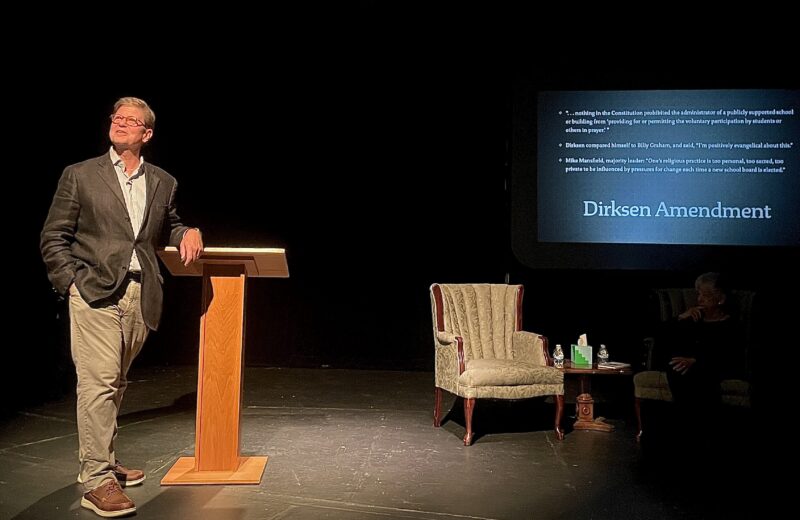
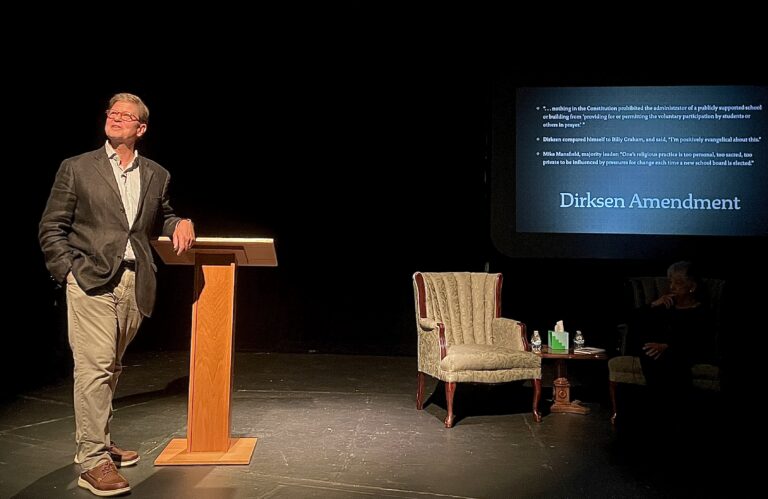
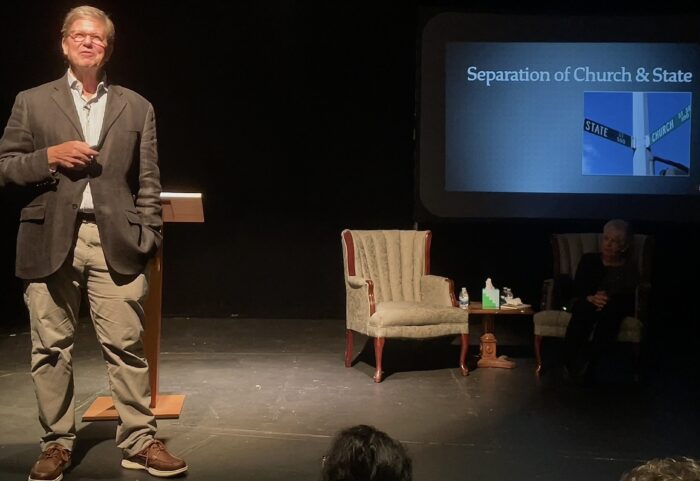
Balmer, an Episcopal priest and professor of religion at Dartmouth College, spoke to a crowd of about 120 people on Saturday, Sept 19 at the second annual Larry B. Hayes First Amendment Forum, held at First Presbyterian Church in Fort Wayne. Balmer’s presentation was followed by a discussion between Balmer and legal scholar Sheila Suess Kennedy. The forum closed with a panel discussion of community leaders, moderated by the publisher of the Indiana Citizen, Bill Moreau.
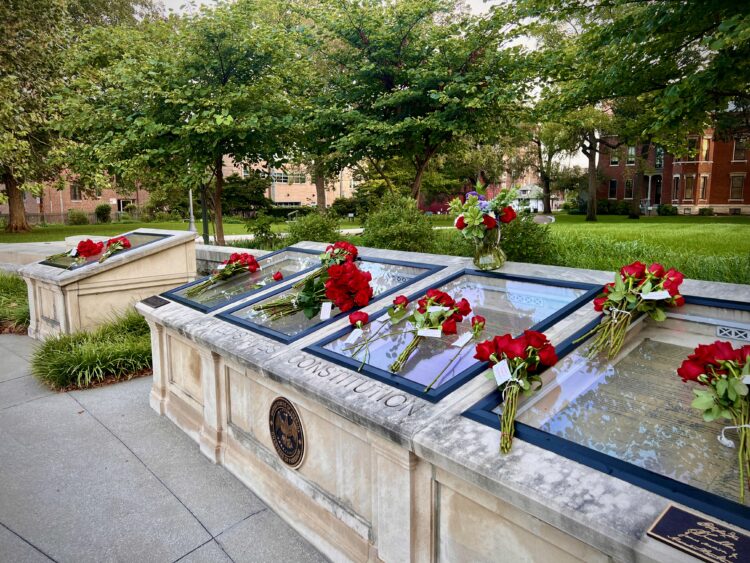
The event was organized by Hoosiers for the Separation of Church and State, a nonprofit organization that focuses on discovering, exposing and resisting American religious authoritarianism. This was the second year for the forum, and Rebecca Reeder, president of the board of Hoosiers United, said that this date was specifically chosen to coincide with Constitution Week, which runs from Sept. 17 to 23 and honors the signing of the US constitution into law on Sept. 17, 1787, in Philadelphia.
To illustrate how influential Christian nationalism has become, Balmer started his talk by sharing a remark Vice President JD Vance made at Turning Point USA’s 2025 AmericaFest in Phoenix.
“Christianity is America’s creed, the shared moral language from the Revolution to the Civil War and beyond,” Vance said in December 2025. “The only thing that has truly served as an anchor of the United States of America is that we have been, and by the grace of God we always will be, a Christian nation.”
Balmer refuted the idea Christianity has been the “only anchor of the United States” and that the United States has been a Christian nation from the founding. He explained that most of the founding fathers, like Benjamin Franklin and John Adams, were deists rather than Christians, which is to say they believed there was a divine creator, but that the creator is not active in human affairs.
In a letter to Ezra Stiles, Benjamin Franklin wrote, “As to Jesus of Nazareth….I think the system of morals, and his religion, as he left them to us, the best the world ever saw, or is likely to see; but I apprehend it has received various corrupting changes, and I have, with most of the present dissenters in England some doubts as to his divinity.”
Jefferson’s disbelief in Jesus’ divinity is most prominently illuminated by his creation of what is now known as the Jefferson Bible, a version of the New Testament that omits any reference to Jesus’ divinity.
Balmer also spoke about how the 13 original colonies were a “laboratory of religious diversity,” and that the founding fathers knew better than to repeat the mistakes of European countries which had fought countless religious wars. He reviewed the various Christian denominations represented in colonial America, and mentioned the first group of Jewish people immigrated to the US in 1654. Muslims have also been present in the United States since before the revolution, although the vast majority of Muslims in colonial America were enslaved Africans forced to convert to Christianity.
Some Christian nationalists acknowledge America’s early religious diversity but believe that even if the United States wasn’t founded as a Christian nation, it should be one now. The belief that Christians nationalists have a divine right to take over a culture is illustrated by the Seven Mountains Mandate, which aims for Christians to dominate the seven key parts of culture: education, entertainment, family, business, religion, media and government.
But Balmer argued that the separation of church and state has actually helped keep America stable, and has even allowed religion to flourish. He compared the separation of church and state to capitalism, as described by Adam Smith in his book “The Wealth of Nations.”
“We’ve had religious entrepreneurs competing with one another for followers,” Balmer said, giving a few examples. “Joseph Smith, founder of the Mormons, Ellen Gould White, founder of the Seventh Day Adventists, Mary Baker Hetty, Christian Science, Elijah Muhammad [the Nation of Islam]. This is a marketplace because the state has stayed out of it.”
Balmer concluded his talk with a quote from late U.S. Supreme Court Justice Sandra Day O’Conner on the separation of church and state: “why would we trade a system that has served us so well for one that has served others so poorly?”
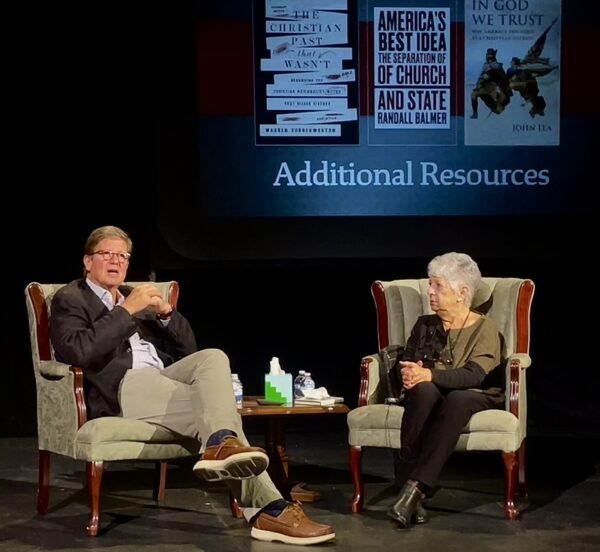
After Balmer spoke, he sat in an armchair on stage to speak with Seuss Kennedy, attorney and professor who gave the keynote address at last year’s forum. They spoke about the tensions between the First Amendment’s establishment clause — “Congress shall make no law respecting an establishment of religion,” and the free exercise clause — “…or prohibiting the free exercise thereof.”
“Those of us who consider ourselves purists on the First Amendment have to recognize that there is conflict,” Seuss Kennedy said. She recalled a debate about whether or not it was okay to allow state-funded vaccination in parochial schools. “It’s not that there’s never going to be conflict between state action and individual conscience,” she said, “but people of goodwill and some moral integrity will find that balance.”
They also discussed the origins of the religious right, which arose in the 1970s and is often believed to have been focused on abortion. Balmer said that the real issue that mobilized the religious right was desegregation, and pointed out that the Southern Baptist Convention even passed a resolution calling for the legalization of abortion in 1971, and reaffirmed that opinion in 1974.
Balmer said that abortion was just used by conservative Christians who were actually upset about Green v. Connally, a 1971 ruling which said that groups that practiced racial segregation could not receive tax exempt status.
“Do you think that maybe got the attention of Bob Jones University or Jerry Falwell, who had his own segregation academy in Virginia?” Balmer said, “That was a catalyst for religious right.”
The forum concluded with a panel discussion, moderated by Moreau.
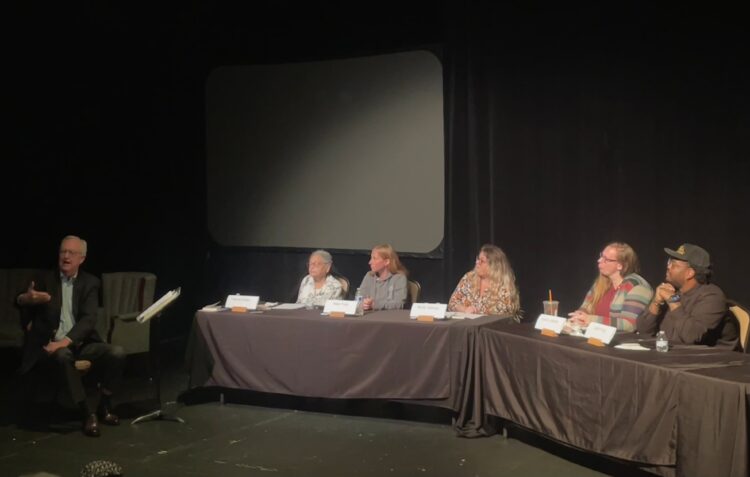
Panelist Nikki Fultz, the executive director of Fort Wayne Pride and a third grade teacher, spoke about the ways that religion harms members of the LGBTQ community.
“A lot of times at home people are not welcome, and that really comes back to religion. It comes back to that over and over again. We still have people taking their lives. We still have people who are losing their jobs. We still have people who are denied rights to their children.”
Fultz also spoke about an initiative launched by Attorney General Todd Rokita in 2024 called Eyes on Education, where people can submit examples of things they claim are being taught in schools or social media posts they alleged were made by teachers that they don’t approve of. Submissions focus on gender, sexuality, race and DEI, and there is an entire section for submissions related to Charlie Kirk, the conservative activist assassinated in September 2025.
Panelist Molly Gaines spoke about the work of the Secular Education Association, which raises awareness and combats release time for religious education, most commonly seen via Lifewise Academy.
Harriet Miller, co-founder of the Fort Wayne Women’s Bureau and Run, Jane, Run, spoke about how Christian nationalism is damaging for women. “You came from our womb,” she said, “We gave you life, and now these Christian white nationalists want to control our womb, our bodies, our hearts, our souls.”
Laura Jacobs spoke about her work as a licensed clinical mental health counselor and her work with Fuerza Unida, a digital community that aims to “help Latinos find their voice, access information, and become more engaged in their communities.” She spoke about the ways that white Christian nationalism has impacted the Latino community, and the importance of practicing hope instead of just giving into despair.
Joshua King, director of advocacy and engagement with Neighborly Fort Wayne and digital peacemaker coordinator with Alive Community Outreach spoke about how important it is to him as a pastor to denounce white Christian nationalism as a heresy, and that to truly understand the threat of Christian nationalism it is important to “have a theological framework to understand where they’re coming from.”
After the panel, Reeder concluded the forum by saying that she hopes everyone in the audience can “find that one thing that makes you feel like you’re making a difference.” Then she read a story as told by the late civil rights activist and congressman John Lewis in his memoir about a house that was about to blow away in a storm.
“They stayed, they came together, and they did the best they could, clasping hands and moving toward the corner of the house that was the weakest, and then another corner would lift, and we would go there, and eventually, inevitably, the storm would settle, and the house would still stand.”
“But we knew another storm would come, and we would have to do it all over again, and we did, and we still do.” Lewis wrote, “All of us, you and I, children holding hands, walking with the wind.”
Note: The Indiana Citizen was a financial sponsor for this event
Greta Lapp Klassen is a paralegal and freelance journalist based in Indianapolis.
The Indiana Citizen is a nonpartisan, nonprofit platform dedicated to increasing the number of informed and engaged Hoosier citizens. We are operated by the Indiana Citizen Education Foundation, Inc., a 501(c)(3) public charity. For questions about the story, contact Marilyn Odendahl at marilyn.odendahl@indianacitizen.org.