By Marilyn Odendahl
The Indiana Citizen
September 4, 2026
After a night of playing the board game Catan, Lindsey Beckley was observing one of her colleagues teach a group of young students about Indiana’s early history when she had a “hmm, I wonder” moment.
The director of special events and marketing at the Benjamin Harrison Presidential Site saw the potential for a new board game that would require adults to settle the territory and build a town with the goal of achieving statehood for Indiana. Rather than pitting the players against one another, her game would have the participants collaborate. They would make decisions together about managing their limited resources, growing their community, and overcoming the unforeseen events that were part of frontier life.
Thoughts of creating such a game kept swirling in Beckley’s mind. With a thumbs up from Charles Hyde, president and CEO of the Harrison Presidential Site, and a $1,000 grant from Indiana Humanities and the National Endowment for the Humanities, she began working in earnest on making her idea a reality.
Throughout the day, Beckley would sketch designs, scribble notes and craft the rules. Having previously worked for the Indiana Historical Bureau, researching and writing historical markers, she brainstormed ways to incorporate key tidbits from Hoosier history.
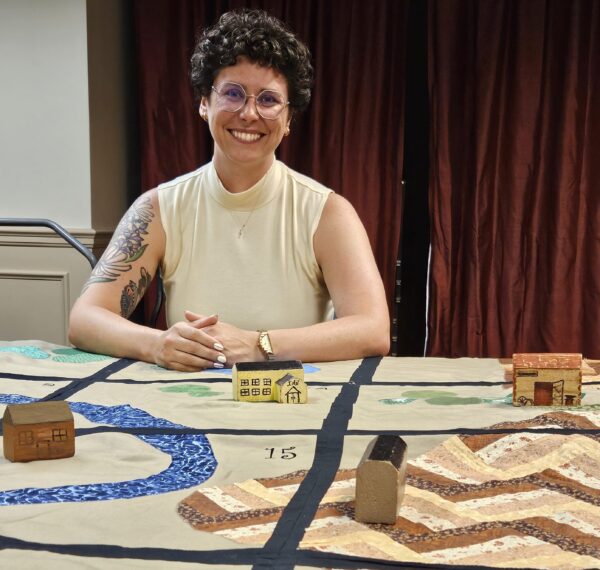
Co-workers and volunteers at the Benjamin Harrison home helped Beckley. Often, they would play the game as it was being developed and then give feedback on what they did and did not like and what was too easy or too difficult.
Beckley tweaked and balanced, but always made sure collaboration was the central theme of the game. The players, who can number as few as five or as many as 12, will all succeed or fail together.
“It’s very much about solving issues as a community,” Beckley said of her game. “That’s what the 10 people who are playing together are doing the whole time is solving problems as a community. And I hope that they then take that out into the world and solve problems in their own communities in a similar respectful, cohesive manner.”
The project hit a milestone recently when Beckley unveiled her tabletop game – called There at the Founding – to the public. At an event hosted by the presidential site, 10 board game enthusiasts gathered around a table in this historic home in Indianapolis and conducted their own test run.
Beckley said she was happy and relieved that the gamers quickly understood the rules and worked to reach a consensus on many issues. Although they made a few missteps with managing their resources, the team was able to build a community and narrowly achieve statehood.
“People really enjoyed it,” Beckley said. “They started automatically talking about the things that I had hoped that they would discuss in making decisions. I think it was really a positive evening, and I’m excited to see, with a few tweaks, how future evenings go.”
There at the Founding was inspired by the presidential site’s Settlers & Surveyors program for third and fourth graders. Watching Roger Hardig, vice president of education at the Harrison home, teach the students about the challenges the early Hoosiers faced, Beckley saw a possibility for adults to play a game and learn about Indiana history, too.
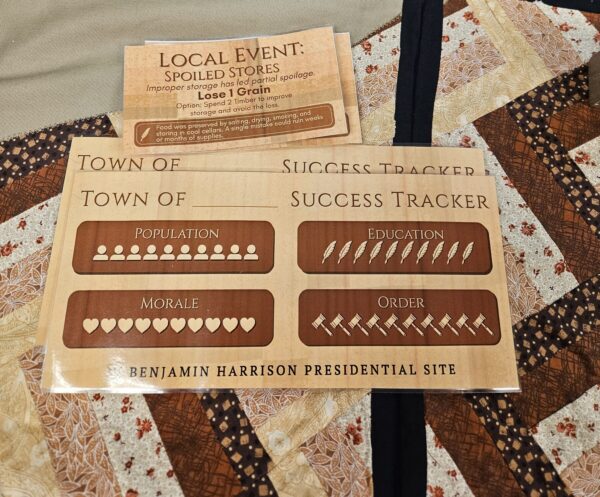
Beckley’s game starts in 1763, when the Seven Years’ War had just ended and Indiana was a burgeoning territory, and progresses through seven rounds to 1816, when Indiana became a state. The players have to manage their resources – livestock, iron, timber and grain – while accumulating the trackers necessary to become a state: population, education, morale and order.
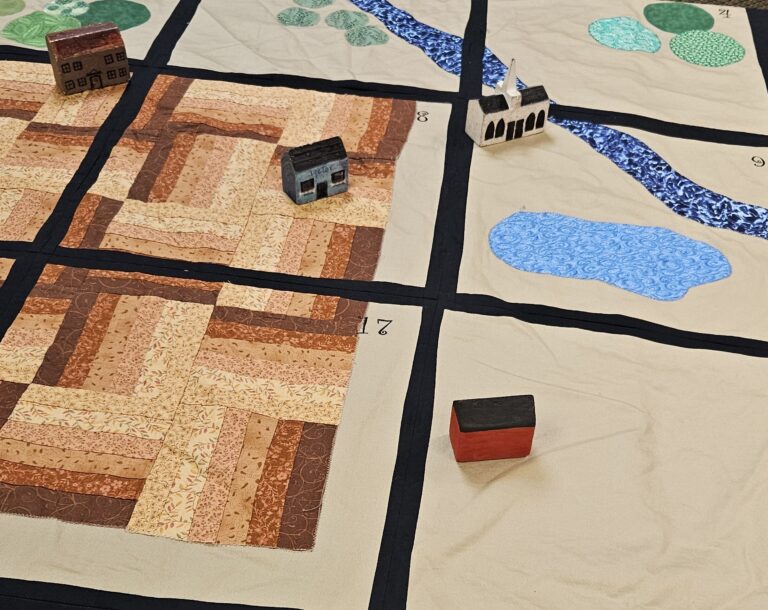
On a cloth game board that is divided into squares, just as the Hoosier State was sectioned into square miles as it was being settled, the players decide such things as where to plow a field or when to build a school. Building a home is an example of the trade-offs the players have to make, since they will have to spend two timbers, one iron and one grain to construct the house, but they will add to their population tracker tally.
Each round of the game starts with a national historical event, such as the passage of the Stamp Act or the Revolutionary War and includes a local event that could derail the community’s progress. If residents in the town begin dying of milk sickness, which happens when cows’ milk turns poisonous because they have eaten the white snake root weed, the players will have to decide whether to suffer through the illness and lose population or stop the tragedy by giving up three livestock.
Beckley said she spent a lot of time adjusting the mechanics of the game to find the right balance. She wanted a level of complexity that would engage the players but also a certain amount of intuitiveness, so people would not have to spend time reading a thick book of rules before starting.
“There’s just a lot of tweaking that goes on throughout the process of making things just a little bit harder, then just a little bit easier, to make sure that you’re hitting the right notes and it’s fun,” Beckley said of creating the game. “I wanted it to be a challenge but not impossible.”
The gamers, perhaps heeding the desire of today’s voter for younger politicians, elected the lone youngster in the group, an 11-year-old, as the town mayor. They then proceeded to spend all their resources in every round, but when hit with a natural disaster or food spoilage, they did not have any way to mitigate the impact. After a few rounds of living on the edge, the players started hoarding some of their resources for emergencies.
After every game is completed, Beckley said the players will have a discussion and reflection of what happened. They will review the decisions that helped and hurt, and how the outcome could have been different if another choice or two had been made.
Beckley is continuing to incorporate the suggestions from those who have played the game and adjust the balance a little bit more. She hopes to have larger playthroughs with more people starting next year, and she sees the possibility of businesses enlisting the game as a team-building exercise.
“There’s always something more to think about,” Beckley said of playing the game. “That’s also something I hope people go away with is a better appreciation of the many things that go into building a community. That is, it’s not easy, but it’s worthwhile.”
Dwight Adams, an editor and writer based in Indianapolis, edited this article. He is a former content editor, copy editor and digital producer at The Indianapolis Star and IndyStar.com, and worked as a planner for other newspapers, including the Louisville Courier Journal.
The Indiana Citizen is a nonpartisan, nonprofit platform dedicated to increasing the number of informed and engaged Hoosier citizens. We are operated by the Indiana Citizen Education Foundation, Inc., a 501(c)(3) public charity. For questions about the story, contact Marilyn Odendahl at marilyn.odendahl@indianacitizen.org.