By Bill Moreau
The Indiana Citizen
September 3, 2026
A week spent fly-fishing with our grandsons and great-nephew in Montana proves the idiom, “You can’t teach an old dog new tricks.”
I’m a decent Indiana bass fisherman, but stick an unfamiliar fly rod in my hands, put me on the back of a pitching rowboat rushing down the turbulent Madison River in gale force winds, and our comedian/guide observed, “Bill, I think you just set the record for the number of times I’ve had to pull a fly out of a client’s shirt.” Yeah, dude, thanks for the helpful critique. I could have stuck the fly in your exposed neck, pal.
Suffice it to say, Grandpa/Uncle Bill finished a very distant last in our annual fishing derby. Fortunately, our grandsons and great-nephew had a blast, which is what happens when you actually catch and release the beautiful species of trout that inhabit Montana’s amazing rivers.

Within a few days of returning home, the skies opened up. The horrific flooding and weather-related misery suffered by many thousands of our fellow Hoosiers should put the lives of us fortunate folks into perspective, right? Why do these disasters always fall hardest on those who can least afford them? Basic economics: the cost of housing in flood-prone areas in the Midwest is lower. We have a friend who lives in Indianapolis’ Ravenswood neighborhood who lost everything. She could afford flood insurance for half the value of her house, but contents coverage was prohibitively expensive. She’s tough and she’ll bounce back, with help from neighbors, family and friends. Many Hoosiers won’t, constrained by their poverty.
Then, there’s the debacle in Gary which has drawn national attention that should be a source of shame to all Hoosiers. As I write this, about 1000 of our fellow Hoosiers–yes, down from the initial 400,000–have been without electricity for 15 days. The reason has less to do with NIPSCO’s immediate response, and more to do with the years of preventive maintenance neglect that preceded the derecho that blasted the community on August 11. While it is true that big storms can knock over healthy trees, persistent trimming can reduce the damage and the resulting interruptions.
You don’t have to take my word for that assertion, it’s the position of the State of Indiana.
Follow this link to a site where you can contribute to the Red Cross’s “Help in the Heartland” project spearheaded by Radio One, Kroger, Fox59 and CBS4.
Prof. Michael Hicks–one of Indiana’s best-known public intellectuals–just retired from Ball State and has taken a new position at Shenandoah University in Winchester, Virginia, leading the newly combined College of Business and Technology.
The Muncie Star Press ran a story headlined, “’Controversial’ economist and writer Michael Hicks leaves Ball State.” (Here’s a link to the article with apologies if you can’t get past the paywall.) My favorite quote is, “When the lieutenant governor calls me ‘woke,’ it’s because he knows that people in his party believe the things I have written. If a Democrat gets mad at me, it’s because they know powerful people in their party have read what I do.
A pretty good summary of the work we do at The Indiana Citizen. And it’s why I’m grateful for this note Mike sent me: “I’ve appreciated the courage of your publication. It is too rare, and if courage is spreading (as it seems to be), it is in part because of your diligent example.”
Mike truly went the extra mile with these generous comments on X:
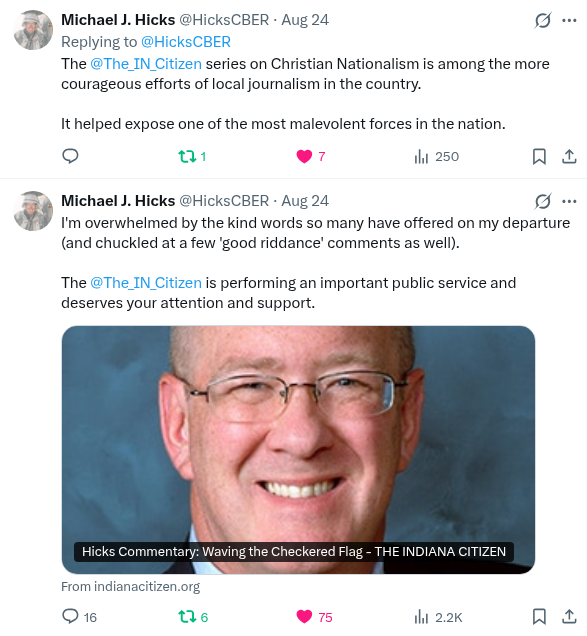
This is a link to one of Mike’s last columns that attracted many views. You’ll find a possible explanation for why he and his wife moved to the Shenandoah Mountains.
And here’s a column about Christian nationalism he wrote for us upon the inauguration of Micah Beckwith.
The quality of public discourse in Indiana was just diminished. His voice will be missed. Who will take his place?
Yes, you read that correctly. A hearty “thank you” to Lt. Gov. Beckwith for forcing me to confront my own views of how immigrants should adapt to our country. Recall that he was a featured speaker–by a recording, not in person–at Indiana’s first-ever “Mass Deportation Rally.” We can only hope there’s not a second.
Candidly, when I first heard Mr. Beckwith use “assimilate,” the image of the Borg from Star Trek: The Next Generation sprang to mind. “We are the Borg. You will be assimilated. Resistance is futile.” Here’s a link to our reporting about his speech and here’s the speech in its entirety:
Our coverage of LG Beckwith’s assimilation speech caused one of our most thoughtful supporters to caution, “Careful, you’re treading on thin ice. Do you really want to be seen as ‘anti-assimilation?’” That caught my attention. Must Americans now choose between “I’m pro-assimilation” or “I’m anti-assimilation?”
If being “pro-assimilation” means signing up for Mr. Beckwith’s vision that every American citizen must speak only English, become a Christian, hate Muslims, demonize LGBTQ folks, reject pluralism and dismiss the doctrine of separation of church and state as a “myth,” count me out. I won’t be assimilated by the Beckwith Borg.
But if you are describing the concept of “civic assimilation” as the process by which an immigrant is integrated into our political system, obeys the law, pays taxes, exercises civic duties such as voting or military service, and embraces our core constitutional values, count me in.
Exploration of the various definitions of “assimilation” caused me to think about the process an immigrant must follow in order to become an American citizen. (I often tell folks that a brand new citizen knows more about basic civics than most birthright citizens.) I had always thought an immigrant had to navigate the procedural journey using enough English to reach the destination. I was wrong. There are exceptions, which you can find here. Ask yourself how you feel about these exceptions.
The naturalization process culminates in the new citizens taking the following oath. If you have ever attended a naturalization ceremony, you’ve been moved to tears.
Does it really matter whether a new citizen takes this oath in English, Spanish, Swedish or Arabic? One of the smartest people I know, Purdue Poli Sci Assoc. Prof. Jesse Crosson, put it this way, “If someone is committed to our ideals, I don’t much care in which language they pledge allegiance.”
We’ve carved out a space on our landing page–an oasis, if you will–to post the speeches of prominent Hoosiers of faith who are pushing back on the Christian nationalist rhetoric that aims to dominate our civic discussion. State Treasurer Daniel Elliott’s powerful speech at the June 11 “Faith Over Fear” rally in the Statehouse was our first post.
Our second “contributor” is Reverend Christopher Henry. I put “contributor” in quotes because our goal is to repost speeches that were prepared for and delivered to Hoosiers outside The Indiana Citizen’s sphere. We urge you to send us videos you think match my description.
Reverend Henry has been Senior Pastor of Second Presbyterian Church in Indianapolis since 2018. He is a graduate of Duke University (BA, Religion) and Columbia Theological Seminary (MDiv). In this nine-minute excerpt from his August 16, 2026, sermon, Rev. Henry confronts the misuse of Scripture to justify hatred, violence, superiority, and contempt for others. Addressing the question “Can I trust the Bible?” he argues that the faithful response to weaponized religion is not to abandon Scripture, but to read it more deeply—in community and through the life and love of Jesus Christ. Authentic faith, he reminds us, is known by the fruit it produces: compassion, courage, service and love of neighbor.
P.S. If you didn’t get the chance to watch Wednesday’s debate featuring the four candidates for Indiana Secretary of State, here’s a link.
As candidate debates go, this one could serve as a model: civil, informative, a great job by moderators Dan Spehler and Lesley Weidenbener. Kudos to the Indy Chamber for this contribution to a better-informed Hoosier electorate. (Whether Hoosiers should support a state-funded voter guide–as proposed by Lincoln Party candidate Greg Ballard–is a debate worth having. Until the State of Indiana starts sending them out, however, stay tuned for our Virtual Ballot™ which we’ll launch after Labor Day.)