By Marilyn Odendahl
The Indiana Citizen
July 17, 2026
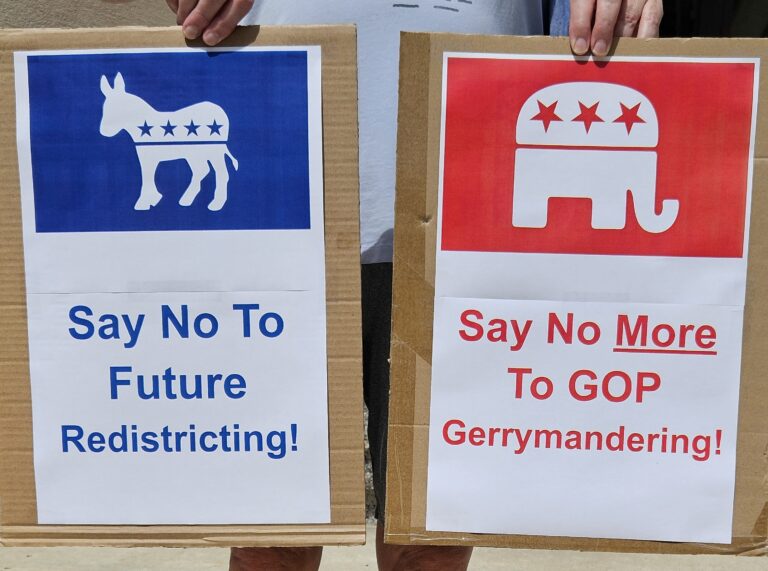
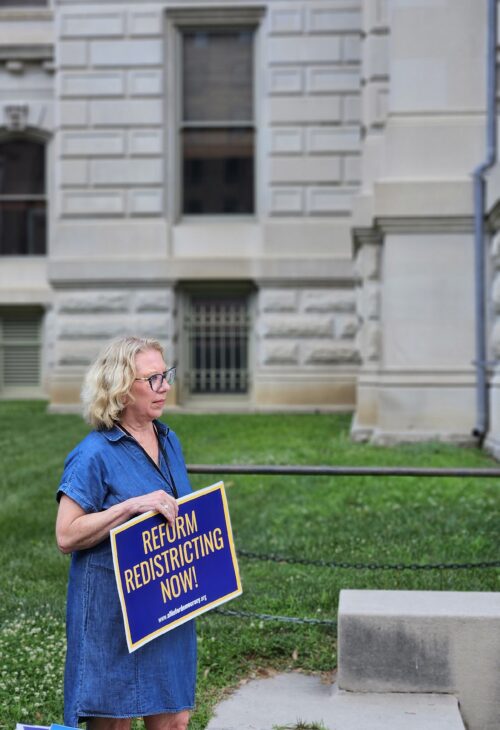
Seven months after successfully convincing the Indiana General Assembly to not redistrict ahead of the 2026 midterm election, voting-rights advocates and protesters were on the steps of the Statehouse on Friday waving signs and applauding the speakers in anticipation that a push to redraw the congressional maps will resume during the 2027 legislative session.
“It’s not just control of the Statehouse or Congress that hangs in the balance,” Amy Courtney, executive director of MADVoters Indiana, told the small crowd. “It’s about the very future of our democracy and our country.”
The rally was organized by the All IN for Democracy coalition and held on the birthday of Founding Father and former Massachusetts Gov. Elbridge Gerry, dubbed the father of gerrymandering. A three-hole mini-golf course was part of the protest to highlight what Julia Vaughn of Common Cause Indiana described as the obstacles lawmakers have erected to prevent redistricting reform.
More than calling attention to the possibility of another redistricting fight, the rally marked the restart of the mobilization effort that worked so well in 2025. The coalition is launching another online petition for Hoosiers to sign, asking legislators to leave the congressional map alone. Also, Vaughn said, the voter-advocacy groups will be asking all the legislative candidates whether they support or oppose midcycle redistricting.

State Sen. Fady Qaddoura, who opposes redrawing the congressional maps before the next U.S. Census is completed, energized the crowd by recalling the discrimination, racism and hatred that were overcome in the past by grassroots movements like the one that stopped redistricting in Indiana last year.
In particular, the Indianapolis Democrat focused on the years around 1920, when the Ku Klux Klan dominated Indiana. No one could run for mayor, the legislature or even the governor’s office without the endorsement of the KKK. The Klan used prejudice and hatred, he said, to create an ethno-state.
“Their message was wrapped with patriotism,” Qaddoura said. “You will hear them talk about patriotism and loving our country and loving our families. But embedded in that message is a deep, deep flawed ideology that prefers one specific narrow view of what America is: one class, one race, one ethnicity, one faith.”
As the state senator also talked about Jim Crow laws and poll taxes and literacy tests that were designed to prevent Black citizens from voting, he noted the work to end these practices continued for generations before reaching a pinnacle with the passage of the Civil Rights Act of 1964. And he implored the crowd to not underestimate its power to bring change.
“We defeated the ideology of hate,” Qaddoura said. “We defeated racism and discrimination at every stage. … Democracy is not a state. Democracy is an act and that act must be carried on by every generation.”
Still, the opponents of midcycle redistricting will have to overcome some obstacles that did not exist last year.
Namely, more lawmakers might support redistricting in 2027, Vaughn and Courtney said. At least six of the Republican state senators who voted against the new map lost their primaries in May to challengers who are closely aligned with President Donald Trump and will likely vote for a new congressional map if they are elected to the legislature in November.
Also, the U.S. Supreme Court removed the prohibition against racial gerrymandering.
During the 2025 debate over redistricting, the potential for Indiana to be sued for creating congressional districts that diluted the minority vote loomed so large that some Republican lawmakers insisted the map was draw for the permissible partisan reason of increasing the membership of the GOP caucus on Capitol Hill. In Louisiana v. Callais, a narrow majority on the Supreme Court found the protections against racial gerrymanders in the Voting Rights Act violated the U.S. Constitution.
Maaike Alejandra Mora, 16, is not old enough to vote, but she reminded the crowd on the steps of the Statehouse that her generation will be paying for the actions taken today.
“We’re the generation that’s going to inherit every decision made today – the climate, the debt, the housing crisis, the cost of living – and we’re the ones who’ll be paying for it for decades,” Mora said. “And when we try to show up and vote, we find out the game was rigged before we even got to the table.”
Mora was part of the Carmel Young Progressives who organized the student walkout in January to protest the opening of an ICE administrative office in Hamilton County.
Her generation and other generations, Mora said, have been told their voices do matter. Like Qaddoura, she said Hoosiers have the power to bring change and she encouraged the crowd to not become cynical, but to vote, organize and “demand that the next time these lines are drawn, they’re drawn for us, not for the people who’ve been in power long enough to think they own the place.”
Dwight Adams, an editor and writer based in Indianapolis, edited this article. He is a former content editor, copy editor and digital producer at The Indianapolis Star and IndyStar.com, and worked as a planner for other newspapers, including the Louisville Courier Journal.
The Indiana Citizen is a nonpartisan, nonprofit platform dedicated to increasing the number of informed and engaged Hoosier citizens. We are operated by the Indiana Citizen Education Foundation, Inc., a 501(c)(3) public charity. For questions about the story, contact Marilyn Odendahl at marilyn.odendahl@indianacitizen.org