By Sydney Byerly
The Indiana Citizen
April 2, 2026
As early voting begins in Indiana’s primary election, new survey data shows support for Christian nationalism is not just holding steady—it is growing in the state.
A recent report from the Public Religion Research Institute offers a detailed look at how those views break down across the country, including in Indiana. Nationally, attitudes toward Christian nationalism have remained largely unchanged in recent years.
But Indiana is seeing a measurable increase.
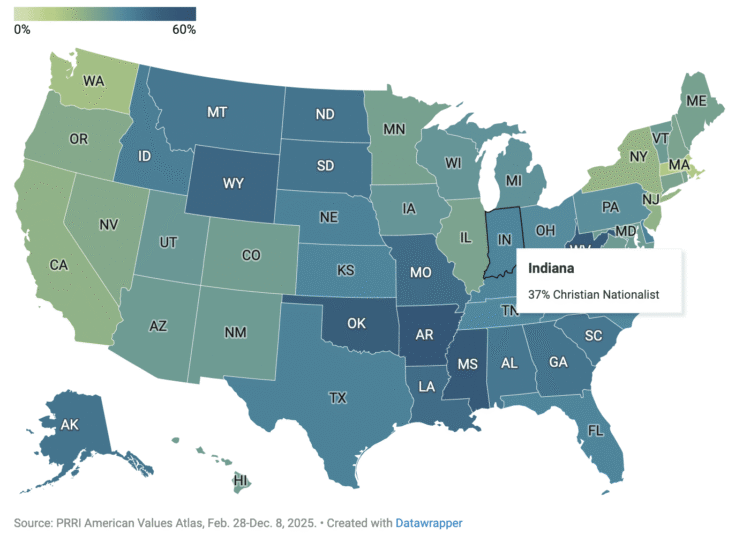
According to the survey, 37% of Indiana residents now qualify as either adherents or sympathizers of Christian nationalism—up from 33% in 2024.
Based on data from “Mapping Christian Nationalism Across the 50 States,” the survey categorizes Americans into four groups—adherents, sympathizers, skeptics and rejecters—depending on their views about the role of Christian Nationalism in American government and identity.
In Indiana, 12% of residents are considered adherents, while 25% fall into the sympathizer category. A majority of Hoosiers still do not align with the movement, with 35% classified as skeptics and 23% as rejecters.
Those numbers are close to national averages, where about one-third of Americans fall into the adherent or sympathizer categories. But they are far lower than in some states, such as Oklahoma, where nearly half of residents qualify as supporters, and higher than states like Massachusetts, where support remains in the low teens.
Political scientist Laura Merrifield Wilson, an associate professor at the University of Indianapolis, said the findings reflect what has already been visible in Indiana’s political landscape.

“They didn’t call Indiana by name, but when you look at the charts—Republican dominance in state legislatures and levels of support for Christian nationalism—it lines up,” she said. “We do have a lot of Christian nationalists within the state, and we also have a Republican supermajority.”
The increase in support, she said, is particularly notable in the number of sympathizers, voters who may not fully identify with the movement but express some agreement with its ideas.
“Sympathizing with the movement suggests it’s not a liability for a candidate,” Merrifield Wilson said. “There are going to be voters who feel positively toward those ideas and the people associated with them.”
That dynamic can have real political consequences, especially in a state where primary elections often determine the outcome.
Candidates, she said, are more likely to emphasize issues that resonate with those voters, particularly social and cultural issues such as abortion, immigration, or transgender and LGBTQ+ issues.
“If you recognize this is a significant part of the electorate, you focus on the issues that matter to them,” she said. “That’s often going to be those culture war or wedge issues.”
While the survey tracks political attitudes, both Merrifield Wilson and Matthias Beier say those views are deeply tied to how some voters understand the relationship between religion and government.
For a segment of the electorate, religious belief serves as a foundation for political decision-making, particularly on social issues.
“If those values are foundational to who you are, they’re certainly going to influence how you vote,” Merrifield Wilson said.

Beier, a professor at Christian Theological Seminary whose expertise is religion and psychology, said Christian nationalism goes a step further by linking religious identity directly to national identity and political power.
“It is a political movement that uses religion for its own purpose,” he said.
From a theological perspective, Beier described that dynamic as a form of “idolatry”—a concept in many religious traditions that refers to elevating something finite, such as a nation or political leader, to a level of ultimate importance typically reserved for God.
In practice, he said, the movement offers followers a sense of certainty and belonging, particularly during times of social or political change.
Beier said that can make the ideology appealing to people who feel uncertainty about the country’s direction or their place in it.
At the same time, he emphasized that many who support or sympathize with Christian nationalism believe they are acting on deeply held values and a desire to do what they see as morally right, often shaped by concerns about social and cultural change.
“Many of the people holding these views think they’re doing the right thing,” he said. “But fear can be a powerful force in shaping those beliefs.”
Sydney Byerly is a political reporter who grew up in New Albany, Indiana. Before joining The Citizen, Sydney reported news for TheStatehouseFile.com and most recently managed and edited The Corydon Democrat & Clarion News in southern Indiana. She earned her bachelor’s in journalism at Franklin College’s Pulliam School of Journalism (‘Sco Griz!).
The Indiana Citizen is a nonpartisan, nonprofit platform dedicated to increasing the number of informed and engaged Hoosier citizens. We are operated by the Indiana Citizen Education Foundation, Inc., a 501(c)(3) public charity. For questions about the story, contact Marilyn Odendahl at marilyn.odendahl@indianacitizen.org.