By Marilyn Odendahl
The Indiana Citizen
March 25, 2026
The fireworks started early during Tuesday’s court hearing to determine whether Alexandra Wilson is eligible to run in the May 5 Republican primary for state Senate District 38.
Shortly after nationally known conservative attorney James Bopp began his argument, asserting that Wilson was disqualified to be on the ballot, because, he said, she had “pleaded guilty to a felony,” attorney Samantha DeWester, representing Wilson, objected. She said her client had never pleaded guilty to a felony and that Bopp’s interpretation of an incident that happened more than 15 years ago was false.
Later, after DeWester interjected while Bopp was speaking, he looked directly at her across the courtroom and said, “Do not argue over me.” DeWester brushed his anger aside, saying he had to address his comments to the judge and not to her.
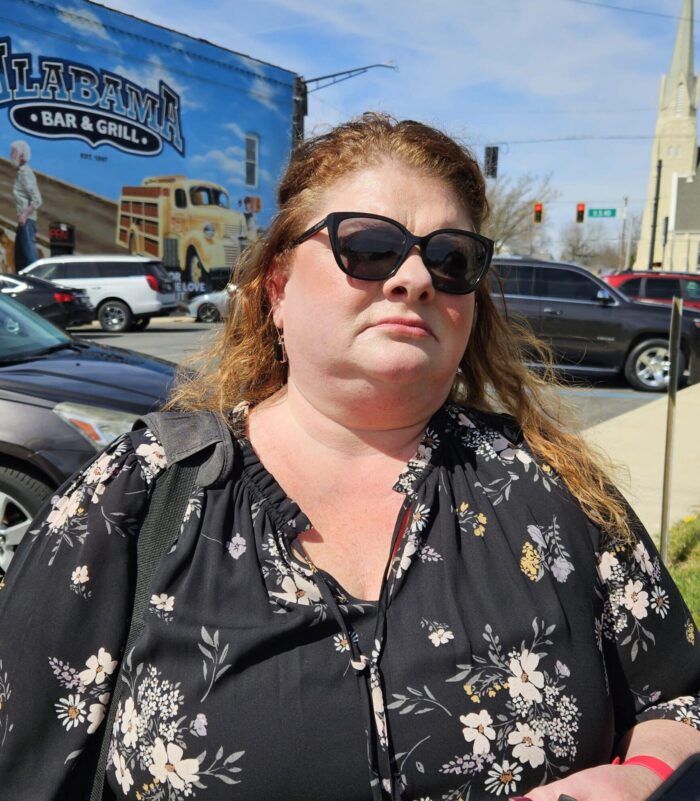
“You’re not the judge,” DeWester said to Bopp, while pointing to the bench. “Talk to the judge.”
During her argument, DeWester criticized Bopp for his multipage exhibit that included just one page from the transcript of the Indiana Election Commission’s hearing on this matter. That hearing, she said, was an hour long, yet Bopp just pulled a single page.
Then, DeWester entered into the record her own exhibit – Wilson’s expungement of the conviction at the center of this case. Wilson applied to have her record expunged over the weekend and received notification that it had been granted before the hearing began. DeWester asserted that the dispute over whether her client had pleaded guilty to a felony or a misdemeanor was now moot because the criminal case no longer exists.
Bopp objected. He countered that the court was limited to reviewing the record as it came from the Election Commission and the expungement was not part of that record. Also, he said, in order for the expungement to apply to this case, Wilson should have received it before she filed her candidacy on Feb. 5.
Putnam County Superior Court Judge Charles Bridges, who had been appointed on March 20 to preside over the case, calmly listened to the attorneys. He allowed them to take all the time they needed to explain the issues, occasionally asked a question, and never intervened as Bopp and DeWester threw verbal punches at each other.
Held in Clay County Circuit Court, where the case was filed, the hearing lasted about an hour and a half. At the conclusion, Bridges gave the attorneys seven days to submit their proposed orders after which he said he would issue his ruling.
This was the latest chapter in the ongoing fight to stop state Sen. Greg Goode, R-Terre Haute, from being reelected to the Indiana General Assembly. By the time Alexandra Wilson entered the race, Vigo County Council member Brenda Wilson was already running in the Senate District 38 contest and riding on an endorsement from President Donald Trump.
Bopp has maintained that having two candidates with the same last name in the same race is not a coincidence. He has alleged Alexandra Wilson was encouraged to run, so the opposition vote would be split and Goode would win the Republican nomination.
After the hearing, he described Alexandra Wilson’s candidacy as a “dirty, dirty trick” meant to confuse the voters.
“(This race) should be about the issues and the candidates, and these kinds of dirty tricks should not be rewarded,” Bopp said. “They should not reward that sort of behavior.”
Standing outside the courthouse, DeWester dismissed Bopp’s allegations and said her client was the victim of political trickery.
“This is political,” DeWester said, adding that the opponents to Alexandra Wilson’s candidacy know she does not have a felony conviction, but they are dragging her through the mud and calling her a felon to force her from the race. “She’s just caught in the crosshairs.”
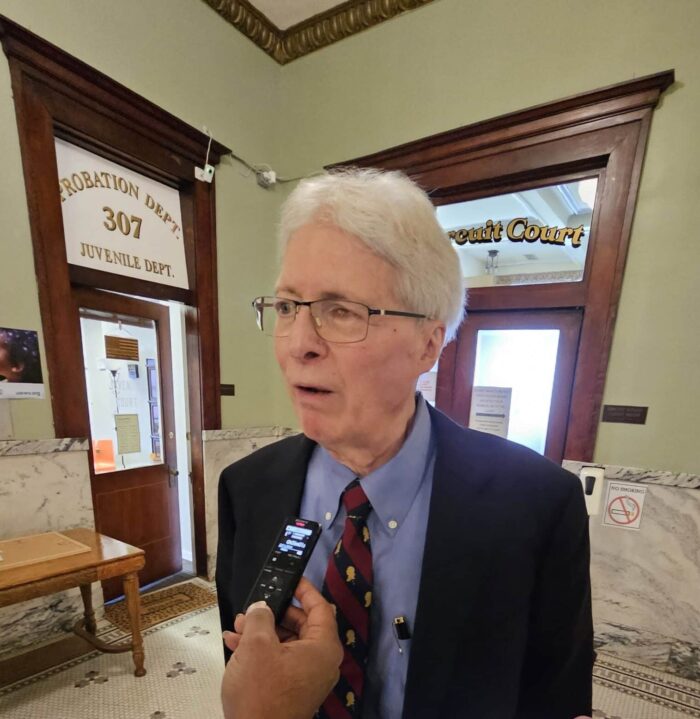
Jeffrey Gallant, represented by Bopp, filed a challenge to Alexandra Wilson’s eligibility to be on the ballot with the Indiana Election Commission in February. He argued that Wilson was disqualified from running for office because in 2010 she had pleaded guilty to resisting law enforcement, a Class D felony. Under Indiana Code 3-8-1-5, individuals who enter a guilty plea to a felony are prohibited from being a candidate or holding elected office.
The Election Commission deadlocked 2-2, which enabled Alexandra Wilson to remain on the May ballot.
However, Bopp filed a petition for judicial review of the Election Commission’s ruling. Arguing the commission members misinterpreted the state’s disqualification statute, he asked the court to set aside the decision and remand the matter back to the commission with instructions to remove Wilson from the May GOP primary.
During Tuesday’s hearing, Bopp walked through a detailed analysis of his argument that Wilson is disqualified under state statute.
Flipping among Indiana statutes and highlighting Wilson’s plea agreement, portions of the commission hearing transcript as well as the briefs filed with the court, Bopp asserted Alexandra Wilson pleaded guilty to a felony. The statute disqualifies an individual who pleads guilty to a felony, which, he said, shows the legislature intended to focus on the plea and not on the actual conviction. Therefore, any subsequent reduction to a misdemeanor would not negate the disqualification.
DeWester, again, objected to Bopp referring to Wilson as a convicted felon, saying the characterization was false and defamatory.
Also, she, too, pointed to Wilson’s plea agreement and highlighted that the judgment of conviction was entered as a Class A misdemeanor. The charge was reduced before Wilson signed the plea agreement, she said, not subsequent. Moreover, she said, Wilson was sentenced to one year and, in the disqualification statute, “felony” is defined as imprisonment for more than one year.
The Indiana Attorney General’s Office, which employs Brenda Wilson as an “outreach representative,” participated in the hearing as the legal counsel for the Indiana Election Commission.
Currently, Alexandra Wilson’s name is on the ballots being mailed to absentee voters. On Friday, Bridges issued an order lifting the stay that was prohibiting Vigo and Clay counties and the portion of Sullivan County that is in Senate District 38 from distributing the mail-in ballots.
Early in-person voting for the primary will begin on April 7.
Speaking after the hearing, Bopp did not rule out an appeal if the trial court upholds Alexandra Wilson’s candidacy.
“I know how to do this, if necessary,” Bopp said of potentially seeking a reversal at the Court of Appeals of Indiana. “I hope it won’t be.”
Outside the courthouse, DeWester reiterated her argument that the disqualification statute is clear, but, she said, Bopp and Gallant were clouding the issue with all the “garblely gook.”
“If the General Assembly wants to make (the statute) clear, they certainly can weigh in,” DeWester said. “I’m guessing they will clear it up, because there’s no way they intended for someone convicted of a misdemeanor to not be able to run, because, let’s be honest, some people in the General Assembly wouldn’t be able to run.”
The case is Jeffrey P. Gallant v. Indiana Election Commission and Alexandra Wilson, 11C01-2603-RA-185.
Dwight Adams, an editor and writer based in Indianapolis, edited this article. He is a former content editor, copy editor and digital producer at The Indianapolis Star and IndyStar.com, and worked as a planner for other newspapers, including the Louisville Courier Journal.
The Indiana Citizen is a nonpartisan, nonprofit platform dedicated to increasing the number of informed and engaged Hoosier citizens. We are operated by the Indiana Citizen Education Foundation, Inc., a 501(c)(3) public charity. For questions about the story, contact Marilyn Odendahl at marilyn.odendahl@indianacitizen.org