This story was originally published by TheStatehouseFile.com.
By Colleen Steffen
TheStatehouseFile.com
March 28, 2026
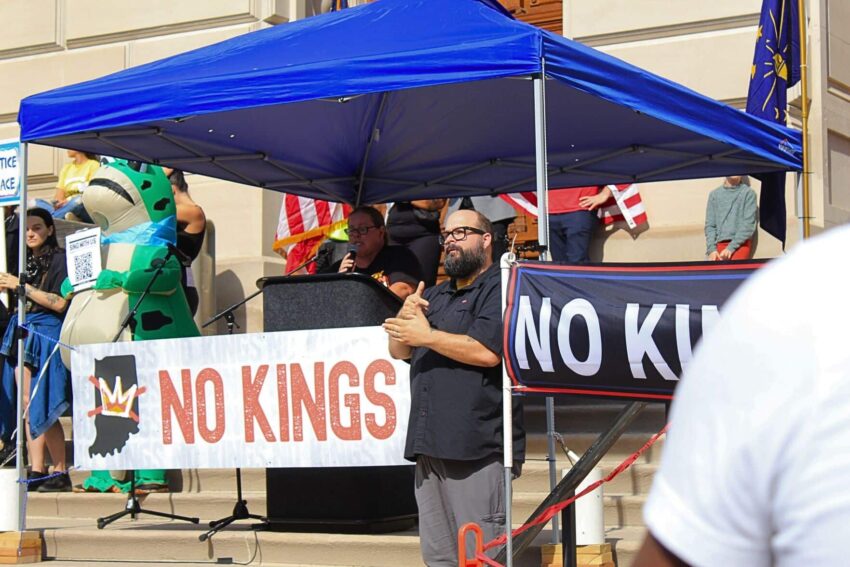
People protest against things—to communicate their disapproval, to demand change. When they protest together, they unite around common grievances. So, at Saturday’s 60-some No Kings protests across Indiana, those gathered likely would have echoed each other’s condemnations of the Trump administration and its policies, from ICE raids to the Iran war.
But people also protest for things—to express love for something, to try to protect it. In that way, their reasons for protesting prove unique.
In Muncie, where protesters filled the sidewalks on both sides of the Fallen Heroes Memorial Bridge crossing a muddy White River near downtown, some paused to share their stories on a beautiful but cold blue-sky morning. Honking cars streamed past, and a bald eagle, as if ordered from Central Casting, flapped in a nearby tree.

For her former students: Elizabeth Raymond
57, of Muncie
Two-year cancer survivor
Retired special-education teacher
For 10 years, Elizabeth Raymond taught special-education students in Seattle, where 60% of her school’s population were Somali and Muslim immigrants.
“And they were the best community I have ever taught in,” she said. “They had more family engagement, and to see the president slander our Somalians makes me livid because I put a face—”
Her voice started to quiver
“Every time he says that, I see a little face from one of my classrooms, and it makes me really angry.
Maybe it seemed an incongruous thing to say in her giant floral eyeglass frames, in a neon blow-up cat costume reminiscent of the Portland Frog that famously danced and gyrated at protests in Washington state last fall. “Meow! We are grabbing back,” said her sign, her face peaking out of a hole in the cat’s chin.
Two little girls interrupted her to say hi and stare like she was a character at a theme park.
“I love it,” she said. “I love America, and to me, this is an expression of the freedoms that it grants me, the freedom to be silly.
“You know, I don’t like the narrative that we are a bunch of Antifa terrorists, it’s ridiculous, and I think when you point out the absurdity by dressing absurd, it kind of throws it back into their face.”
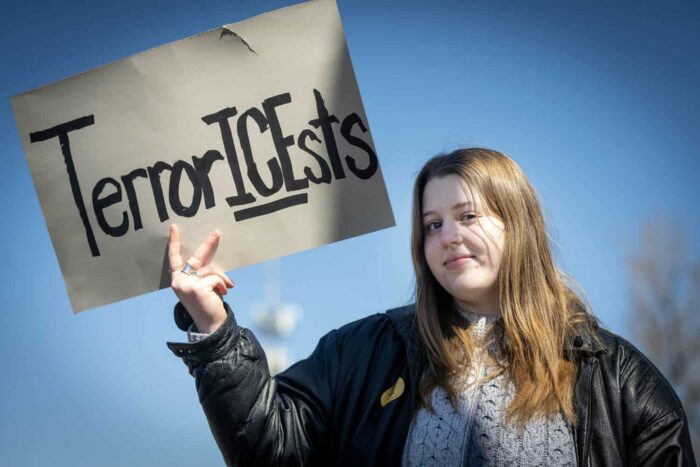
For that hopeless feeling: Lucy Rutter
19, of Muncie
Miami University at Oxford student studying kinesiology
Lucy Rutter founded Burris Laboratory School’s Students Demand Action chapter when she was still a high-schooler there. She had parents who took her to protests as a little kid and were involved in local political organizations.
She grew up thinking it was her job to show up. So, she finds it frustrating when her friends and fellow young people don’t.
“It’s hard, I think especially because I feel like I do know a lot of people who don’t really know what’s going on in the country at all,” she said. “They have no idea what’s going on, and that makes me feel pretty hopeless.”
Are protests for politicians to see or protesters to experience? Pundits often ask this question, but why not both, Lucy asked.
“On days like today, I feel a little more hopeful just seeing all these people out here— young people, old people, all different kinds of people out here for this cause that we all really, really care about,” she said.
“It makes me feel like we do have the power to change things.”

For his parents: Carl Kizer
76, of Muncie
Retired business owner
Former school board member and president
Former local transit board member
Carl Kizer’s mother was the old Ball Hospital’s first Black registered nurse—nicknamed Bullseye for her virtuosity with an IV. She had served in the Army as a nurse helping prisoners of war and later would be a nurse in a school, organizing health clinics at the local community center so families could afford to get their children’s vaccines.
She was an usher in her church, where Carl’s father, a post-office worker and a scout troop leader, taught Sunday school.
“Everything revolved around the church because that’s where we were safe,” said Carl, standing close to the road in a fedora and scarf. “And then it reverted back.”
The pews at Carl’s church are emptier now, he said, even though the times begin to feel dangerous again. But if these days remind him of those of his childhood, he knows what to do, what he’s been doing his whole life.
“To follow my parents’ example,” he said.
For the end of the story: Mary Stephenson
78, of Anderson
Mother of two and grandmother of six
Mary Stephenson was 13 and home sick from school when President John F. Kennedy was killed. Half asleep, listening in disbelief to the radio, at first thinking they were talking about the Abraham Lincoln assassination, it was her first confrontation with politics in any form. It launched her into a lifetime of studying government and reading news.
Now she’s 78, and Saturday when she saw an older man named Carl Kizer standing several feet out in the road in front of the line of protesters, she joined him in her Uncle Sam hat, with her huge sign calling for a full release of the Epstein files. She didn’t want him to be standing alone.
“I may not be here to see the end of this, how it ends,” she said. “I hope I am because I’m hoping for a good ending. I like a happy ending to stories. But I am anxious, I guess is a good word.”

For people who think protests don’t work: Ryan Murray
Of Muncie
Local business owner
Father of two
Ryan Murray, standing over the choppy water with a gigantic sign, said only 15% of a country’s population has to protest to topple a dictator—or maybe avoid one altogether.
He was citing studies that were actually even more optimistic about the numbers. A Guardian article published toward the beginning of Trump’s first presidency said just 3.5% of the populations in places like Chile and Serbia engaging in nonviolent resistance were able to sweep their dictators from power.
“And we are on the path to dictatorship,” Murray said. “That leads us toward needing as many of us as possible to speak up.”
For the babies: Deb Spurlock Dalton
65, of Muncie
Retired from a career in social services
Widow of a disabled Marine
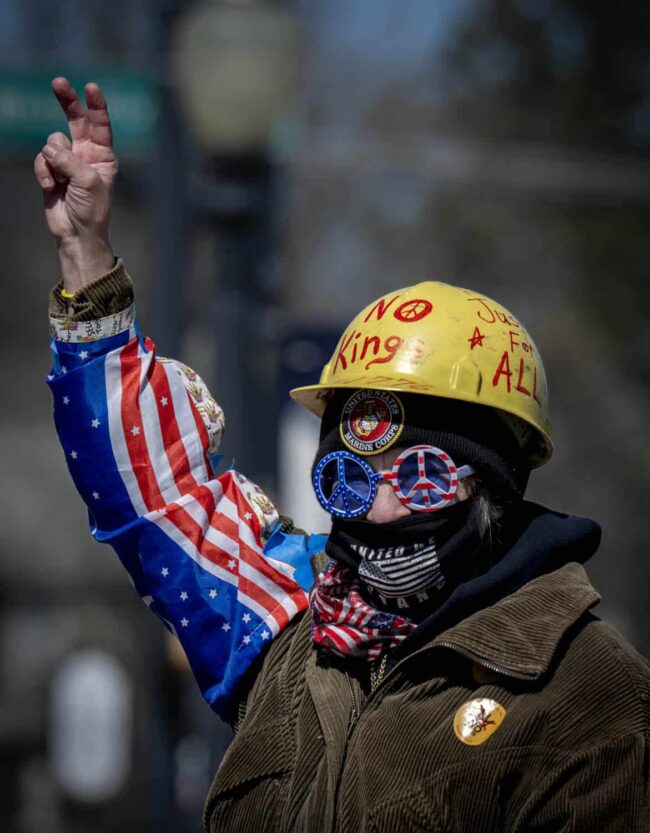
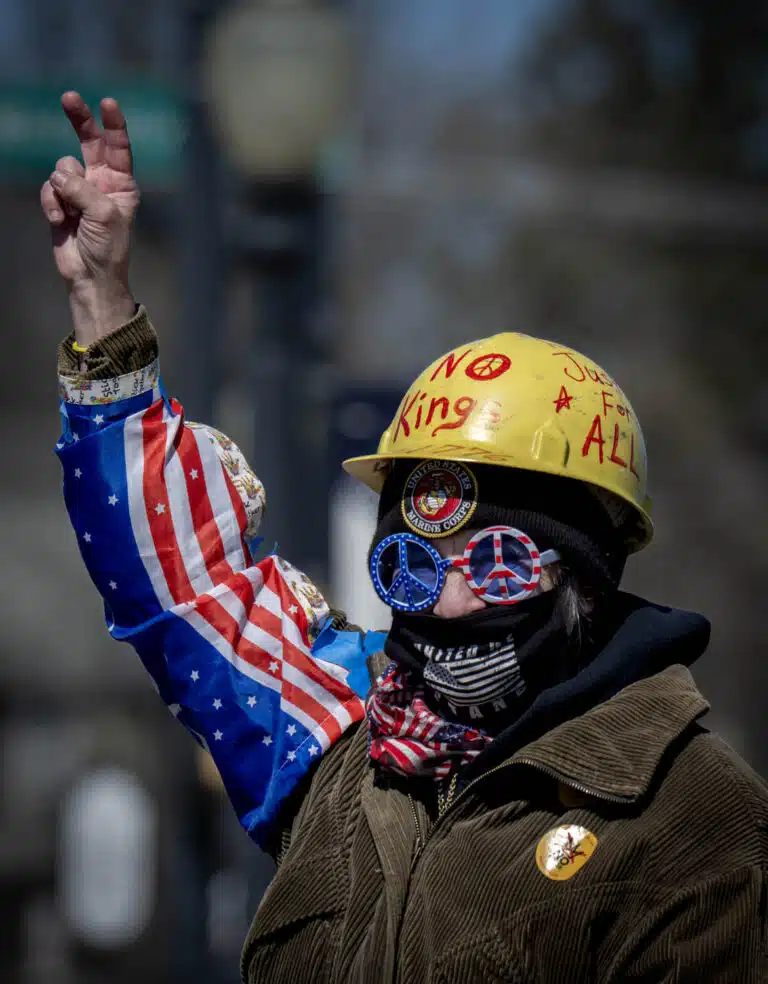
Deb Spurlock Dalton wore a “No Kings” hard hat over her Marine Corps beanie, a star-spangled jacket, a U.S. flag mask. This spot halfway over the bridge, with a street lamp to cling to as she waved at cars, was where she had stood for all three No Kings protests.
“Spurlock is my real name before they took me from my birth family and ripped my sisters from my arms and put me in a foster home with a pedophile,” she said. “And I was in two other foster homes. They ripped my 3-year-old sister out of my arms, and they put us all in separate foster homes, and all three of us were molested.”
Tears started to collect behind her red, white and blue peace-sign sunglasses. She had to take them off to wipe her eyes.
“They say they want more babies. I want to take care of the babies that are here,” she said.
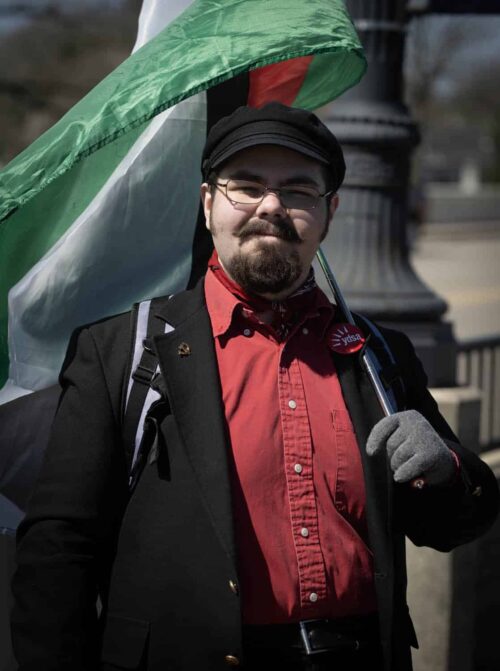
For the beauty in not giving up: Uther Henderson
21, of Greenwood
Young Democratic Socialists of America member
Ball State University student studying social studies education
Uther Henderson, in his comrade’s cap, waxed mustache and hammer-and-sickle pin, laughed when asked if he’d been thinking about the Bolsheviks of 1917 Russia when he got dressed that morning.
“They’re on my mind quite a few days of the week,” he said.
Maybe they’re his Roman empire? “Sure, I guess so,” he laughed.
But what’s that old saying about laughing so you don’t cry?
“It’s often a lot of despair,” the young man said, particularly when it comes to climate change. “I find that it’s very difficult continuing on organizing and struggling for a better world because it seems like nothing’s going right.
“At the same time, I think that there’s a certain beauty in struggling for a better world even if you won’t get it. There’s no worse existence than just giving up.”
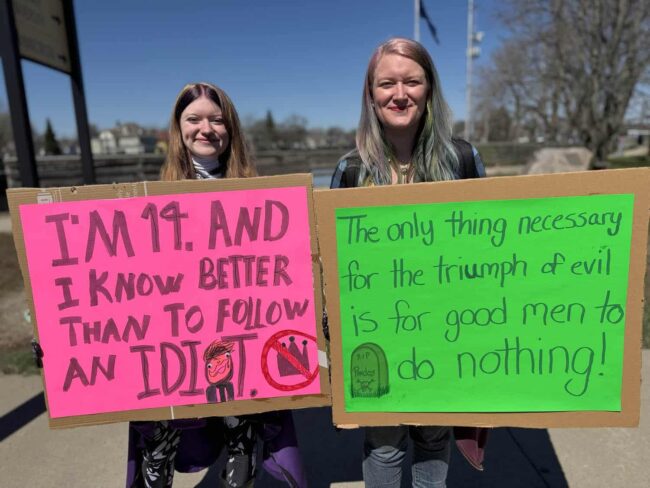
For her daughter: Tara Morrison
34, of Elwood
Mom of two
Tara Morrison’s 14-year-old daughter, Serena, wanted to come to the latest No Kings protest, so this mom who has homeschooled the girl her entire life gassed up the car. Afterward, they would relocate to the parking lot of a CVS in downtown Elwood, whose history as a sundown town they alluded to, for their own two-person protest.
Mom and daughter wear the same rainbow highlights in their hair. They belong to the LGTBQ+ community, and they can feel isolated and alone in their 8,400-person town. Last time they took their protest signs to Elwood’s main drag, someone threw a soft drink at them through a passing car window. But someone else stopped and gave them a $20 bill and told them to go buy bigger pieces of cardboard for their messages.
It’s all just a different kind of lesson Tara wants her daughter to have.
“It refills your cup,” she said. “Like you’re emotionally drained and you just want to crumble
give up, but you’re here, and these people aren’t giving up, and I ain’t giving up either.”
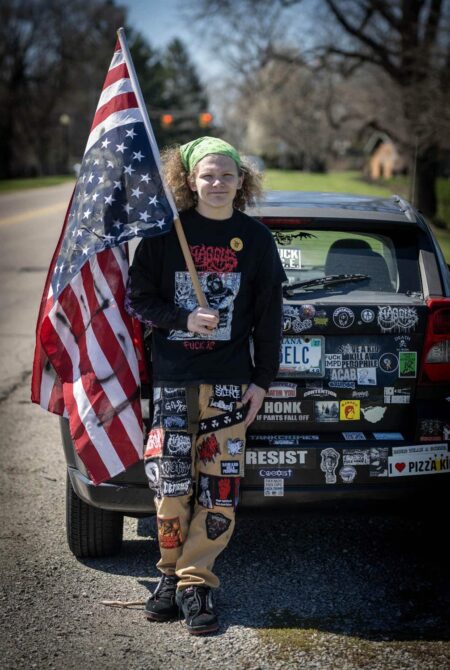
For expressing yourself: David Canada
18, of Muncie
Senior at Burris Laboratory School
David Canada’s political education started with his dad, who teaches history at his high school in Muncie. It has continued more recently at the punk shows in Indianapolis he loves and will go to by himself if he has to.
“The people on stage, they say what they think,” he said. And he might have said the same about his pants, covered in band patches, or his bumper-sticker-covered car.
He wasn’t just the most conspicuous but one of the last to leave the bridge when the protesters dispersed after noon.

Colleen Steffen is executive editor of TheStatehouseFile.com, a news site powered by Franklin College journalism students. She worked as a newspaper reporter and editor for more than 13 years and is now in her 11th year mentoring college journalists.