But there’s another context to consider here.
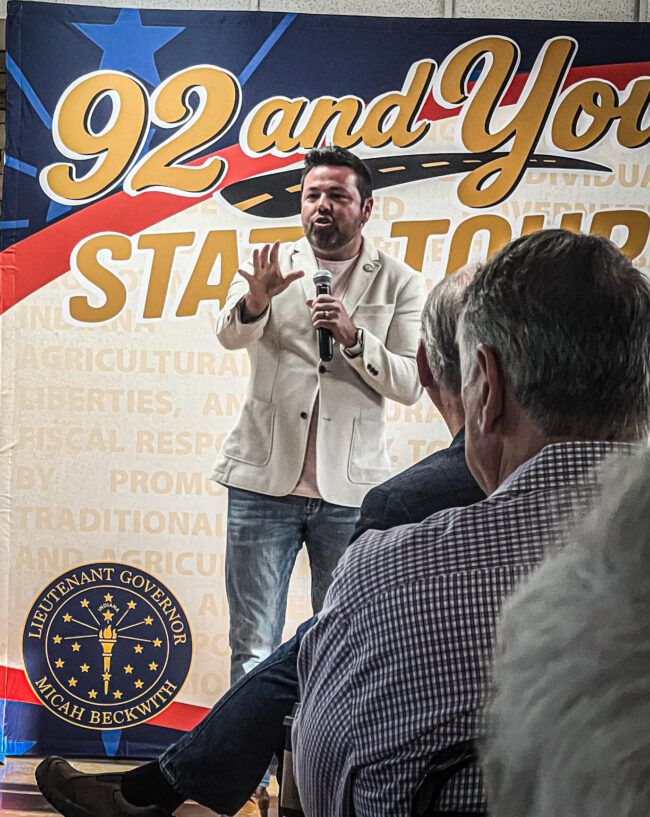
Beckwith is a self-proclaimed Christian Nationalist.
Christian Nationalists are also sometimes called Christian supremacists. They harbor the conviction that America is a Christian nation and that Christian principles—as defined by them—should determine how the nation is run.
To arrive at this conclusion, Christian Nationalists have become adept at ignoring or rewriting huge swaths of U.S. history. This hunger to summon an American past that lives only in a desperate partisan’s imagination is powerful.
It spurred Beckwith’s bizarre assertion that the U.S. Constitution’s notorious provision that slaves could be considered three-fifths of a human being to add voting strength for their owners while denying slaves the right to vote themselves was actually a benefit for Black Americans.
To make the case that America was founded as a Christian nation, blind observers such as Beckwith must reshape our country’s early days into something severed from truth.
To be fair to the lieutenant governor and his fellow delusionists, there have been voices arguing that the United States should be a Christian nation from our earliest days. Christian Nationalists cite, for example, a letter John Adams wrote saying that our country was founded on Christian principles, but they skip right over the Treaty of Tripoli Adams signed that said that “the government of the United States of America is not in any sense founded on the Christian religion.”
Then there’s the letter President George Washington sent to the Hebrew Congregation of Newport, Rhode Island. The father of our country wrote:
“The citizens of the United States of America have a right to applaud themselves for having given to mankind examples of an enlarged and liberal policy—a policy worthy of imitation. All possess alike liberty of conscience and immunities of citizenship.
“It is now no more that toleration is spoken of as if it were the indulgence of one class of people that another enjoyed the exercise of their inherent natural rights, for, happily, the Government of the United States, which gives to bigotry no sanction, to persecution no assistance, requires only that they who live under its protection should demean themselves as good citizens in giving it on all occasions their effectual support.”
These sentiments were in keeping with the more succinct argument offered by Thomas Jefferson. That apostle of liberty wrote: “It does me no injury for my neighbour to say there are twenty gods, or no god. It neither picks my pocket nor breaks my leg.”
This thinking prompted the founding generation to demand that a Bill of Rights be added to the Constitution—the First Amendment of which prohibits the establishment of a state church, Christian or otherwise, and guarantees all people the right to follow their own spiritual paths.
This means Micah Beckwith’s quarrel isn’t with Daniel Elliott or Muslims.
It’s with George Washington, John Adams, Thomas Jefferson and their friends.
Good luck with that quarrel, Micah.