By Lauren Warner
TheStatehouseFile.com
September 3, 2026
As the 2026-2027 school year kicks off, kids attending public school are facing a big change: an entire school day without using personal wireless devices.
Previous legislation from 2024—Senate Enrolled Act 185—only required schools to enforce cellphone bans during class time, allowing students to pull out their devices during passing periods and lunch, The Indiana Capital Chronicle reported. However, after complaints about the difficulty of enforcement, Senate Enrolled Act 78 was signed into law earlier this year.
The new law, which went into effect on July 1, stipulates that public schools must separate minors from their personal wireless devices—such as cellphones, smartwatches, earbuds and wireless headphones—for the entirety of the school day, both in and outside of class. Notable exceptions to the law include students with language needs or medical complications, such as heart conditions, diabetes or anxiety.
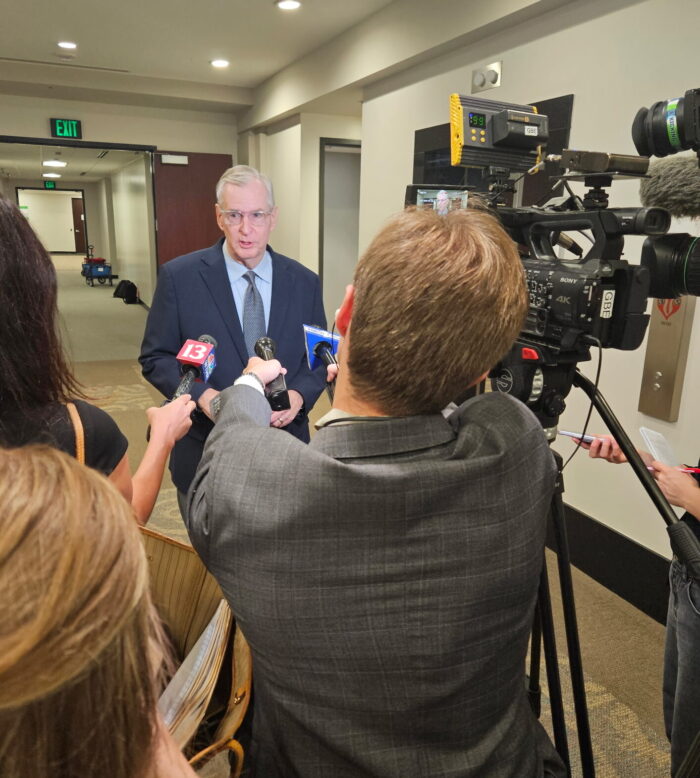
While legal guidelines advise schools to distance students from their devices through external storage units—lockers, sealed magnetic pouches, etc.—Whiteland Community High School’s large student population and physical layout makes such measures unrealistic, said Principal Duke Lines. Instead, students are required to power off their devices and place them in their backpacks from the tardy bell (7:35 a.m.) to the dismissal bell (2:45 p.m.)
If a student is caught using an unauthorized wireless device during the school day, they are immediately asked to place the item in a secure storage bin, Lines said. He emphasized that teachers instruct students to place their items in the bin—rather than forcibly wrenching them from their grasps—to keep interactions civil and calm.
“I want to keep the little, little,” Lines said. “I don’t want to escalate it.”
After the school day, students can collect confiscated items from a central location on their way out. If a second offense occurs, the same process ensues. However, this time around, the student is recorded as a second-time offender in the school system, and administration calls home to report the student’s behavior, Lines said.
Further offenses result in further consequences, he explained. Students may be required to give their phone to their dean before the school day begins for a certain period of time. If misbehavior continues, students can be required to hand in their phone before the tardy bell for the rest of the year.
“It can go up to in-school suspension and things like that because here’s the reality of this,” Lines said. “If you’re a repeat offender, you’re really no longer breaking the wireless device progressive (discipline) rule, right? You really are now being insubordinate. And when you’re being insubordinate, that’s when we start to talk about in-school suspension, out-of-school suspension, behavior contracts, those sorts of things.”
The adjustment may be easier for some students than for others, Lines acknowledged. However, he voiced a continuing commitment to intentionality and transparency as kids and families adapt to the ramifications of the new law.
“We will be clear in our expectations, and we will follow through on our plan,” Lines said. “I do believe that students will respond appropriately over time. It takes time to adjust.”
Hamilton Southeastern (HSE) schools are taking a similar approach, Christi Thomas, director of student services at HSE, said. Throughout the entire day, devices are to be stowed away in a backpack or a locker. During class time, all backpacks are lined along a wall, and students take necessary supplies to their desks, leaving their backpacks in a classroom during lunch, Thomas explained.
As students walk from class to class, teachers, deans and administrators keep an eye out for any banned devices. Having a cellphone or another wireless device out during a passing period or lunch results in confiscation by a dean, assistant principal or member of the administration, Thomas said. The school is “taking a hard stance at it from the get-go,” she explained.
“We’ve pushed that (information) out to our community so that they have access to that, and we’ve created an FAQ, and that’s on our website,” Thomas said. “Our procedures itself, we’ve got our handbook that spells out that they’re not allowed, and what items aren’t allowed. It then goes into our consequences, which is confiscation, detention, possible suspension. There’s a progression there, but the state has given the warning. … Wireless devices aren’t allowed, and we need to get into that mindset.”
Brooke Fuentes, an English teacher at Whiteland Community High School, told TheStatehouseFile.com that she was worried the adjustment to the new law during the first few weeks of the school year would prove more distracting than the devices themselves. To ensure class time remained productive, she said that conversations about the cellphone ban with students would be a “non-starter” in her classroom.
“It’s not going to be a back and forth,” Fuentes said. “I’m just going to ask them to give it to me to try to take up as little time as possible. I assume there will be some kids who want to argue about it, but I can’t change a rule, so I’m not the one to argue with.”
She also voiced concerns about enforcement loosening as the year goes on, causing the initial problems to resurface. After the previous legislation passed in 2024, Whiteland started off by requiring students to put devices away all day. However, as time went on, the standards loosened, and teachers only enforced the device ban during class time.
To help educators keep the issue “front of mind,” she hopes administration will schedule a monthly reminder in order to maintain consistency.
“Most students will follow a rule when it’s a rule and when it’s evenly enforced,” Fuentes said. “When they see that in some places it’s enforced and some places it’s not, they see that very black and white as not fair, and that’s when they’ll start misbehaving.”
Katie DeClercq, an English teacher at Whiteland Community High School, also anticipated problems arising as students adjust to the new rules.
While acknowledging the ban’s benefits, calling the legislation “necessary,” she wondered about details surrounding implementation, especially at the beginning of the year.
“How are we going to handle that situation if a kid just refuses to hand it over?” DeClercq said. “I think we’re going to be busy with it, I guess—kids testing to see if we’re actually going to follow through and that type of thing. I think (that) is going to be probably the biggest challenge.”
DeClercq also foresees complications occurring as students attempt to complete in-class work. During one of her classes, AP Seminar, she allowed students to use their phones to do research because the school filters on their Chromebooks blocked searches for specific topics. Now, under the new legislation, she will need to work with the school’s tech department to ensure her students can access the information they need.
Additionally, she anticipates initial communication difficulties with kids involved in extracurricular activities.
“I’m also student council advisor and a golf coach, and so a lot of times I would use messaging services to get a hold of my kids during the school day because I knew that they don’t check their email,” DeClercq said. “So that’s going to change, definitely. I think building the habits for the kids to check their email, especially for those kids that I work with in extracurricular capacities.”
However, even with the challenges, DeClercq hopes to see an uptick in social interaction. A teacher for more than 20 years, she has noticed a large drop in student engagement over time.
“It had been real quiet in my classroom because everybody was on their phone,” DeClercq said. “So I’m looking forward to them interacting with each other. I know when we first started (the initial ban), I heard them talk a lot about like, ‘Yeah, we actually played a game at lunch today,’ and that type of thing.”
Additionally, she plans to use the ban as an opportunity to decrease her overall use of screens in the classroom.
“I’m also implementing less digital time in my class with Chromebooks and more analog,” DeClercq added, “just to try to overcome ChatGPT and AI and all of that fun stuff.”
Parents have given mixed responses to the new legislation, DeClercq said. While some believe their children will benefit from the policy, other parents have raised concerns.
“There are some parents that are very much against it and very much want to have access to their child whenever they want access to their child,” DeClercq said. “And there’s a lot of talk of the fear of what if something happens, not being able to get a hold of your kid if something were to happen at the school and things like that.”
Lines explained that, in the case of an emergency, Whiteland students will still have access to their powered-off phones since they will simply be stowed away in their backpacks.
“I understand that that’s your concern, but also, let’s play that scenario out,” Lines said. “We are not going to be yelling at the students to put their phones away in an emergency. We are going to be doing our darndest to keep them safe.”
For daily communication, parents can contact the front office or email their students directly through their Chromebooks, he added.
“So I’m hoping that’s a positive ripple effect of this,” Lines said. “While they’re on the email, you know, emailing mom, dad, brother, sister, whoever, they also will check out the email from myself or others in this building.”
DeClercq has largely seen Whiteland students react negatively to the new law.
“They are not excited,” DeClercq said. “They think that it’s a prison. They are not looking forward to this at all.”
Lines has also experienced student pushback, he said.
“I have a Warrior Advisory Committee made up of some of our student leaders in all grades,” Lines said. “We met this past spring to go over the legislation, what that means for them, give them an opportunity to vent a little bit because … if I’m a young person, I’m feeling like this is the law doing something to me that I had no say in.”
He anticipates students struggling not only with the ban on cellphone use but also with the ban on devices like airpods and wireless headphones.
However, he believes the law is a chance for students to learn how to adapt to adverse and/or unwanted situations.
“It’s never fun when you feel like something’s being done to you and you didn’t have a say,” Lines said. “You might not know how to process that and work through that, and that’s gonna look a little bit different from student to student, person to person. But again, that in and of itself is a life lesson of like, events happen, and you have the opportunity to respond to it.”
In spite of the potential challenges, Fuentes hopes the ban proves beneficial for students, encouraging “more regulated nervous systems.”
“Some of my students in the past who are most dependent on their phone are the ones who are also super anxious, super high strung,” Fuentes said. “I just don’t think that the constant notifications, even if they’re benign notifications, I just don’t think they’re healthy. … I don’t think we’re wired to be that way.”
Thomas also wants to see more student interaction both in and outside of the classroom, hoping that the removal of digital distractions will improve academic performance across the board.
Lines agreed, explaining that the ultimate goal of the ban is increased engagement.
“It’s about connecting our students with themselves, one another, the staff here, the community here, that’s the biggest thing,” Lines said. “How can we continue to expand those connections and opportunities for our kids? And I would like to think that fewer distractions on the phone can lead to higher success in these other areas.”
Lauren Warner is a reporter for TheStatehouseFile.com, a news website powered by Franklin College journalism students.