They made their 2024 margin of victory completely disappear.
What happened to Republicans in Indiana and across the country wasn’t just a defeat.
It was a smackdown.
A spanking on a massive scale.
And—most of all—an epic, epic repudiation of Trump and Trumpism.
The evidence that a strong majority of the country has turned against the president certainly could be seen here in the Hoosier state.
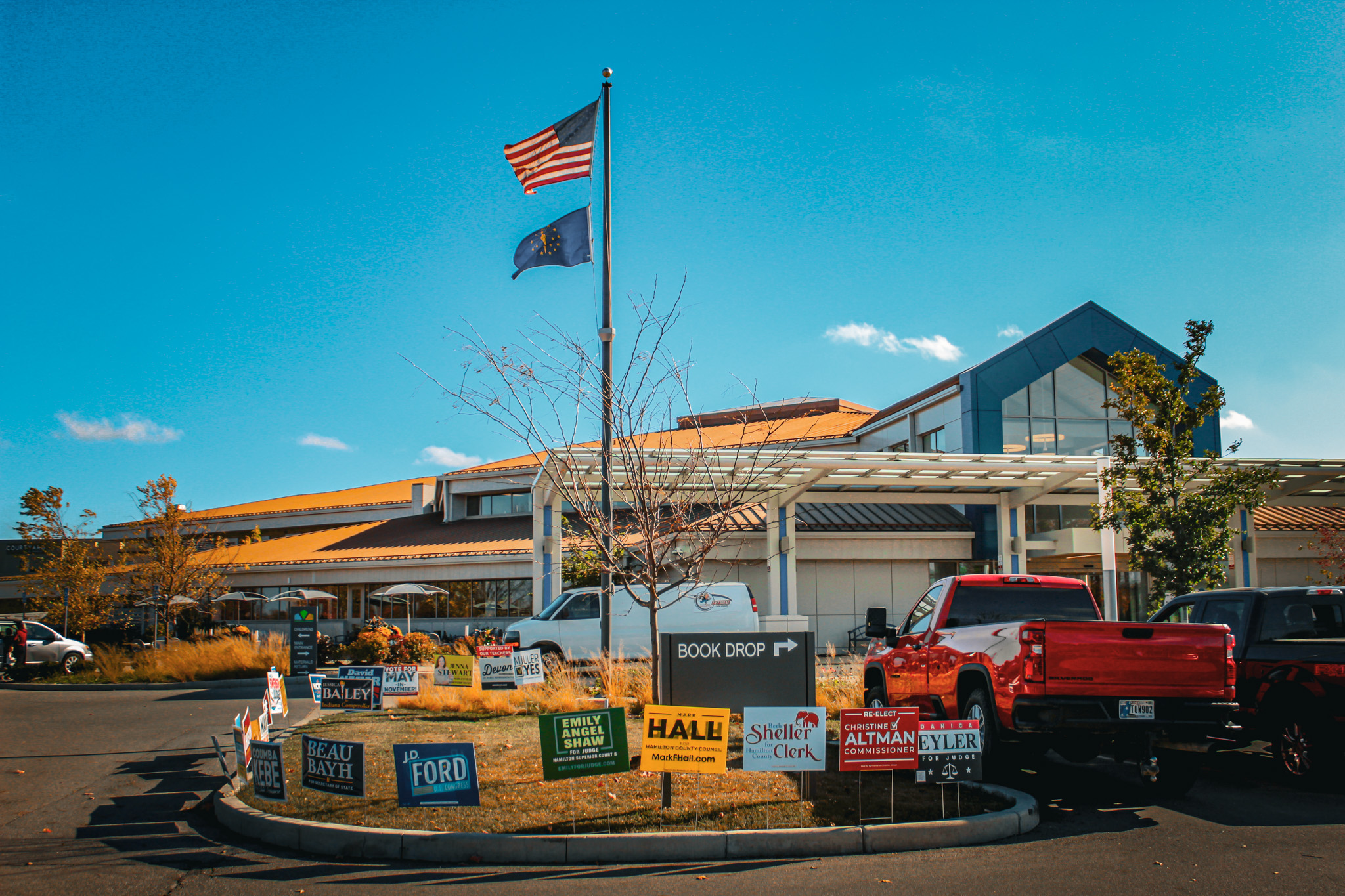
In the closely watched and hotly contested Indiana secretary of state’s race, Democrat Beau Bayh ran up huge margins in traditionally Democratic counties—but also performed well above expectations in counties that once were considered GOP strongholds.
Along the way, Bayh defeated Republican Max Engling and became the first Democrat to win a statewide campaign in Indiana in almost 15 years.
The secretary of state’s race wasn’t the only one in which Hoosiers decided to send Trump and Republicans a message.
In the state’s Fifth Congressional District—which Trump carried by roughly 18 points just two years ago—Democrat J.D. Ford clawed out a hard-fought victory over U.S. Rep. Victoria Spartz, R-Indiana.
Ford will be the first Democrat to represent that district in more than 30 years.
And because the Fifth has long been a bastion of traditional Republicanism—a place where the old heart of the GOP that believed in limited government and free trade beat most strongly—Ford’s triumph signaled just how profoundly what once was the party of Lincoln has fractured.
That fact was underscored by the almost certain loss by Indiana House Speaker Todd Huston, R-Fishers.
At this time last year, the Republican leaders of two legislative chambers—House Speaker Huston and Indiana Senate President Pro Tempore Rodric Bray, R-Martinsville—disagreed over Trump’s ill-advised and possibly illegal plan to redistrict the state’s congressional maps in the middle of a decade.
Huston supported the president’s plan. Bray opposed it.
Trump’s allies in Indiana—Gov. Mike Braun, Lt. Gov. Micah Beckwith, Indiana Attorney General Todd Rokita and U.S. Sen. Jim Banks, R-Indiana—all exerted pressure to punish Bray by having him lose his leadership post.
Bray stepped aside gracefully, saying he didn’t want to become a distraction for the other Republican members of the Indiana Senate caucus.
Huston believed he had weathered the storm.
The voters thought otherwise.
Somewhere, Bray doubtless is fighting a strong temptation to say, “I told you so.”
But this rebuke of the president and his party wasn’t confined to Indiana.
Republicans lost in states that Democrats once would have found impregnable. Democrats picked up U.S. Senate seats in once bright-red states such as South Carolina, Texas, North Carolina, Kansas and Ohio. They regained control of the U.S. House of Representatives in overwhelming fashion.
And the blue tidal wave also washed Republicans out of and Democrats into governors’ offices in red state after red state—most notably Georgia, Texas and Ohio.
In almost every case, voters opted to punish candidates either handpicked by the president or perceived as close to him.
Once the vast scale of the Republican disaster became clear, Trump posted on Truth Social: “I wasn’t on the Ballot and if I was, we would have won IN A LANDSLIDE! Thank you for your attention to this matter.”
The fact, though, is that the president has been telling his supporters and other Americans that they should vote as if he were on the ballot.
The voters took him at his word.
And delivered the most powerful rejection of a sitting president in close to a century.
Democrats will have many difficult choices to make in the days ahead. Most notably, they will have to decide how to handle the many legal and ethical controversies generated by this president, his family, his Cabinet and his allies.
The Republicans, on the other hand, have an even tougher task ahead of them.
These election results signal that many, many, many voters feel the GOP betrayed them by focusing more on intraparty feuds and political retribution than on serving the public.
Republicans will do a lot of finger-pointing as they try to figure out who to blame for this debacle.
President Trump shouldn’t struggle with that question.
He’ll find the answer every time he looks in a mirror.