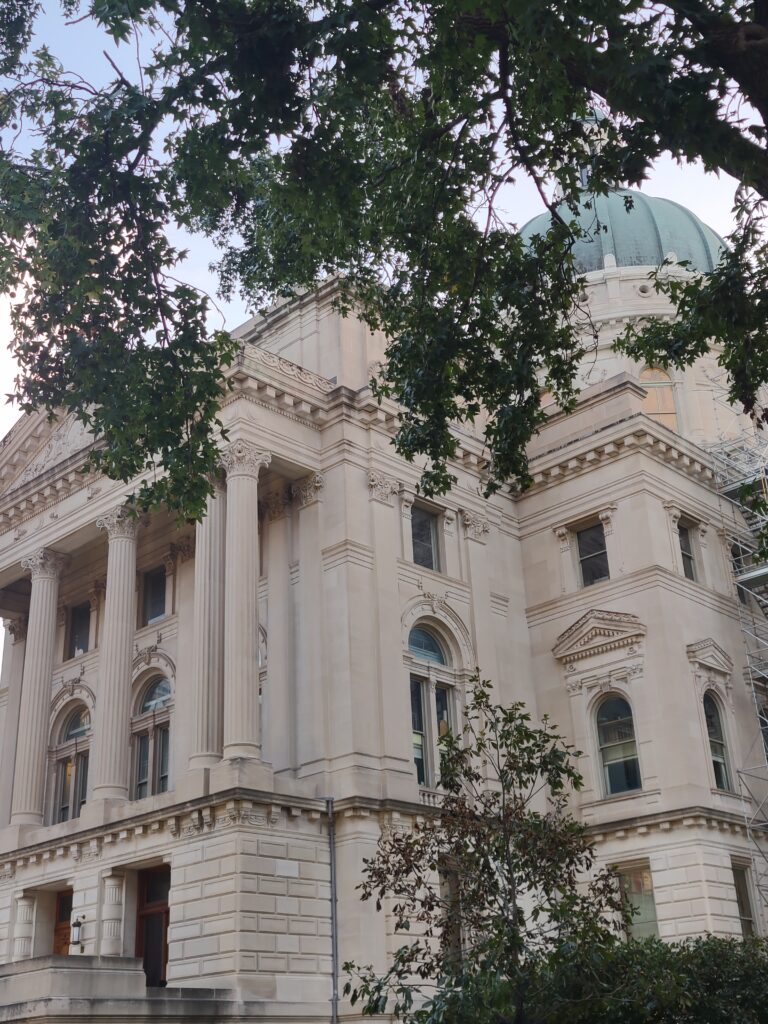
Just days before the marathon meeting of the Interim Study Committee on Energy, Utilities and Telecommunications at the Indiana Statehouse, the Indiana Office of Utility Consumer Counselor approved an investigation for the Indiana Utility Regulatory Commission (IURC) to investigate NIPSCO (one of northern Indiana’s largest utility providers) and its restoration practices during the incident.
A total of eight legislators—all Democrats—from both chambers testified on their own experiences with the severe weather and those of the Hoosiers they represent. It was agreed on both sides of the aisle that the events of Aug. 11 needed answers as to both what happened and what can be done to prevent incidents of this scale in the future. In total, more than half of the meeting’s duration was devoted to testimony.

Committee Chair Rep. Ed Soliday, R-Valparaiso, opened the meeting with a request for civil discussion and that committee members refrain from asking questions about the IURC’s investigation.
“Believe me, something of this magnitude needs an investigation, not a one-day hearing,” he said.
Reports from various state agencies and testimony pieced together a picture of what happened during the severe weather and its aftermath. Lawmakers shared their experiences of losing power, discarding spoiled food and navigating without electricity. Some pointed to the circumstances of vulnerable communities; others shared anecdotes of Hoosiers driving as far as across the state border to get gasoline for their backup generators.
Affected citizens, most from Gary, spoke of hardships like the need for food and the pressure of no air conditioning during high summer temperatures.
Why restoration efforts still left communities without power for more than a week, however, was more difficult to answer. Soliday pointed to poor communication on the part of NIPSCO. Committee members discussed if the vegetation and trees that severe winds later carried or toppled into infrastructure was not properly managed. The unpredictability and severity of the storm begged the question of how much could have been done to prevent the damage that 100-plus mile-per-hour wind speeds had.
Some blamed legislation while others said the utilities were at fault, and despite Soliday’s request that discussion not involve it, high rates still made its way into several pieces of testimony.
What happened on Aug. 11
Dan Chavas, an earth, atmosphere and planetary science professor from Purdue University, began his expert presentation with the weather.
The 100-mile-per-hour winds that spanned across Lake County were the result of a severe, unpredictable weather event called a derecho, he said. It’s a system of hurricane-level winds that spans across multiple states and lasts several hours.
On Aug. 10, weather models showed an organized storm system moving across Iowa and Illinois toward Indiana, but Chavas said there were no clear warnings of a derecho until 8 a.m. Central the next morning. Even then, nothing indicated that wind strength would reach the severity that later left Hoosiers in the dark with no electricity.
At 11:10 a.m., when the storms hit Lake County, there was little time for preparation.
NIPSCO was ready for the weather it thought was coming, a representative said, not the storms that actually resulted. It started preparing for those beginning Aug. 7. But later, in response to the severe damages, NIPSCO entered into its largest restoration effort in its history, bringing in contractors and linemen from beyond state borders.
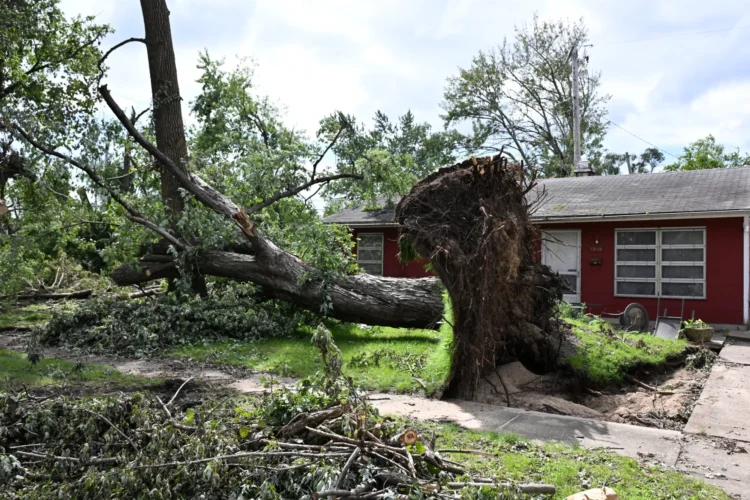
Brian Thiry, representing ReliabilityFirst, part of the broader company NERC that works to ensure a reliable energy grid, was the first to put numbers to the damage. In the aftermath of the derecho, 1,500 wood poles were in need of replacements. One 345 kilovolt transmission line, a steel tower that acts as an interstate of energy, sustained severe damage. The current infrastructure in place, Thiry said, is designed to withstand up to 94 mile-per-hour winds, not the 99-plus speeds witnessed in August.
Constant adverse weather conditions and debris-blocked roads prevented many linemen from safely making repairs. Ryan Baker, president of USW Local 12775 (part of United Steel Workers), said members worked thousands of hours of overtime, many on the job for 16 hours at a stretch, some up to 24. In an isolated incident, two workers were put under gun fire while working repairs.
Eddie Melton, mayor of Gary, said the city has picked up 280,000 cubic yards of tree debris, costing $8 million—with more cleanup still needed.
What went wrong
Derechos, typically occurring in the summer, have steadily increased in frequency over the last decade; in the past, they happened every five years or so but now take place every two. They’re expected to become even more regular, according to Chavas. Although he said there is no known explanation for the increase, it prompted some lawmakers to question if climate change is to blame. Committee members consequently debated how to avoid another weeks-long outage in the instance of the next derecho and asked what went wrong this time.
Failing to manage vegetation is a possible answer. Utilities are expected to maintain and trim the trees and greenery within a certain perimeter of infrastructure. Mismanagement carries a hefty fine in Indiana of up to $1 million a day. Utilities face annual inspections with no more than 18 months between them, and inspection frequency changes depending on circumstances—for example, an increase in dead trees from invasive species, Thiry said.
Falling trees were a factor in power outages, but it was unclear whether the magnitude was from mismanagement or the storm’s severity. NIPSCO said with how severe the storm was, it wouldn’t have mattered how well vegetation was managed. The same question arose regarding the integrity of the current infrastructure.
Rep. Bob Morris, R-Fort Wayne, asked if the 1,500 damaged wooden poles could have been avoided had the IURC invested in ones that were steel.
Baker pointed out that the number of linemen has decreased, stretching NIPSCO’s workforce thin and forcing the company to rely on outside contractors with employees that need training to meet state expectations and standards. He said that the utilities need adequate “native staffing” to meet customer needs.
Across the hours of testimony, some scrutinized alternative interests from NIPSCO and its partners; one testifer said that, backed by powerful lobbyists, they write their own legislation, something Soliday was quick to rebuke. A Gary resident questioned why financial relief was so difficult considering the state’s $1.86 billion surplus and $4 billion in reserves from the last fiscal year. NIPSCO said it donates roughly $2 million to three different agencies that work locally to help customers in need after power outages, but there is no direct reimbursement for the food and medication lost without refrigeration.
What’s next
NIPSCO has already committed to reporting on the findings of an internal review examining its response to the Aug. 11 power outages.
Long before testimony even began, the committee voted unanimously on its recommendations on legislation for next session. This would include requiring IURC utilities to establish written procedures for preparing for and restoring service to customers after an interruption emergency and update those procedures every year. Secondly, legislation would require the IURC to conduct a field audit of vegetation management every other year.
Several lawmakers shared they’re already making adjustments in preparation for the next outage, including checking the viability of their generators and storing nonperishable food.
“Our residents deserve to know what happened, why it happened and what will be done differently next time,” Melton said.