By Amelia Angelone
The Purdue Exponent
September 18, 2026
WEST LAFAYETTE – Over two centuries after the founding of the United States and the writing of its foundational documents, much has changed for our present-day democracy. Though, Professor Richard Pildes says there are still changes that could be made to better represent the people of 21st-century America.
Pildes, a professor in constitutional law at the New York University School of Law, was chosen as Purdue University’s Program on American Institutional Renewal speaker for this year’s Constitution Day.
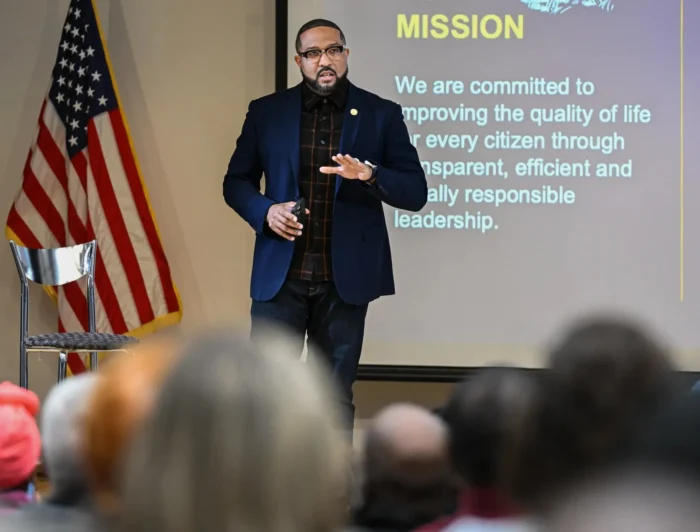
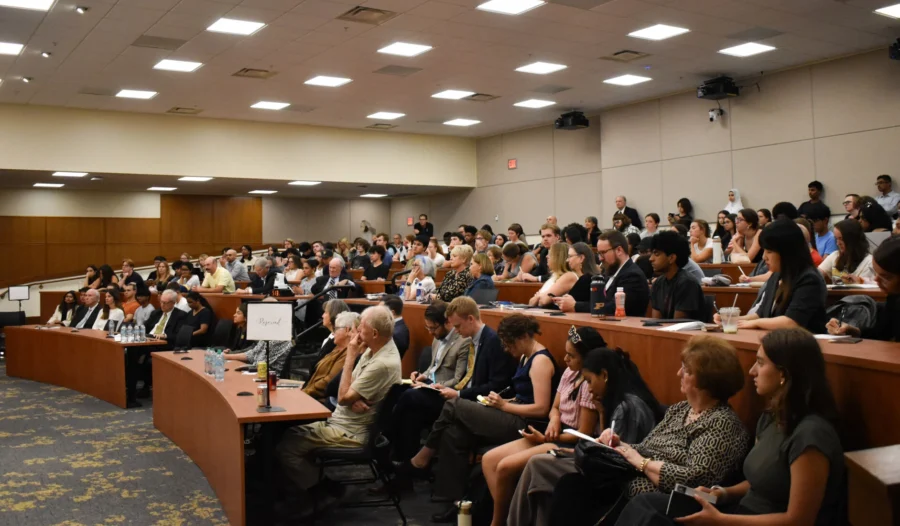
With decades of both academic and practicing experience in law and policy, Pildes gave a lecture in Pfendler Hall for Purdue students, local leaders and members of the Greater Lafayette community about how American political institutions can be revived.
“We have always reformed our institutions to make them more responsive to what people want, and we’re in a moment where we need to think seriously about political reform to make the system more responsive to political minds and health,” Pildes said.
During his lecture, he proposed a series of ideas which he posits could help combat the “toxic and tribalistic” political culture America faces today. While the country’s institutions were initially formed to represent the people, Pildes cited a Gallup poll stating only 15% of Americans currently approve of the job Congress is doing.
“Few of us 250 years later (from the country’s founding) are happy with the state of American democracy right now,” he said. “When democratic governments appear incapable of delivering effective policies on major issues, it can lead to anger, distrust, the kind of dissatisfaction with government we see.”
Pildes attributes the gridlocks and lack of compromise in Congress to a political system which he says currently favors the extreme candidate who is able to gain attention, outrage and online donations.
His first proposal to improve the current political system was to change how primaries work. He suggested that they are representative of a much smaller number of voters than general elections, and they are also representative of voters which tend to lean towards more extreme ends of the political spectrum.
“The traditional party primary, controlled by this small unrepresentative electorate, has become a significant source that fuels the rise and success of more ideologically extreme candidates,” Pildes said.
In order to cater to these more polarized voters, he says elected officials may become less likely to compromise to avoid a challenger in future primaries.
His proposed solution: an “all-candidate primary” where voters can vote across partisan lines and better show the desires of a state’s constituency.
“Given the dissatisfaction so many voters have with how our political system is functioning. I think the possibilities for voter-supported reform remain plausible,” Pildes said, noting the implementation of all-candidate primaries in states like Alaska.
His second proposal was to implement “instant runoff” or ranked choice voting. In this reform, Pildes said it’s easier to see whether candidates actually have majority support, or if it’s just a matter of plurality.
“You can think of instant runoff voting as like a traditional runoff election, in which if no candidate wins a majority, there’s a second round in which the top two candidates then compete head to head,” Pildes said. “That’s a different way of ensuring that the winner has majority support, not factional support.”
This system, which Pildes says was initially enacted to prevent extremist candidates from taking office, has already been implemented on the national level in other countries like France.
However, he recognized the turnout for runoff elections like those seen in France tends to be much lower than the general election in the U.S., suggesting an “instant runoff” election, where voters rank their choices of candidates during a single election day.
“Voters rank candidates in order of preference, and then as candidates are eliminated, the voters’ vote on that ballot is transferred to the voter’s second ranked preference,” Pildes said.
Ranked choice voting, he says, has already been implemented in almost 50 cities across the U.S., though some red states — including Indiana — have banned this election process.
“I’m not sure why this has become more of a partisan issue in recent years, except perhaps because a Democratic candidate benefited in a couple of the very first sort of high-profile races under the system,” Pildes said. “The issue has become as polarized as many of the other issues are in our politics today. But there’s no reason instant runoff voting should favor one party and the other.”
His third proposal is to look into the design of districts, something he has worked on extensively and even argued on before the U.S. Supreme Court.
While understanding and preventing gerrymandering is important, Pildes says there is more to understanding the design of election districts than gerrymandering. He says reflecting on whether a district is truly competitive in its election is also of great importance to understanding the role districts play in which candidate is elected.
“From the early 70s to the early 90s, about a third of congressional districts were competitive,” Pildes said. “These days, it’s about eight to 10 percent, and yet constructing election districts to be competitive, where possible, is another aspect of institutional design that I think can help reduce polarization and extremism.”
Competitive districts are districts where candidates are likely to take 55% or less of the vote, leading to districts where Pildes says candidates have to work to win over voters to take the election.
This can prevent extremism, he said, by requiring candidates to consider the votes of centrist voters rather than leaning into extreme sides of their party’s ideology.
“In competitive seats, candidates know they have to compete to win in the general election. They know they must win over enough voters in the center who might swing to either party, while also holding on to their core base. If they move too far toward the wings of their party, they risk losing the centrist voters they need to win,” Pildes said.
His final proposal is to better understand the realm of campaign finance and how “small donors” from online platforms can lead to more polarization in elections.
“Individual donors are much more ideologically extreme on both sides than Americans as a whole, … and affluent donors are even more ideologically extreme than affluent voters of the same party who don’t donate,” Pildes said. “The rise of small donors to the internet over the last five to 10 years has made this (political polarization) even worse.”
He says that some candidates may lean into this polarization and use the internet as a tool for outrage and thus collect donations from these smaller, more polarized donors.
Candidates may feel as though they have to cater to these donors, thus allowing additional polarization into otherwise more moderate campaigns.
“The more outrage you can create, the more attention you’ll get, the more that will turn on the spigot of small donors. Many of the more extreme positions and tactics you find from politicians, these performative politicians, are designed precisely to turn on that spigot from small donors,” Pildes said.
Private finances, PIldes said, encourage greater polarization, so he believes finances should be wholly granted by parties rather than private voters.
“It’s important to stress that well-designed systems of public financing would reduce the weight of individual donors and help mitigate polarization and extremism, and maybe also reduce the flood of emails and texts you get from the campaigns asking for money,” Pildes said.
While many Americans remain dissatisfied with the condition of the political system in the present day, Pildes says it’s important to remember change has happened since the writing of the Constitution in 1787 and change can continue to happen today, if people are willing to work to improve the political climate.
“It’s very important for people to participate, and if they want the system to change, they have to participate,” Pildas said. “They have to avoid a disillusionment that leads them to withdraw.”
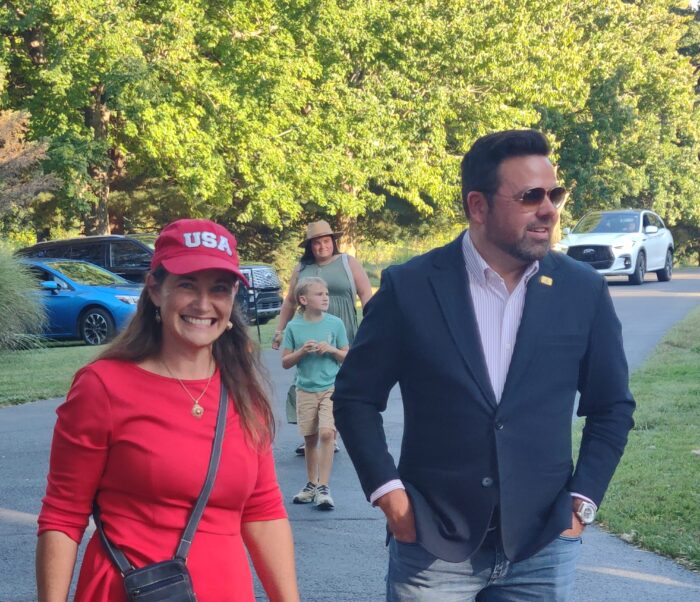
Attending politicians voiced agreement with Pildas. Indiana Secretary of State Democratic candidate Beau Bayh said he hopes to see change in the current political system.
“The more voices in our democracy the better,” Bayh said. “We need more people having their voices heard.”
The Purdue Exponent is the independent student media organization serving the Purdue University community. It is published by the Purdue Student Publishing Foundation, a non-profit educational organization. For questions about the story, contact editor-in-chief Avery Goldthorpe at editor@purdueexponent.org.