By Sydney Byerly
The Indiana Citizen
July 23, 2026
For years, relationships connecting many of Indiana’s faith traditions have existed quietly: clergy members meeting over coffee, nonprofit leaders collaborating on community needs and advocates looking for ways to build trust despite theological differences.
Those relationships are rarely visible until a moment of conflict brings them into public view.
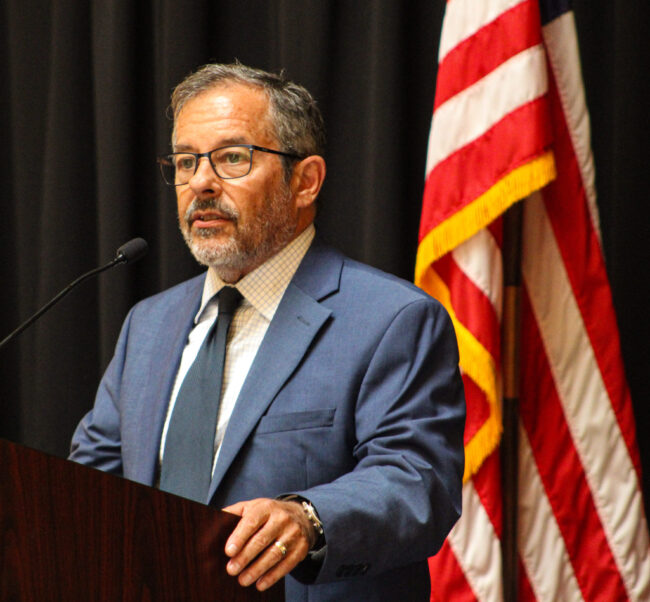
That happened this summer after Lt. Gov. Micah Beckwith’s repeated attacks on Islam was met with strong criticism from Muslim advocates and other faith leaders. Organizations, including the Greater Indianapolis Multifaith Alliance, Concerned Clergy of Indianapolis and the Indiana Muslim Advocacy Network, publicly responded with statements condemning the Republican lieutenant governor’s remarks. They also gathered for a Statehouse rally to petition Gov. Mike Braun to reaffirm religious liberty protections and take steps to shift faith-based initiatives out of Beckwith’s purview.
While each group approached the controversy from a different perspective, their responses reflected something less visible: a network of relationships that had been built long before those groups stepped into the spotlight to condemn Beckwith’s remarks.
“I think maybe we’re seeing more activity,” said Maliha Zafar, executive director of the Indiana Muslim Advocacy Network, “not because these interfaith groups haven’t been here in the state, but maybe because we’re feeling more obligated to stand together.”
The Center for Interfaith Cooperation, for example, focuses less on advocacy and more on helping people navigate religious differences before they become sources of conflict.
Rev. Erin Hougland Glass, the center’s executive director and a former priest at Trinity Episcopal Church in Indianapolis, said its programs bring together religious leaders, nonprofit organizations, educators, public officials and people with no religious affiliation to better understand different belief systems and learn how to have difficult conversations despite their differences.
Unlike some faith-based organizations, Hougland Glass said the center does not see itself as a political advocacy group.
“We are not lobbying in the Statehouse. We are not pushing any political agendas,” she said.
Instead, she described the center’s work as a long-term educational effort designed to help people understand different religious and moral frameworks while building the skills to engage respectfully when disagreements emerge.
The center does make public statements in some circumstances, Hougland Glass said, particularly when religion is used “as a weapon” or when religious communities face harassment, violence or dehumanizing rhetoric. Beckwith’s comments about Islam met that threshold, she said.
That distinction illustrates the different roles organizations play within Indiana’s faith landscape. Some focus on creating relationships across religious traditions. Others organize around specific community issues or advocate for particular religious communities when public policy or political rhetoric affects them.
Rabbi Aaron Spiegel, executive director of the Greater Indianapolis Multifaith Alliance, said the organization grew out of a research project on civil dialogue before launching in Indianapolis in 2018. Faith leaders from different traditions identified shared community concerns, eventually making housing and eviction prevention one of the group’s primary areas of work.
Today, the alliance hosts monthly “Sacred Friends” gatherings. The goal, Spiegel said, is not necessarily agreement.
“We’re not all about finding commonality and the kumbaya moments,” he said.
Instead, the organization tries to create enough trust that people can disagree while continuing to work together.
“If GIMA could do nothing but catalyze relationships, I’d be satisfied,” Spiegel said.
Concerned Clergy of Indianapolis represents another part of that ecosystem of interfaith coalitions.
Although the name suggests an organization made up entirely of pastors, President David Greene said only about 30% to 40% of its members are clergy. The rest are business leaders, community advocates and residents committed to civil rights and issues affecting marginalized communities.
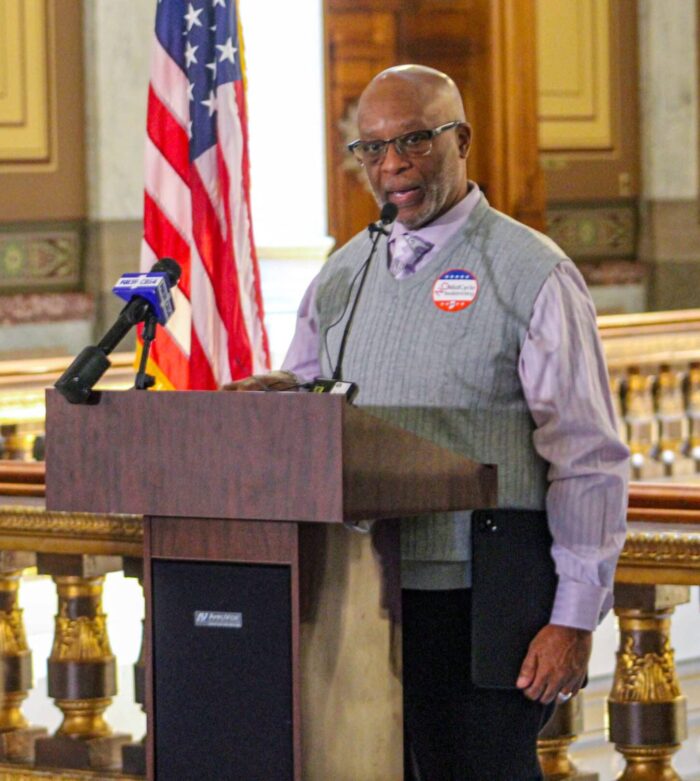
The organization focuses on housing, health care, education and economic opportunity.
Greene, who has been involved with Concerned Clergy for about 20 years and has served as its president for roughly a decade, said its work is rooted in the belief that faith communities have responsibilities beyond their own congregations.
“For clergy that get involved, they understand that the church is outside the four walls,” Greene said. “It’s about how we can impact the lives of people.”
The organization does not “swing at every ball,” Greene said.
Instead, members decide whether an issue significantly affects the community and whether their voice could make a meaningful difference.
For Greene, that often means building coalitions rather than acting alone.
“I believe for success, it involves a broad coalition,” he said. “I think it’s extremely hard to be successful against the fights that we’re engaged in in a silo fashion.”
Those connections become especially important when a controversy involves one particular religious community.
Following Beckwith’s comments about Islam, Greene said the question became not simply whether Muslims would respond but whether other communities would stand beside them.
“Are there other people standing with the Muslims?” he said. “Is the Jewish community standing? Is the Black Church standing?”
The goal, he said, is not about winning an argument.
“At the core, we just want to strengthen the community,” Greene said. “Our compassion isn’t partisan.”
For the Indiana Muslim Advocacy Network, those relationships become especially important when Muslims are targeted directly, as Beckwith has in recent weeks.
Zafar described IMAN as a statewide advocacy organization that monitors legislation and public policy affecting Muslim Hoosiers and other minority communities. Its work includes issues involving religious freedom, immigration, free speech and church-state separation.
But Zafar said interfaith relationships are not built only around legislation. They also grow through community service, educational events and years of collaboration among leaders from different faith traditions.
When one religious community becomes the target of criticism or discrimination, she said, those relationships help determine how others respond.
“When a specific faith group is targeted, we’re going to the people who are taking their lead,” Zafar said. “We’re asking them what they need.”
The increased visibility of these organizations raises a broader question: Are Indiana’s faith networks expanding, or are longstanding relationships simply becoming more visible?
Zafar said organizations focused on interfaith cooperation have existed in Indiana for years. But she said recent controversies involving religion have created more urgency around those relationships.
Hougland Glass said Indiana’s growing religious diversity is also encouraging more people to engage with those outside their own faith.
One of the biggest misconceptions about interfaith work, she said, is that it asks people to water down their own beliefs. Instead, she said, learning about other faith traditions often deepens people’s understanding of their own.
“Just because someone doesn’t have a membership to a gym doesn’t mean they don’t have a physical body,” Hougland Glass said. “And just because you don’t belong to a religious tradition does not mean you don’t have a value system and a moral system, or a system of belief that helps inform what matters to you most.”
Greene said he has seen a similar shift. As more faith communities become involved in public debates over identity, policy and religion, he said more organizations are recognizing they cannot operate alone.
“Most of these organizations have decided we’re stronger together than we are apart,” Greene said.
Sydney Byerly is a political reporter who grew up in New Albany, Indiana. Before joining The Citizen, Sydney reported news for TheStatehouseFile.com and most recently managed and edited The Corydon Democrat & Clarion News in southern Indiana. She earned her bachelor’s in journalism at Franklin College’s Pulliam School of Journalism (‘Sco Griz!).
The Indiana Citizen is a nonpartisan, nonprofit platform dedicated to increasing the number of informed and engaged Hoosier citizens. We are operated by the Indiana Citizen Education Foundation, Inc., a 501(c)(3) public charity. For questions about the story, contact Marilyn Odendahl at marilyn.odendahl@indianacitizen.org.