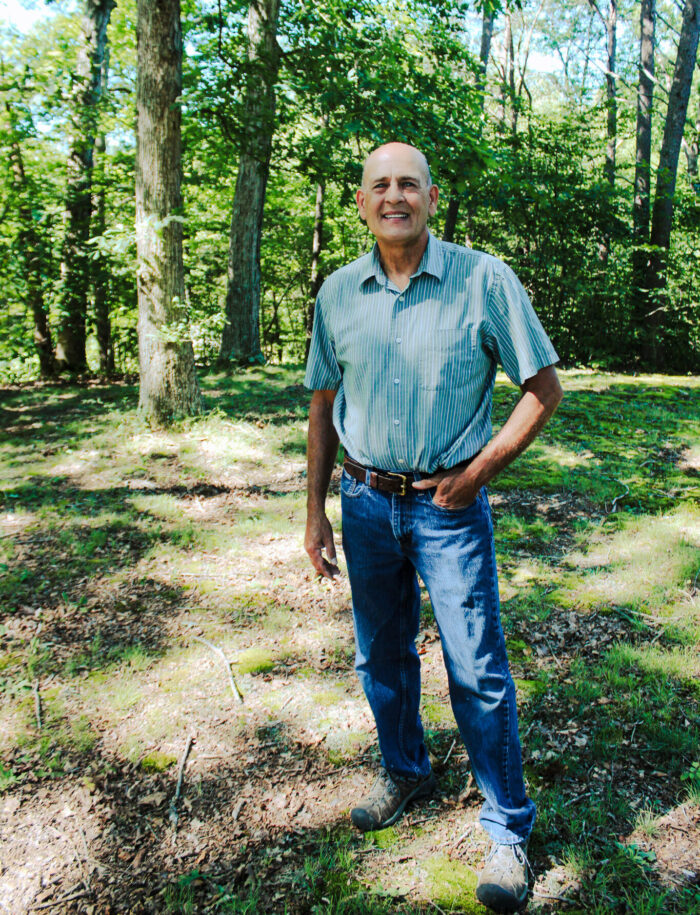
Sen. Gary Byrne, R-Byrneville, tends to the cattle on the Harrison County farm that has been in his family for more than 200 years. (Photo/Sydney Byerly)
By Steve Hinnefeld
The Indiana Citizen
July 15, 2026
Micah Beckwith has a talent for making headlines, engaging in fights on social media and stirring up outrage. When it comes to changing policy? Not so much.
Indiana’s lieutenant governor, an avowed Christian nationalist, listed a half dozen bills that he wanted to see passed at the start of the 2026 legislative session. None became law. He was an outspoken advocate for redrawing Indiana’s congressional districts before the 2026 midterm election, which also failed.
Sen. Gary Byrne isn’t always in the news, but he has a talent for getting things done. In his first term as a legislator, he has advanced bills to limit diversity and sexuality education, ban gender-affirming care for minors and move Indiana toward partisan school board elections. In the 2026 session, he authored 10 bills, and seven of them passed.
The Byrneville Republican, who represents Senate District 47, is a farmer and small-business owner. He doesn’t explicitly identify as a Christian nationalist, but he has arguably done more for Christian nationalist priorities than any other government official in Indiana.
“Gary is really good at persuading people,” said Scott Fluhr, chair of the Republican Party in Harrison County, where Byrne lives. “Politics is the art of the possible. It’s easy to introduce a bill that gets a lot of attention. It’s harder to get it across the finish line.”
Sen. Gary Byrne served on the North Harrison School Board and the Harrison County Council before becoming a state legislator in 2022. (Photo/Sydney Byerly)
Byrne, 64, has been a member of the Indiana Senate since 2022. Representing a rural district far from Indianapolis, he may seem an unlikely leader for the conservative movement. But he believes in the cause, supporting low taxes, local control and limited government.
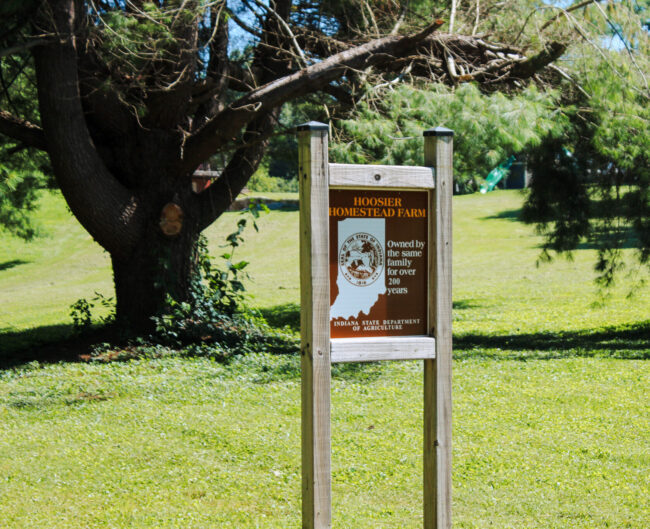
“I consider myself a Christian conservative,” he said in an interview at the 130-acre farm that has been in his family for over 200 years. “And I’ll be straight up with you. I never dreamed I’d be a state legislator. It wasn’t on my radar.”
Byrne got his start in politics on the local school board. He served one term, lost a re-election bid, then came back and was elected to the board again two years later. Next, he spent four years on the Harrison County Council; he ran for re-election but lost. When a two-term state senator resigned, a Republican caucus chose Byrne to replace her.
Amiable and self-effacing, he is the right’s happy warrior. He enjoys talking with people, even when they disagree with him. He’s usually smiling. But his legislation often makes his political opponents grind their teeth. He has fanned the culture-war flames with bills focused on LGBTQ+ rights, diversity, sexuality education and other divisive issues.
Byrne can easily summon arguments and talking points from right-wing advocacy groups and media. He was a devoted listener of Rush Limbaugh, who died in 2021. He now follows right-wing broadcaster Mark Levin and other media provocateurs.
“I’m a Rush baby,” he said with a grin, recalling how, when working, he would eat lunch in his truck so he could listen to the broadcaster.
Byrne grew up on the family farm near Byrneville, a cluster of homes on Whiskey Run Road named for a relative. His grandparents lived next door. He developed a work ethic at an early age, working in the fields, tending livestock and cutting tobacco. His best job, he said, was working as a lifeguard at Buffalo Trace Park, where he met his wife.
He figures he’s one of the few Indiana legislators without a college degree. He attended Indiana University Southeast for a year, dropped out, got married, and started a small business.His wife, Angela, helps with Byrne Inc., which started out installing home satellite systems and later included video rental and security systems. She also serves on the local school board.
They have three sons – two live nearby and one across the Ohio River in Kentucky – and nine grandchildren.
On a recent afternoon, Angela was driving their youngest son and his family to the Louisville airport. They were flying to Kenya, where Byrne’s daughter-in-law grew up. For their young, biracial grandchildren, it would be the first time to meet their African grandparents.
When his own sons were young, Byrne got involved in running a youth baseball program. That led to an interest in the North Harrison Community School Corp.; he was concerned about a plan to renovate a poorly designed building and an impasse over the local teachers’ contract. He was elected to the school board in 2006. But he lost when he ran for re-election in 2010. After a two-year hiatus, he was elected to the board again.
In 2016, he was elected to the Harrison County Council. He lost a re-election bid four years later. Local critics said he has consistently “failed forward.”
Sen. Gary Byrne’s ancestors established the family farm in Harrison County in 1808 – eight years before Indiana was admitted to the Union. (Photo/Sydney Byerly)
‘Not a fan’ of teachers’ unions
Byrne was on the school board at a time of instability. The district went through a string of superintendents, and Byrne and other board members clashed with the North Harrison Classroom Teachers Association, the teachers’ union. Teachers went eight years without a new contract. Money was tight, insurance was an issue, and teachers were laid off.
Byrne had an ally in Phil Partenheimer, who spent two years as North Harrison superintendent and left in 2008 to head the Wilson Education Service Center. Partenheimer called Byrne a “pro-learning educator,” who supported his focus on the basics.
“We’re here to teach the kids the state standards,” Partenheimer said. “A gay flag in the classroom, you don’t need that stuff. You don’t need a Confederate flag in the classroom.”
Byrne said the board was looking out for teachers by holding the line on spending. He said budget problems were preventing raises for new teachers and risking more layoffs.
Dan Haskell, a middle school math teacher who spent several years as president of the union, remembers Byrne’s tenure differently. “Unfortunately, after he got elected, his whole focus seemed to be on keeping taxes low as possible,” he said. “No matter how low it was, Gary was always pushing to drop it lower and lower.”
Haskell said local education conflicts revolved around taxes and spending. The culture wars that would eventually sweep across schools were years in the future. But Byrne said his school board experience influenced his penchant, as a legislator, to take on issues like diversity and sex education. The experience also left him suspicious of teachers’ unions.
“I’m not a fan,” he said. “I think that, in my personal belief and witnessing of this, the unions are there for the adults, and not necessarily all the adults.”
In a video for the Foundation for Government Accountability, a conservative advocacy group, Byrne says the U.S. used to be “the top of the world” in education, but its status declined because of the rise of unions and creation of the U.S. Department of Education.
The Byrne family farm in Harrison County is home to Sen. Gary Byrne and his wife along with two adult sons and their families. (Photo/Sydney Byerly)
After losing his county council re-election race in 2020, Byrne said he “was sitting around doing nothing. I said, well, something will come up.” It did. Erin Houchin, a Republican from Salem, resigned from her state Senate seat in February 2022 to run for Indiana’s 9th Congressional District seat. A Republican caucus chose Byrne to replace her. He immediately faced a contest in the May 2022 primary. Republican Kevin Boehnlein had been appointed to a different Senate seat. Redistricting had put them in the same district.
“I wasn’t supposed to win,” Byrne said. “I had zero dollars when I was finishing the session. I mean, I had never raised a dime in my life.”
Boehnlein, who had funding from the Indiana Chamber of Commerce, outspent Byrne by nearly 10-to-1, according to campaign finance records. Byrne won with 54% of the vote. Fluhr said Byrne ran an energetic campaign. “Gary believes in hard work,” Fluhr said. “As a small-business person and a candidate and an elected office holder, he will work hard.”
He recalled a mailer that showed Byrne dressed in farm clothes with the slogan “Country, not country club.” The approach resonated in rural stretches of the district, which includes Harrison and Washington counties and part of Floyd County.
District 47 once leaned Democratic. Democrat Frank O’Bannon represented it until he was elected lieutenant governor in 1988, then governor in 1996. The O’Bannon family owned the local newspaper, the Corydon Democrat, until four years ago.
But party alignment flipped in rural Southern Indiana during the Obama years. In the 2022 general election, Byrne got two-thirds of the vote against Democrat Katie Forte. He’s heavily favored to win this year against Democrat Ethan Sweetland-May.
Adapting to the Statehouse
Byrne likes to portray himself as a fish out of water in Indianapolis. He said he had never been to the Statehouse prior to 2022. On his first visit, unfamiliar with downtown, he parked blocks from the building and got soaked in a rainstorm.
That summer, he supported and voted for Indiana’s strict ban on most abortions, enacted in a special session after the U.S. Supreme Court overturned Roe v. Wade. His Senate biography boasts of awards he has received from Indiana Right to Life.
Byrne jumped head-on into the culture wars in 2023. With Sen. Tyler Johnson, R-Leo, he authored Senate Bill 480, which outlawed gender-affirming medical care for minors.
Opponents said the bill was a cruel attack on transgender children and their families. They said gender-based surgery was not performed in Indiana, and they argued that treatments such as hormone therapy was sometimes necessary. Byrne stood firm.
“I think it’s harmful to our children,” Byrne said. “It still shocks me to hear some of the testimony, that we had hospitals willing to mutilate our children chemically. To me, that was an evil, harmful thing that we should have banned, and I’m glad to be supportive of that.”
Byrne said gender dysphoria, a mismatch between a person’s gender identity and their assigned sex at birth, is a “mental disorder” that nearly all children outgrow.
Advocates push back against that view. Matthias Beier, a professor at Christian Theological Seminary in Indianapolis and a pastoral psychotherapist who works with individuals, couples and families, said families understand when gender-affirming care is appropriate.
“Families are wrestling with these decisions,” he said. “Trying to say this is a leftist, woke agenda is just not what I see on the ground.”
The American Civil Liberties Union of Indiana challenged the law in a class-action lawsuit but dropped the challenge last month after encountering setbacks in federal courts.
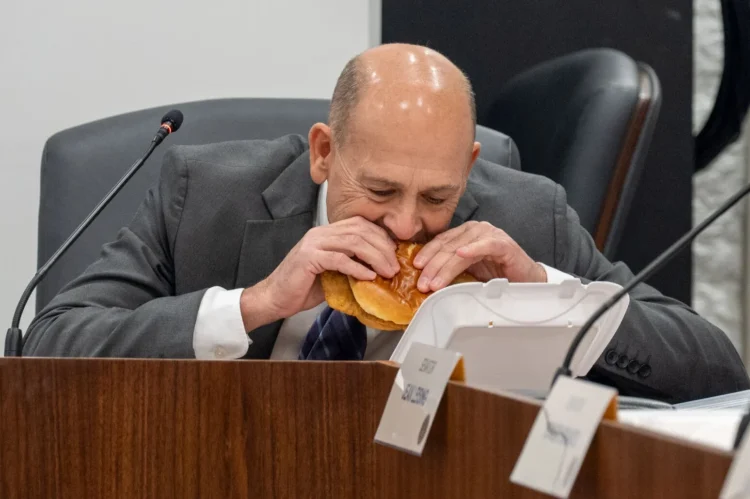
Sen. Gary Byrne sampled a pork tenderloin during a January 2026 legislative committee hearing when a bill to make the Indiana staple the official state sandwich was under consideration. (Photo/Connor Burress of TheStatehouseFile.com)
Also in 2023, Byrne was a Senate sponsor of House Bill 1608, a so-called “don’t say gay” law that restricted sexuality education in schools. In 2025, His Senate Bill 442 imposed more limits on sex education, requiring schools to get parent permission and post materials online.
He said the impetus came from a teacher who objected to university-prepared curricular materials that included gay and lesbian characters and themes. He said such materials were offensive to Christian families that consider homosexuality a sin.
“That’s what I consider part of that indoctrination,” Byrne said. “I mean, our universities are indoctrinating these teachers to teach this indoctrination.”
Byrne initially tried to remove from SB 442 a requirement that schools teach “the importance of consent to sexual activity,” drawing an outraged response from House Democrats. A Facebook video of the exchange in the spring of 2025 was viewed over a half million times, and Byrne relented before the bill was passed and signed into law.
2025 was a good year for Byrne’s legislation. Senate Bill 287 accomplished a conservative goal of bringing partisanship to school board elections. As introduced, it would have required candidates to be nominated in party primaries and run with a party label. As approved, on a 26-24 vote in the Senate, it made party affiliation optional.
Senate Bill 289 took aim at practices supporting DEI, or diversity, equity and inclusion. It eliminated programs to promote diversity in colleges and universities and imposed restrictions that appeared to target instruction on institutional and historical racism in the U.S.
This year, Byrne’s Senate Bill 88 requires state universities to accept scores on the Classic Learning Test, a conservative college-admissions exam, on an equal basis with the SAT and ACT. The bill also adds the so-called success sequence to K-12 citizenship instruction: that young people should finish high school, work full time and marry before having children. As introduced, it would have included the Ten Commandments in a list of documents to be taught in Indiana’s required middle-school civics curriculum; that language was removed from the bill.
Senate Minority Leader Shelli Yoder, D-Bloomington, who has served with Byrne on the Senate Education and Career Development Committee, did not respond to a request for an interview.
Supports trend to vouchers, charter schools, trades
While Byrne’s education bills have focused on social issues, he’s a solid supporter of Indiana Republicans’ move to expand charter schools and private-school vouchers. That includes making vouchers available this year to all private-school students.
“I do support that,” he said. “I think those dollars should follow the child, and I don’t care what your economic status is.”
He likes Indiana’s recent shift to emphasizing career education and the value of trades. But he’s not happy that schools keep “squeezing” the summer, making it shorter. Students can best learn work skills, he believes, if they have summer jobs.
Byrne said he has had no qualms about introducing legislation on controversial topics and facing criticism for his principles. “None whatsoever,” he said. “I mean, when I knocked on doors to get elected in ‘22, those are the things I said I was going to fight for.”
His focus on social issues raises the question of whether he’s promoting Christian nationalism. He doesn’t embrace the label, but he doesn’t run from it.
State Sen. Gary Byrne is a self-described Christian conservative who promotes legislation based on a fundamentalist interpretation of Christianity. Does that make him a Christian nationalist? It’s probably the wrong question, according to experts on the topic.
“If it means that you have Christian beliefs, and you love our nation and think we live in the greatest nation in the world, if that’s what your definition is, count me in,” he said. But “I’m not a member. I don’t pay dues to be a Christian nationalist.”
In the interview, Byrne did express views that are associated with Christian nationalism. He said the Constitution is “based off of the Bible.” He said Supreme Court rulings that affirmed separation of church and state were misguided. He said Americans “lost our states’ rights with the 17th amendment,” which established direct election of senators.
At the same time, Byrne doesn’t wear his religion on his sleeve. He attended a Baptist church as a child but doesn’t affiliate today with a certain creed or religious organization.
“I believe in the Bible, the principles of what’s in the Bible, and I’ve looked to the Bible for answers,” Byrne said. “But I don’t have a particular church that I go to today.”
Beckwith, the lieutenant governor, had stirred up controversy when he called Islam a “demonic death cult.” Byrne wasn’t bothered by the comment, insisting it was intended to apply to what he calls “radical Islam.”
“I probably wouldn’t use those words, but what I believe he’s talking about is a concern,” he said. “There is radical Islam that wants to end the United States and Israel, and so I believe that’s probably what he’s talking about.”
Beckwith also said he hated Islam and celebrated that “we’re giving people permission to hate again.” Byrne wasn’t bothered by that comment, either. “For me, just a simple country boy talking, you hate the sin, but love the sinner,” he said. “If you’ve got a religion that hates the sin and hates the sinner … that’s radical Islam for me.”
‘Happy to be there’
Byrne has never lacked confidence, but he has grown more effective as a legislator. In his first full session, in 2023, he authored only six bills and two passed. In 2024, he authored nine bills and none passed. In 2025, he authored 20 bills and seven passed. This year, in addition to his seven bills that became law, he co-authored high-profile House bills on immigration and electronic devices in schools.
Byrne said the impetus for many of his bills comes from constituents. “I feel like I’m a conduit to people who I represent,” he said. But he admits that some ideas come from conservative groups like the American Legislative Exchange Council and the Foundation for Government Accountability. His 2025 anti-DEI bill was based on a model bill from the Pacific Legal Foundation, a Sacramento-based conservative/libertarian law firm that focuses on property rights, individual liberty and limited government. “Some of your best ideas are stolen,” he said.
Byrne says he’s willing to meet with any advocates and lobbyists. Even with the Indiana State Teachers Association, he’s listened to their objections and sometimes made changes to bills. He has compromised on partisan school board elections and other issues.
“Part of being successful is, I like to talk to people,” he said. “I’m happy to be there. You know, you can be opposed to one issue, but I’m not going to hold it against you, because maybe we will be together on the next issue.”
The ISTA confirmed it has met with Byrne but declined to comment for this story.
Sen. Gary Byrne successfully campaigned for the Indiana General Assembly on the slogan, “Country, not country club.” (Photo/Sydney Byerly)
Byrne traces his conservatism to his background: family, the land, growing up on a farm, working hard and starting and running a business, all factors he’s happy to talk about.
An ancestor migrated from North Carolina and established the family farm in 1808. Nearby Corydon was founded that same year; it would become the first state capital in 1816. Byrne and his wife and her mother live in a two-level brick home that he built on the farm in 1984. His father lives next door. His middle son and his family live in a third house on the property.
On an idyllic June morning, Byrne gave a reporter a tour, driving a four-seater ATV. A great blue heron swooped from a stock pond covered in lily pads. An Eastern kingbird danced along a fenceline. Byrne paused to move a wire fence, letting his herd of black baldy cattle move to fresher pasture.
“Right now, we’ve probably got about 28, 29 mama cows,” he said. “We’re going through calving season now, so I’ve got 10 calves.” One calf was born breech, a rare occurrence, and its mother died. “I’m having to bottle-feed it now in the barn,” he said.
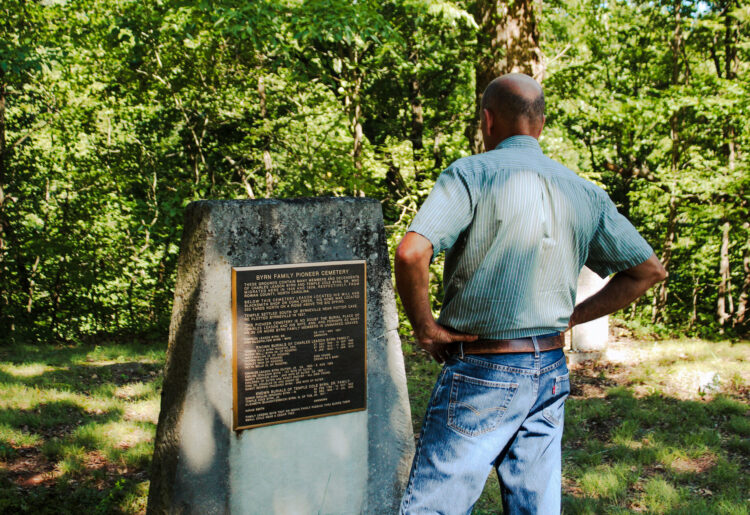
Wearing jeans, a short-sleeved shirt and work boots, Byrne drove over sloping pastures and through wooded ravines and creeks, and past a weathered barn. He paused at a small pioneer cemetery from the early 1800s and talked about ancestors who are buried there.
It’s a far cry from the Indiana Statehouse with its suits and ties, its frantic schedules, its noise and its deadlines. Byrne seems comfortable in both worlds.
Fluhr, the county Republican chair, thinks Byrne is living his best life.
“I think he’s going to keep doing what he’s doing,” Fluhr said. “He seems really happy with it. He cares about a lot of these issues, and he is able to get things done on them – to actually get legislation passed to advance the bill on a lot of these conservative issues.”
Steve Hinnefeld is a freelance writer based in Bloomington. He formerly was an adjunct instructor at the Media School at Indiana University, a media specialist at Indiana University and reporter for the Bloomington Herald-Times. He has had no affiliation with the Media School since spring 2022.
Dwight Adams, an editor and writer based in Indianapolis, edited this article. He is a former content editor, copy editor and digital producer at The Indianapolis Star and IndyStar.com, and worked as a planner for other newspapers, including the Louisville Courier Journal.
The Indiana Citizen is a nonpartisan, nonprofit platform dedicated to increasing the number of informed and engaged Hoosier citizens. We are operated by the Indiana Citizen Education Foundation, Inc., a 501(c)(3) public charity. For questions about the story, contact Marilyn Odendahl at marilyn.odendahl@indianacitizen.org.


 State Sen. Gary Byrne is a self-described Christian conservative who promotes legislation based on a fundamentalist interpretation of Christianity. Does that make him a Christian nationalist? It’s probably the wrong question, according to experts on the topic.