This story was originally published by Chalkbeat. Sign up for their newsletters at ckbe.at/newsletters
By Amelia Pak-Harvey
Chalkbeat
Sign up for Chalkbeat Indiana’s free daily newsletter to keep up with Indianapolis Public Schools, Marion County’s township districts, and statewide education news.
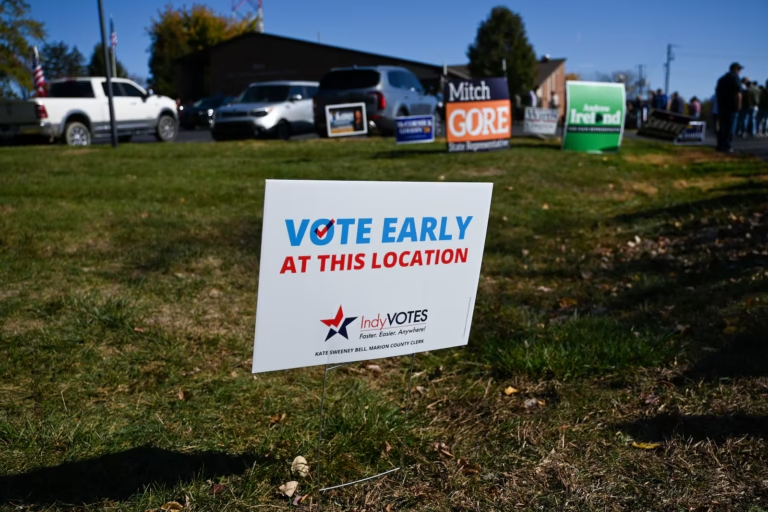
A plurality of school board candidates in central Indiana did not declare a party affiliation ahead of the general election in November, when school board races across the state will be partisan for the first time.
But those who did declare a party tended to declare themselves Republican, with about one-third of candidates identifying with the GOP in candidate filings.
In the nine-county region, about one-third of the 211 candidates are Republicans, while roughly 13% are Democratic and 9% are independent. About 45% of candidates did not declare a party affiliation. Incumbent candidates were more likely to identify as Republican or not have a party listed. Only incumbents in Marion County identified themselves as Democrats.
The filings for central Indiana could shed light on how political partisanship affects school board races. In Marion County, Democratic candidates outnumber Republican candidates. Yet in the more conservative counties that surround the state’s capital, Republican candidates outnumber Democratic ones.
State lawmakers approved partisan school board races last year despite significant opposition from educators and advocates who argued that partisan politics would disrupt inherently nonpartisan activities left to the school board, like selecting a superintendent and approving an annual budget. But some Republican lawmakers who backed the legislation said it would help voters support candidates who align with their values.
The new state law allows candidates to include a political party after their name, leave their political affiliation blank, identify as independent, or state that they do not identify with a party. But candidates who identify as Democrats or Republicans could gain a key advantage.
Under a state law adopted this year, the party whose candidate received the most votes in the county in the most recent election for secretary of state will be listed first on ballots. The party with the second-highest number of votes for that office will be listed second, followed by independent candidates or those affiliated with parties that did not have a secretary of state candidate. Finally, candidates who do not disclose any political affiliation will appear last.
That means in Democratic-leaning Marion County, for example, Democratic school board candidates will be listed before their Republican opponents. But elsewhere in the state, Republican school board candidates will be first on the ballot — which some research suggests could give them an advantage over other candidates.
The move toward partisanship comes as national political polarization has begun to affect state and local races that have typically been less partisan, said Michael Wolf of the Mike Downs Center for Indiana Politics at Purdue University Fort Wayne. In K-12 education, this shift has fueled divisive debates over book bans and mask mandates.
The change could have upsides and downsides, Wolf said. While fewer candidates may be interested in running in partisan races, more voters may cast a vote for school board candidates if they’re aware of the candidate’s party.
“One of the benefits, certainly, of partisan elections is that you probably would have more participation at least in people not skipping that race when they’re voting,” he said.
Some incumbents say voters have often wanted to know what political party school board candidates belong to.
When Zachary Smith Howard knocked on doors in his first bid for the Franklin Township Community School Corporation board in 2018, the most common question people asked him was his party affiliation, he said.
“I would tell people, ‘This is a nonpartisan race, but I identify with the Republican Party,’” said Howard, who is on the board of the Indiana School Boards Association but spoke to Chalkbeat in his personal capacity. “Most people don’t do the homework on the school board elections, they just don’t.”
Howard is seeking his third term as the sole candidate for the northeast portion of the district. But this time, he filed as a Republican.
Howard considers his Republican affiliation as just another piece of information for Marion County voters in Franklin Township to consider. But he also wishes voters would do more research on what candidates stand for, he said, because there’s more to a candidate than a partisan label.
“My fear is that people will just look at the label and that’s how they’ll make a decision,” he said.
In Westfield, the partisan school board law spurred Gabriel Crawford-Paree to run as a Democrat for the at-large seat on the Westfield Washington school board — even though he opposed making school board elections partisan.
“Filing as a Democrat is my shorthand way to signal to the likely many voters I won’t be able to reach during my campaign that I do support public education,” he said.
His opponent in Hamilton County, Republican incumbent Amber Huff Willis, said she’s seen voters struggle to understand why the school board races are nonpartisan when she’s run for her seat in the past.
Although she declared a party affiliation, she said lawmakers shouldn’t have introduced political partisanship into school board races because it shouldn’t matter.
“I would say nine out of 10 times if you’re involved in a community, you probably understand who does what and who falls where,” she said.
The general election is on Nov. 3.
Amelia Pak-Harvey covers schools for Chalkbeat Indiana. Contact Amelia at apak-harvey@chalkbeat.org.
Chalkbeat is a nonprofit news site covering educational change in public schools.