By Sydney Byerly
The Indiana Citizen
June 25, 2026
Republican state Rep. J.D. Prescott is hitting the road to pitch his plan to eliminate Indiana’s property taxes, while acknowledging that convincing lawmakers to give up a key revenue source will be a “monumental undertaking.”
Sixteen years after Indiana enacted constitutional caps on property taxes, the idea of phasing them out entirely is gaining steam with some Republicans. At the state GOP convention in Fort Wayne last weekend, the party amended its platform to support the elimination of property taxes. Lt. Gov. Micah Beckwith, a Republican, has long advocated such a move.
Still, even supporters of Prescott’s proposal to eliminate property taxes say they are skeptical of its chances of passage when state lawmakers reconvene early next year.
“I think it’s a well-thought-out bill that has no prayer of surviving the legislature,” said Dan Stock of McCordsville, who attended a town hall Prescott hosted Tuesday night at Glendale Public Library in Indianapolis.
His proposal is also drawing stiff opposition from those concerned about how remaking the state’s tax system to eliminate a key source of local funding would affect schools.
Lauren Lai of Indianapolis, who has two children in public schools, said she attended to better understand how schools would be funded under the proposal.
“I wanted to hear the plan because I’m worried about it,” she said. “Who’s going to bear the brunt of the cost?”
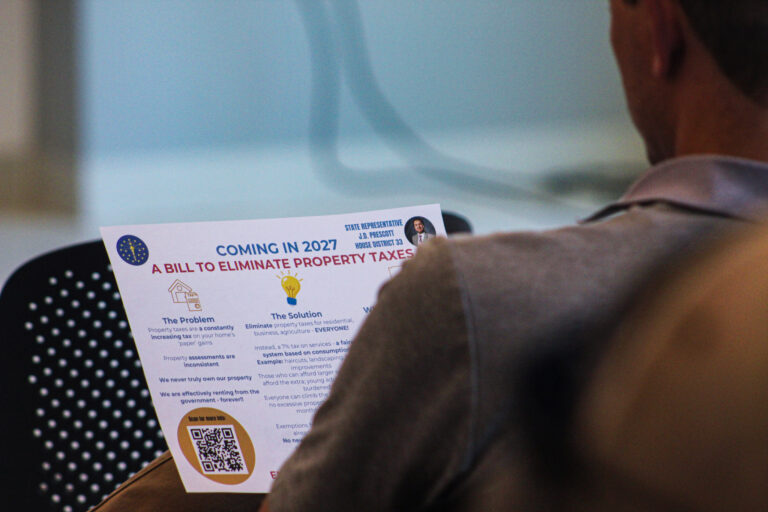
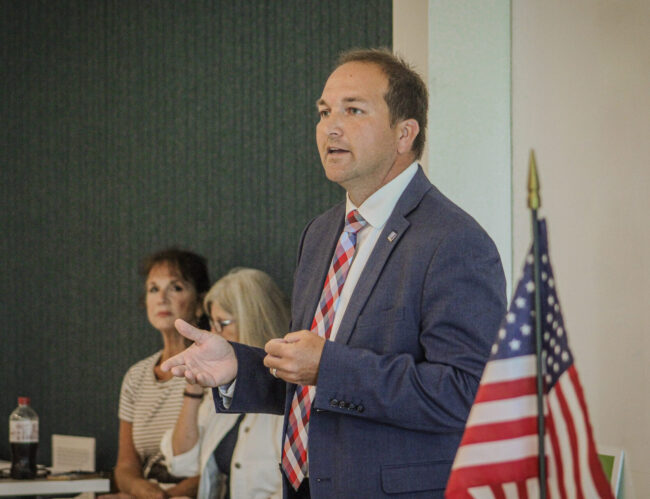
Prescott, of Union City, is holding a statewide tour to attempt to sell Hoosiers on his proposal to eliminate Indiana’s property taxes and replace them with a 7% sales tax on services.
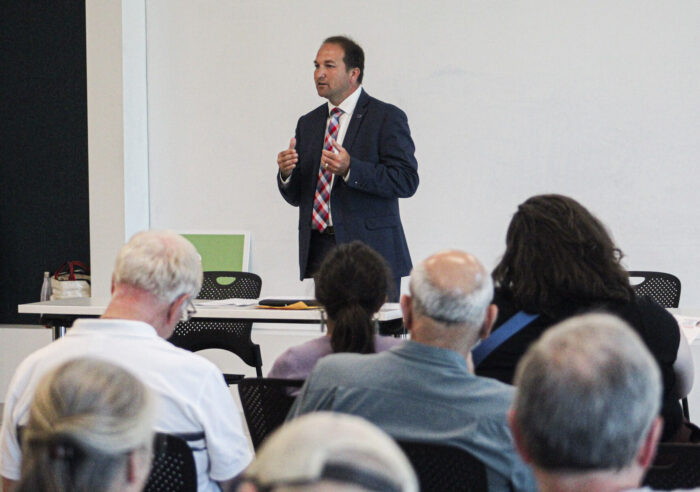
He outlined the plan during a stop at Glendale Public Library, framing it as a response to what he described as long-standing shortcomings in the state’s approach to property taxation.
Prescott said he intends to reintroduce the proposal next session if reelected, arguing that Indiana’s current property tax system unfairly taxes homeowners as property values rise and creates uncertainty for both taxpayers and local governments.
“Property taxes are broken,” Prescott said during the roughly 90-minute town hall.
Under his proposal, property taxes on residential, agricultural and commercial property would be eliminated and replaced with a broadened sales tax applied to services such as haircuts, legal services, landscaping, construction labor and vehicle maintenance. Health care, education and other categories currently exempt from Indiana sales tax would remain exempt.
Prescott said he understands property tax reform has been debated for years, but argued that previous changes have failed to address what he sees as real issues.
“Every time a change is made or proposed, it’s basically tried to put a Band-Aid on symptoms versus treating the underlying symptom,” he said in reference to rising assessments and unpredictable tax bills.
He encouraged attendees to share feedback with legislators, business groups and professional organizations, noting that previous proposals to eliminate property taxes have never received a legislative committee hearing.
“I’m not trying to give false hope,” Prescott said. “It’s a monumental undertaking. If people like it, I’ll try to push full steam ahead.”
The Indianapolis event was the third stop on Prescott’s tour, with previous meetings in Frankfort on May 21 and in Seymour on June 9 with Republican state Reps. Mark Genda and Jim Lucas, respectively. Another stop is scheduled for July 1 at the Elks Golf Club in Muncie.
The proposal would also, according to Prescott, make Indiana the first state in the nation to eliminate property taxes entirely.
It would significantly restructure how local government is financed and administered. A fiscal analysis from the Legislative Services Agency found the plan would eliminate county and township assessor offices over time, prohibit new property tax-backed debt and phase out tax increment financing districts after passage.
Business-to-business services — such as accounting services between firms, consulting contracts, or equipment maintenance agreements between companies — would also be subject to the tax, expanding the scope of taxable transactions in a way that could affect costs throughout supply chains.
A fiscal analysis of a prior version of Prescott’s legislation estimated the expanded sales tax on services could generate between $13.7 billion and $15.9 billion annually, compared with roughly $10.6 billion in property tax revenue. The analysis noted uncertainty around revenue distribution and potential changes in consumer behavior.
Prescott acknowledged the proposal faces steep political hurdles.
“Not one legislator can get a bill through on their own,” he said. “The only way this is going to work is if it gets grassroots support all through the state.”
Under current state law, Indiana distributes most K–12 funding through a combination of state dollars and local property tax revenue, along with additional funds generated through local referendums. Charter schools do not levy property taxes, but state law requires that certain local school property tax revenues be shared with eligible charter schools under specific formulas.
The proposal would significantly alter that structure by directing education funding based on student enrollment and explicitly including charter schools and students using Indiana’s Choice Scholarship voucher program — a shift likely to draw scrutiny from public education advocates.
That change drew concern from some attendees, who questioned how the plan would affect public school funding and whether it would redirect resources away from traditional districts.
MaryAnn Schlegel Ruegger, an Indianapolis attorney and board member of the Indiana Coalition for Public Education, said she was concerned both about the expansion of the sales tax to professional services and its downstream effects on education funding. She noted that legal services have historically been exempt from Indiana sales tax and questioned whether taxing them could increase costs for lower-income residents seeking legal assistance.
She also raised concerns about the proposal’s emphasis on private education funding streams, saying charter schools and private schools are not subject to the same financial reporting requirements as public districts.
Emily Wood, also of Indianapolis, said she was concerned about how the plan would reshape education funding, particularly its inclusion of charter schools and the state’s Choice Scholarship voucher program.
“Schools are the cornerstone of a community,” Wood said.