By Marilyn Odendahl
The Indiana Citizen
April 16, 2026
More than 40 days after the challenge to Alexandra Wilson’s candidacy landed in Clay County Circuit Court, a judge issued an order on Thursday keeping Wilson in the Republican primary for Indiana Senate District 38.
However, attorney James Bopp, representing Jeffrey Gallant, who has challenged Wilson’s eligibility to be on the ballot, indicated the fight may not be finished.
“My client is considering an expedited appeal before Primary Election Day, when 90% of Republican voters will cast their ballots,” Bopp said in an email.
Wilson has been under intense pressure from some state and national Republicans to end her candidacy, since she started running for the Statehouse on Feb. 5. The race is attracting national attention because the Republican incumbent, Sen. Greg Goode of Terre Haute, was among the 21 state senators who snubbed President Donald Trump and voted against midcycle redistricting in December. Trump, who vowed to target those Indiana senators for defeat, has since endorsed Brenda Wilson, who is also running for the Senate District 38 seat.
Supporters of Brenda Wilson are concerned that voters will be confused by seeing two candidates with the same last name on the primary ballot, leading to votes being cast for Alexandra Wilson that were intended for Brenda Wilson. As a result, Goode could win the Republican nomination.
Days after she filed her candidacy paperwork, Alexandra Wilson started receiving phone calls and text messages from officials in the Trump administration and Gov. Mike Braun’s office, offering her jobs and appointments to boards or commissions in exchange for her dropping out of the primary race. When she refused, a challenge to her candidacy was filed with the Indiana Election Commission and subsequently in state court.
Thursday, Wilson took a deep breath.
“I am relieved that Judge Bridges signed off on an order that finally makes sense, reaffirming that I am not a convicted felon and I can remain on the ballot,” Wilson said in an email. “Any other ruling would have been a travesty.”
The legal dispute over Wilson’s inclusion in the May primary is rooted in the plea agreement she signed in 2010 as a 19-year-old. Bopp has argued Wilson pleaded guilty to resisting law enforcement, a Class D felony, which under state statute disqualifies her from public office. Samantha DeWester, Wilson’s attorney, pointed to the court docket and countered the charge was reduced to a Class A misdemeanor before the agreement was signed.
In his three-sentence order, Special Judge Charles Bridges agreed with DeWester and affirmed the outcome of the Indiana Election Commission’s February hearing, which allowed Wilson to stay in the legislative race.
Bridges ruled the parties involved in the crafting and acceptance of the plea agreement intended “for the Misdemeanor conviction to be entered on the ‘front end.’ Therefore, the Court Orders (Wilson) is to remain on the ballot.”
The case is Jeffrey P. Gallant v. Indiana Election Commission and Alexandra Wilson, 11C01-2603-RA-185.
DeWester said in an email that she expects the ruling to be appealed, which will “waste even more taxpayer time and money on a nonsensical argument.” Still, she said she was glad the case before the trial court has concluded.
“We are grateful for the ruling today and now Alexandra can focus on things that matter to her constituents and to her unborn baby girl,” DeWester said in an email.
Wilson said she is focused on meeting voters and preparing for the primary on May 5.
“I am very thankful to Samantha for taking this case on and fighting against the stupidity. Outside of the effects this has had on me and my family, it has been an absolute waste of taxpayer time and money,” Wilson said. “Now I am going to try to get out there and reach the voters that I haven’t been able to prior to all of this being resolved and do my best to show that I can and will support this district.”
Indiana Attorney General Todd Rokita’s office has been representing the Election Commission in the court case. The office did not respond to a request for comment.
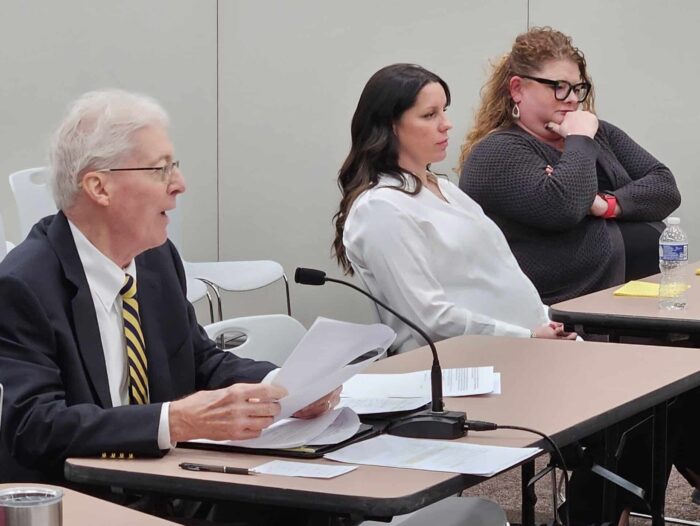
Bopp’s argument has not changed since the challenge to Wilson’s candidacy was filed on Feb. 13. He asserted Wilson pleaded guilty to a felony and later the charge was reduced to a misdemeanor, but she is still disqualified under Indiana law from running for or holding public office.
DeWester argued before the Election Commission and in court that Wilson was charged with a felony but pleaded guilty to a misdemeanor. Also, she was sentenced to 365 days probation, which, DeWester said, does not match the definition of felony conviction as being imprisoned for more than one year.
The two Democrats on the Election Commission determined Wilson pleaded guilty and was convicted of a misdemeanor, because, in part, her sentence did not exceed one year. The two Republicans on the commission did not agree, which resulted in a 2-2 vote and Wilson being able to continue her candidacy.
Bridges held a hearing on the merits of the case on March 24 but did not issue a ruling. Instead, he sent the case back to the Election Commission for consideration of the expungement order Wilson had obtained after she filed her candidacy and which she had also presented at the court hearing.
Members of the Election Commission were confused by the return of the dispute and were critical that the attorney general was not providing them with legal guidance. Again, the commission deadlocked at its April 8 hearing, which kept Wilson on the May ballot.
Two days later, Bopp filed a motion with the court for an expedited resolution of his original petition for judicial review. He reiterated his argument that Wilson is disqualified to be a candidate under state law.
The attorney general’s office filed a response, saying the Election Commission stands by its filings in this case and its oral arguments made at the March 24 hearing.
Early voting in Indiana for the primary began April 7.
Dwight Adams, an editor and writer based in Indianapolis, edited this article. He is a former content editor, copy editor and digital producer at The Indianapolis Star and IndyStar.com, and worked as a planner for other newspapers, including the Louisville Courier Journal.
The Indiana Citizen is a nonpartisan, nonprofit platform dedicated to increasing the number of informed and engaged Hoosier citizens. We are operated by the Indiana Citizen Education Foundation, Inc., a 501(c)(3) public charity. For questions about the story, contact Marilyn Odendahl at marilyn.odendahl@indianacitizen.org