By Marilyn Odendahl
The Indiana Citizen
April 15, 2026
Relying on the precedent created in the 2008 ruling that upheld Indiana’s voter ID law, a federal judge has blocked the state’s ban on the use of student ID cards at the polls.
Senior Judge Richard Young of the Southern Indiana District Court issued a preliminary injunction on Tuesday against Senate Enrolled Act 10, which prohibited students at the state’s public universities from using their college-issued identification cards to prove their identity when they voted. Young ruled the plaintiffs in the case had “demonstrated a reasonable likelihood of success” on their claim that the law was unconstitutional.
Even though early voting has begun and the May primary election is less than three weeks away, the preliminary injunction ordered officials to stop enforcing the ban on “using documents issued by educational institutions as proof of identification” until this case is resolved.
“By eliminating student IDs as an acceptable form of identification, Defendants selectively excluded a form of identification that otherwise complies with the neutral criteria established by Indiana’s voter ID law and that has been accepted as a form of voter identification for nearly two decades,” Young wrote in his ruling.
Count US IN, Women4Change and Indiana University student Josh Montagne filed the lawsuit in May 2025, shortly after SEA 10 was enacted. Jalyn Radziminski, executive and lead policy director for Count US IN, said the ruling will ensure young voters have a voice in the political process.
“This ruling is a victory for every student in Indiana who could have lost their right to vote because of Senate Bill 10,” Radziminski said in a statement. “This law was never about election integrity — it was about silencing the voices of young Hoosiers who want to hold their elected representatives accountable at the ballot box.”
In finding the ban violated the First Amendment and the 14th Amendment, Young looked to Crawford v. Marion County Election Board, which challenged Indiana’s 2005 voter ID law. Under the statute, registered voters had to show a government-issued photo identification, before they were allowed to cast a ballot.
The case went to the U.S. Supreme Court, where a 6-3 majority upheld the law in 2008. The majority of the justices ruled the law did not violate the U.S. Constitution, because the ID requirement applied to a “vast majority” of Hoosier voters and was “amply justified” by valid concerns about the integrity of the electoral process.
Following the precedent established in Crawford, Young considered the burden created by SEA 10 and concluded the prohibition against student IDs fell more heavily on young voters and students. Specifically, he found “the burdened population” – which he estimated to be about 40,000 students – are eligible to vote in Indiana but do not have a “permissible form of photo identification,” other than their student ID.
Young agreed with the plaintiffs that students would have difficulty accessing the documents they need to obtain an Indiana driver’s license or state ID card. Those documents include a U.S. birth certificate or unexpired passport, a card with the applicant’s Social Security number and proof of lawful status in the United States as well as proof of residency in Indiana.
Students also would be hindered in getting to the Indiana Bureau of Motor Vehicles to get a driver’s license or state ID, because of their class schedule and limited access to transportation and funds.
In addition, Young wrote, unlike the represented parties in Crawford, students “cannot rely on the safety valves” that are available to other voters who do not have proper identification. Younger voters would probably not qualify for an absentee ballot and would have to present an accepted ID to have their provisional ballot counted.
Consequently, Young, seeing a slippery slope, rejected the defendants’ argument that students will be able to get the accepted photo ID that they need in order to vote.
“If the mere theoretical availability of alternative ID is sufficient to render any burden minimal, Indiana could continue to eliminate previously accepted forms of identification – and continue to point to available alternatives to insulate itself from challenge – even if tens of thousands of Hoosiers had relied on the previously accepted form,” Young wrote.
The defendants in the case were Indiana Secretary of State Diego Morales; the co-directors of the Indiana Election Division, Angela Nussmeyer and Brad King; and the Monroe County Board of Elections. Also named as defendants were the members of the Indiana Election Commission at the time the lawsuit was filed: Karen Celestino-Horsemen, Suzannah Overholt, Litany Pyle and Paul Okeson.
Speaking on her own behalf, Celestino-Horseman supported Young’s ruling.
“As an officer of the court who believes in the rule of law, I am delighted that the rule of law prevailed,” Celestino-Horseman said in an email. “Voting is our greatest and most important constitutional right. It is what makes America. Government should not work to prevent people from voting but rather make exercising this fundamental right as easy as possible.”
SEA 10, authored by Indiana Sen. Blake Doriot, R-Syracuse, amended Indiana’s voter ID law to exclude student identification cards issued by the state’s public universities. The bill was passed solely with the support of Republican lawmakers and signed into law by Gov. Mike Braun in April 2025.
In his ruling, Young said supporters of SEA 10 said it would improve election integrity, but, he noted, no evidence has been presented showing that student IDs have been used to commit voter fraud or any other kind of voting-related misconduct.
Also, Young determined that blocking the ban on student IDs on the eve of the election would not confuse voters and disrupt the May primary, which the U.S. Supreme Court has repeatedly told federal district and circuit courts not to do. He noted allowing student IDs would just require a “revival of previous practices” without a “significant expenditure of resources” to implement for the upcoming election. Moreover, he said, the change would likely not cause such confusion that voters would stay home, rather than go to the polls on Election Day.
“Defendants provide no evidence that student IDs have ever caused confusion or otherwise complicated election administration,” Young wrote in his ruling. “And the characteristics of student IDs that Defendants warn may cause confusion are equally applicable to other forms of ID that the law still permits, including Veteran’s Administration, military, and tribal ID cards, many of which are less uniform that student IDs.”
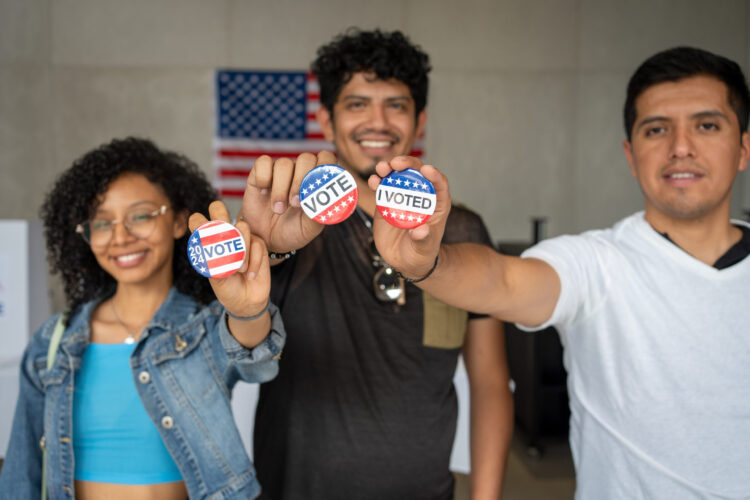
Marion County Circuit Court Clerk Kate Sweeney Bell applauded the ruling, saying SEA 10 was part of an ongoing attempt to “silence the voice of younger voters.” She said students who are registered to vote can now use their valid student IDs at the polls. Those identification cards must be issued by state universities and have an expiration date, along with the person’s name and photograph.
“This is a win for student voters,” Sweeney Bell said in a statement. “And a repudiation of the relentless attack on voters of Indiana. Our poll workers will welcome student IDs issued by state colleges in Indiana as valid proof of identification for voting.”
The case is Count US IN, et al. v. Diego Morales, et al., 1:25-cv-864.
Dwight Adams, an editor and writer based in Indianapolis, edited this article. He is a former content editor, copy editor and digital producer at The Indianapolis Star and IndyStar.com, and worked as a planner for other newspapers, including the Louisville Courier Journal.
The Indiana Citizen is a nonpartisan, nonprofit platform dedicated to increasing the number of informed and engaged Hoosier citizens. We are operated by the Indiana Citizen Education Foundation, Inc., a 501(c)(3) public charity. For questions about the story, contact Marilyn Odendahl at marilyn.odendahl@indianacitizen.org