By Steve Hinnefeld
The Indiana Citizen
April 30, 2026
Both supporters and critics say Indiana’s 2024 “intellectual diversity” law is having its intended effect on college instruction. That’s where the agreement ends.
For supporters, including the law’s author, Sen. Spencer Deery, R-West Lafayette, Senate Enrolled Act 202 is deterring professors from imposing their often-liberal political views on vulnerable students. They say it’s bringing accountability to the classroom and starting to boost public faith in higher education.
But critics, including many university faculty, say the law chills free speech and infringes on academic freedom. They say its vague requirements are causing professors to avoid controversial topics, depriving students of exposure to robust debate on important issues.
“I feel like the law has damaged my teaching,” said Steve Carr, a professor in the communication department at Purdue University Fort Wayne. “I now have to constantly look over my shoulder and figure out if I have followed a law I do not understand.”
Passed in a short legislative session and signed into law by then-Gov. Eric Holcomb, SEA 202 took effect July 1, 2024. It requires faculty at state colleges and universities to “foster a culture of free inquiry, free expression and intellectual diversity” and to expose students to “a variety of political or ideological frameworks” to qualify for tenure or promotion.
It also requires institutions to conduct “post-tenure review” of faculty every five years, provide systems for students and employees to file complaints alleging faculty have violated SEA 202, and report spending on diversity, equity and inclusion initiatives. Faculty with negative post-tenure reviews can face consequences, including losing their jobs.
Since then, more legislative efforts by the Indiana General Assembly to influence university instruction have occurred.
In 2025, the state legislature added higher-education requirements to the state budget bill. The legislation, House Enrolled Act 1001, institutes faculty reviews for productivity, requires professors to post their course syllabi online, eliminates degrees with low enrollment and stipulates that faculty governance is “advisory” only. It also gave the governor power to appoint all nine members of the Indiana University board of trustees.
Indiana lawmakers passed more higher-ed provisions in 2026, including restrictions on degree programs whose graduates earn low wages; a requirement that colleges accept results from the Classic Learning Test, a conservative alternative to the SAT and ACT that includes a greater emphasis on Christian thought; and limits on enrolling international students from certain countries.
Carr, who directs the Institute for Holocaust and Genocide Studies at Purdue Fort Wayne, said the state measures align with a national trend. “They’re part of a larger wave of what seems to be a hostile takeover of higher education,” he said.
Backed by the American Civil Liberties Union of Indiana, Carr is challenging SEA 202 in federal court, along with a Purdue Fort Wayne history professor and professors at Indiana University Bloomington and IU Indianapolis. The complaint was dismissed by the Southern Indiana District Court, and the professors have appealed.
Deery, the author of SEA 202, emphatically disagrees with the law’s critics. He said their claims are based on misunderstandings.
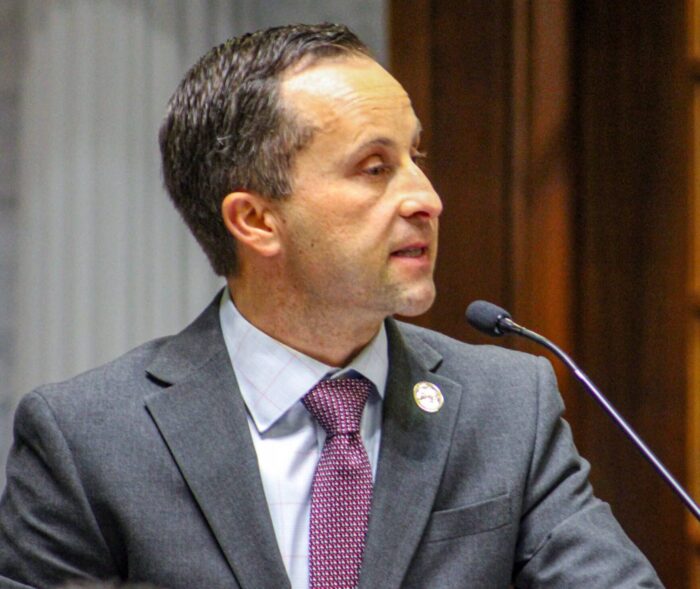
For example, he said, critics claim the mandate to teach diverse perspectives would force them to share discredited or fringe theories. He pointed to language in the law that calls for sharing a variety of perspectives that exist within the curricula or the academic discipline.
“It is absurd,” he said, “to think the faculty of an institution are going to approve a curriculum that requires teaching racism or antisemitism or fringe ideas about the Holocaust. Or nonscientific teaching on, say, climate change.”
Deery said the law actually gives faculty speech more protection by codifying tenure, for the first time, in state law. He noted that it says faculty can’t get negative evaluations for criticizing university leadership or engaging in political activity outside of the classroom.
Deery works for Purdue as an administrator of the university’s online program and is an assistant to President Emeritus Mitch Daniels, a former Indiana governor. He said he wants to boost lagging confidence in universities among the public and his fellow legislators.
“Certainly, one of my goals is to create an environment where my colleagues would feel comfortable continuing to fund higher education,” he said.
Critics also object to the SEA 202 requirement that universities have a system for reporting faculty violations at the state’s public colleges and universities. In the second half of 2024, there were 14 complaints, including nine at IU. In 2025, there were six complaints at Ivy Tech, four at Indiana State, three at Ball State and none at the University of Southern Indiana and Vincennes University. IU, Purdue and the Commission for Higher Education did not comply with requests for their data in time for publication. IU Bloomington received 10 complaints in 2025, according to a report at a faculty council meeting.
Regarding SEA 202, Deery said the scarcity of complaints is “a good sign it’s operating as it should. It’s pushing faculty to check their biases, but it’s also not created this terrible hostile atmosphere.”
While some object that the law is vague, Deery said that is “very intentional. There is not a faculty member in their right mind who wants the General Assembly to prescribe what is taught and what is not taught.” He trusts university administrators to interpret the law. “They’re fully capable of doing this and doing it in professional ways,” he said.
But professors don’t necessarily share that trust.
“These vague laws and stipulations give the Institution an ability to selectively punish faculty,” said Sarah Vitale, a philosophy professor at Ball State University. “I think you could find just about any faculty member and see a way in which they aren’t in compliance.”
Ben Robinson, a Germanic Studies professor at IU Bloomington, believes he was selectively punished for his outspoken criticism of IU officials and his high-profile role in campus protests against Israel’s war in Gaza. A dean sanctioned Robinson in response to an anonymous complaint that he “talks negatively about the state of Israel” and spoke about being arrested twice while protesting the war.
The class was an upper-level course, taught in German. Robinson, who is Jewish, said he invoked his arrests as a “hook” to explain difficult concepts: Kant’s idea of the public use of reason and the thought experiment called the prisoner’s dilemma. Robinson said he appealed the sanction, but it has not been resolved yet.
Aside from his own case, Robinson said, concerns about speech restrictions since the passage of SEA 202 have “rigorously shut down” campus debate about controversial topics, especially Middle Eastern conflicts. “The very idea of academic freedom, in terms of the legislature deferring to academic interests, that idea of academic freedom has totally gone to pot,” he said.
In another IU case, Jessica Adams, a lecturer in the School of School Work, was removed from teaching a graduate-level course, after a student objected when she showed a pyramid-shaped graphic that included President Donald Trump’s “Make America Great Again” slogan as an example of white supremacy. Adams said a student complained to U.S. Sen. Jim Banks, R-Ind., who contacted the university, and an administrator filed an SEA 202 complaint. Adams was allowed to resume teaching the class several weeks later but with university “minders” present.
David McDonald, an IU Bloomington folklore professor and a scholar of Palestinian history, culture and activism, is one of the plaintiffs in the federal lawsuit filed by Carr. In the fall of 2024, the suit says, four students filed complaints after McDonald showed a one-minute film clip of a pro-Palestinian protest in a freshman seminar. It took multiple days of conferring with administrators to resolve the complaints, the suit says.
Heather Akou, president-elect of the IU Bloomington Faculty Council, faulted IU for opening SEA 202 complaints to anonymous claims, which the law doesn’t require. “The way IU is implementing it seems to go far beyond the intent of the law,” she said.
Akou, who teaches fashion history and design in IU’s Eskenazi School of Art, Architecture + Design, says the complaints weigh on faculty. “I certainly think about it frequently,” she said. “I go into classes thinking, ‘Is this the discussion that is going to get me fired?’ ”
IU officials do not comment on personnel matters or lawsuits. University Spokesman Mark Bode provided the following statement: “Indiana University is committed to academic freedom, following policies that uphold due process for faculty and provide a framework to best serve our students.”
At Ball State, Suzanne Swierc, the university’s former director of health promotion and advocacy, was fired for a private Facebook post in which she said the assassination of conservative activist Charlie Kirk was a tragedy but reflected the “violence, fear, and hatred he sowed.” While Swierc wasn’t a faculty member, and her dismissal wasn’t tied to SEA 202, Vitale, the Ball State philosophy professor, said it showed the school’s administration wouldn’t stand up for employees. Swierc sued and reached an undisclosed settlement.

The lawsuit by Carr, McDonald and others alleges SEA 202 violates their First Amendment rights by restricting speech. Deery emphatically disagreed. “There is no mandate in this bill that faculty must teach something or may not teach something,” he said.
Steve Sanders, a professor at the IU Maurer School of Law in Bloomington and an expert on constitutional law, is skeptical that the law itself violates the First Amendment, although he says its vagueness creates a risk that it could be selectively enforced.
“I dislike the hyperbole that this is the end of tenure and all that,” he said. “Show me the evidence. I don’t believe it censors speech. I don’t think it compels speech. I do think SEA 202 is unwise, because I think it’s always a bad idea for politicians, legislators, to inject themselves into academic decision-making.”
Constitutional questions aside, Indiana higher education legislation has received considerable attention from national news media, including articles in The New York Times and The Chronicle of Higher Education, and from advocacy groups.
The progressive group PEN America called SEA 202 “one of the most censorial pieces of legislation that PEN America has come across” in a 2024 report.
“When faculty or students or staff see someone being punished for free expression, for asking questions and trying to answer them, it has effects that ripple out,” said Amy Reid, director of the group’s Freedom to Learn Program. “We’ve reached a point where free expression on campus is precarious.”
On the other side, the National Association of Scholars, a conservative faculty group, congratulated Indiana for enacting SEA 202, saying it “makes many excellent reforms.” However, the group lamented that it doesn’t “remove the existing DEI bureaucracy” from universities.
Jason Fertig, the conservative group’s Indiana president and a management professor at the University of Southern Indiana, said he sees both sides of the debate. “I understand why it’s needed,” he said. “I understand why somebody would be upset about it.”
But Fertig said he enjoys the irony of seeing liberal professors, who often favor assertive government, worrying about government restrictions. “It’s an interesting setup,” he said. “The side that’s supposed to be for less government is using government to do something.”
The Foundation for Individual Rights and Expression, which advocates for freedom of speech on campuses, likes SEA 202’s limits on “DEI statements” for faculty and its ban on retaliating against faculty for criticizing administrators. But it worries about the vagueness of the intellectual diversity language, said Tyler Coward, lead counsel for government affairs.
“Increasing ideological diversity is a worthy goal, but the way the law is drafted can have the effect of chilling speech,” said Coward, an IU Bloomington graduate. “If anything, we should be taking a ‘more speech’ approach.”
He said the law’s requirement that professors provide varied viewpoints risks turning every course into a “survey class” that doesn’t delve deeply into specific topics.
In a November 2025 report, FIRE ranked Indiana University the worst public university in the nation for supporting free speech. The report cited IU’s harsh response to campus protests, the cancellations of an exhibition by a Palestinian artist and a conference on LGBTQ+ health, restrictions on the student newspaper and other factors.
Purdue ranked first among public institutions, although its score, 76 out of 100, was just average. And Purdue hasn’t lacked controversy. Its university senate approved a vote of no confidence in Provost Patrick J. Wolfe on April 20. The American Association of University Professors’ chapter at Purdue said the provost’s office lacks transparency and “tacitly acquiesces to current attacks on higher education.”
Purdue got credit from some free-speech advocates for being the first public university to adopt the Chicago Principles, a set of guidelines adopted by the University of Chicago in 2014 affirming the importance of free expression on campus. Initially a response to so-called cancel culture from the left, the principles have been embraced to support academic freedom broadly.
The IU Board of Trustees adopted the Chicago Principles in February, following a recommendation from faculty. “It was kind of a nice moment to see the trustees, the administration and the faculty come together under the idea of, let’s take a look at this and affirm our support,” said William Ramos, president of the Bloomington Faculty Council.
Sanders, the IU law professor, led the University Faculty Council effort to advance the principles. He said the key question is how they will be followed.
“No set of principles is going to eliminate the need for honest, reasoned judgment,” he said in an interview. “The Chicago Principles are like your conscience speaking to you: the angel on your shoulder telling you what you’re supposed to do.”

Faculty worries about SEA 202 vary by institution and by academic discipline. Liz Brown, president of the Indiana State University Faculty Senate, said anxiety about the law at ISU has mostly faded. She said ISU had post-tenure review for faculty before the legislature mandated it.
“Faculty, I believe, in virtually all cases are professionals,” said Brown, a mathematics professor. “They’re scholars. They take the job seriously and they do their job.”
There is more faculty concern at ISU about the 2025 state budget bill and its elimination of low-enrollment degrees, she said. The law calls for eliminating or merging programs if the number of annual graduates is below 15 for a bachelor’s degree or seven for a master’s.
“Fifteen might be very appropriate for IU and Purdue,” she said, “but it may not be for Indiana State, which is smaller and has a different mission.”
Statewide, nearly 1,300 degrees are being affected by the legislation, either voluntarily by the universities or by action from the Indiana Commission for Higher Education, according to a commission report. Those include 605 degrees at all IU campuses, 274 at Purdue campuses, 127 at Ball State, 83 at Indiana State, 79 at Vincennes University, 64 at the University of Southern Indiana and 47 at Ivy Tech Community College.
At Ball State, one of the degrees the university is suspending is a bachelor’s in philosophy, the program in which Vitale teaches. At the same time, an academic reorganization is eliminating the philosophy department. Vitale would move to the psychology department. Coming on top of the intellectual diversity law, limits on state funding and other setbacks, the loss of a departmental home was the last straw for Vitale.
“I just can’t do it,” she said. “I have too much of my career left.”
This semester is Vitale’s last at Ball State. She’s moving to central New York, her home region, to take a temporary job managing a campaign for a state assembly candidate. She said she will apply for faculty positions if they are open in the region. But she’s not holding her breath, given the current higher-education climate.
I’m a fighter,” Vitale said. “I can work in difficult conditions and fight for what is right. Eventually, I think we’re going to come out the other side of this. But I don’t think it will be soon, and I don’t think it will be without casualties.”
Editor’s note: This article has been updated to correctly identify FIRE as the Foundation for Individual Rights and Expression.
Steve Hinnefeld is a freelance writer based in Bloomington. He formerly was an adjunct instructor at the Media School at Indiana University, a media specialist at Indiana University and reporter for the Bloomington Herald-Times. He has had no affiliation with the Media School since spring 2022.
Dwight Adams, an editor and writer based in Indianapolis, edited this article. He is a former content editor, copy editor and digital producer at The Indianapolis Star and IndyStar.com, and worked as a planner for other newspapers, including the Louisville Courier Journal.
The Indiana Citizen is a nonpartisan, nonprofit platform dedicated to increasing the number of informed and engaged Hoosier citizens. We are operated by the Indiana Citizen Education Foundation, Inc., a 501(c)(3) public charity. For questions about the story, contact Marilyn Odendahl at marilyn.odendahl@indianacitizen.org.