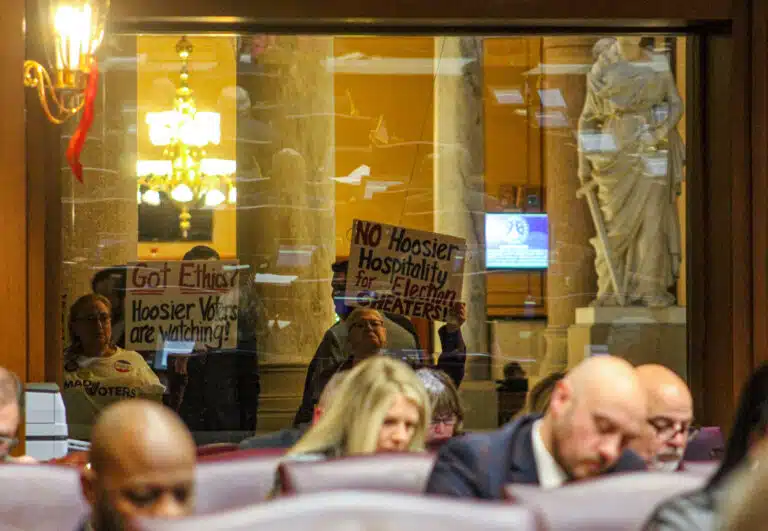
A handful of protesters stood outside the Indiana House chamber while lawmakers debated proposed amendments to the redistricting bill on Dec. 4. (Photo/Sydney Byerly of The Indiana Citizen)
By Chloe White
TheStatehouseFile.com
December 4, 2025
On Thursday, the Indiana House of Representatives dismissed multiple amendments on House Bill 1032. The proposed legislation, written by Rep. Ben Smaltz, R-Auburn, would redraw Indiana’s congressional voting districts mid-decade, ahead of the 2026 mid-term election—a major goal of the Trump administration.
Each of the suggested revisions to HB 1032 were proposed by House Democrats and highlighted concerns like transparency and racial equity. Meanwhile, Smaltz urged the chamber to leave his bill untouched, calling it “carefully crafted,” which received laughs from his colleagues across the aisle.
Funding issues
Amendment 1, authored by Rep. Sue Errington, D-Muncie, would delay the implementation of redistricting until the costs of child care, health care and utilities were lowered across the state. In her testimony, Errington highlighted that 7.6% of Hoosiers have no health care. The amendment failed 27 to 67.
“House Democrats have been and will continue to be focused on the affordability crisis,” said Rep. Carey Hamilton, D-Indianapolis. “We have been and will continue to fight for working families. … It shouldn’t be so difficult for our families to get by.”
Amendment 2, by Rep. John Bartlett, D-Indianapolis, and Amendment 9, by Rep. Vernon Smith, D-Gary, had near exact wording and were rejected under House Rule 80 for not being “germane.” The bills would have required the state comptroller to compile a report highlighting the funding required to perform mid-cycle redistricting. House Democrats requested to appeal the motion, but it was overturned 63 to 29.
Amendment 21, by Rep. Greg Porter, D-Indianapolis, also was concerned with costs. It would have required a state cost-analysis report of redistricting that included topics like state and contracted employee pay and election updating costs, but it failed 29 to 63.
Rep. Sheila Klinker, D-Lafayette, spoke in support of an amendment introduced by Rep. Carolyn Jackson, D-Hammond. “I think it’s imperative to be fair to our constituents,” Klinker said. (Photo/Sydney Byerly of The Indiana Citizen)
Minority impact
Amendment 10, by Rep. Robin Shackleford, D-Indianapolis, which would require the General Assembly to perform an analysis highlighting the impact of policy or budgetary changes on Black and Latino communities. Smaltz said he was uncomfortable changing specific language in HB 1032 and discouraged his fellow representatives from voting in favor of the new wording. The amendment failed 27 to 67.
Amendment 15, also written by Shackleford, would require the General Assembly to perform a district-specific population analysis. This would ensure that the redrawing of congressional maps would be nondiscriminatory and comply with the Voting Rights Act of 1965; however, the amendment failed 29 to 66.
Amendment 16, authored by Porter, would have given Gov. Mike Braun 30 days following the passage of HB 1032 to review the proposed bill to ensure that it does not violate the Voting Rights Act or federal laws and regulations. It also failed 28-65.
Amendment 17, by Rep. Ed Delaney, D-Indianapolis, would define the term “community of interest” in HB 1032. The change was intended to highlight the polarity within the proposed congressional districts. For example, the proposed map would connect rural counties like Crawford, with more urban counties like Marion. The amendment failed 29-65.
“We don’t redistrict for the sole and only purpose of suiting the whims of one political party,” said Delaney. “No interest of the public is involved, only the interest of one political party.”
Public hearings and transparency
Amendment 3, by Rep. Caroline Jackson, D-Hammond, would have added two lines to HB 1032 requiring the General Assembly to hold a public hearing in each congressional district, similar to the previous redistricting process, but it failed 30-64.
“In 2021, the election committee went to each and every district,” said Jackson. “They allowed individuals in each one of your communities to come out and speak, to address issues, concerns, etc. … Why deny them that opportunity this time?”
Amendment 13, by Rep. Mitch Gore, D-Indianapolis, similar in nature to Amendment 3, would have given Hoosiers the ability to provide input and vote on any new district map provided by the General Assembly. Smaltz reminded members of the House that Indiana is not a state that allows referendums. It failed 28-66.
Amendment 18, authored by Delaney would have required the General Assembly to identify all members involved in the redrawing of the congressional map. It failed 29-65.
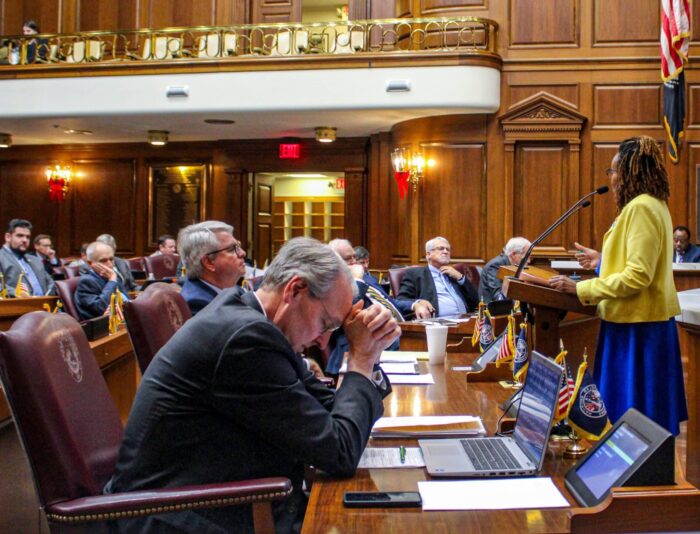
Rep. Matt Pierce, D-Bloomington, held his head as he listened to Rep. Robin Shackleford, D-Indianapolis, present her amendment to the redistricting bill. (Photo/Sydney Byerly of The Indiana Citizen)
Committee work
Amendment 5, 7 and 8 would each assign the topic of redistricting to a regular or interim committee to ensure fairness, legality, nonpartisanship and cost efficiency within the process. All three amendments failed.
“Let’s not only not do mid-decade redistricting, let’s say we’re going to take a stand to take politics out of redrawing maps,” said Rep. Matt Pierce, D-Bloomington. “Let’s send a signal to other states that it’s time to stop.”
On Friday, the House will meet for a third time to vote on HB 1032; if it is passed, it will head to the Senate on Monday.
Sen. Greg Taylor, D-Indianapolis, watched part of the session and said he believes if the legislation passes, topics like fiscal responsibility, citizens rights issues and appropriate representation must be reviewed within the bill before it is put into law.
“Unfortunately, my colleagues on the Democrat side of the House were not successful getting any amendments, but hopefully we’ll get something done in the Senate,” said Taylor. “Midterm redistricting is wrong. … But if we’re going to have it, we should put some guardrails on it.”
Chloe White is a reporter for TheStatehouseFile.com, a news site powered by Franklin College journalism students. Sydney Byerly is a reporter for The Indiana Citizen, a nonpartisan, nonprofit platform dedicated to increasing the number of informed and engaged Hoosier citizens.