By Anna Cecil, Annika Hauer, Elizah Rendorio and Florian Knowles
The Statehouse Reporting Project
January 27, 2026
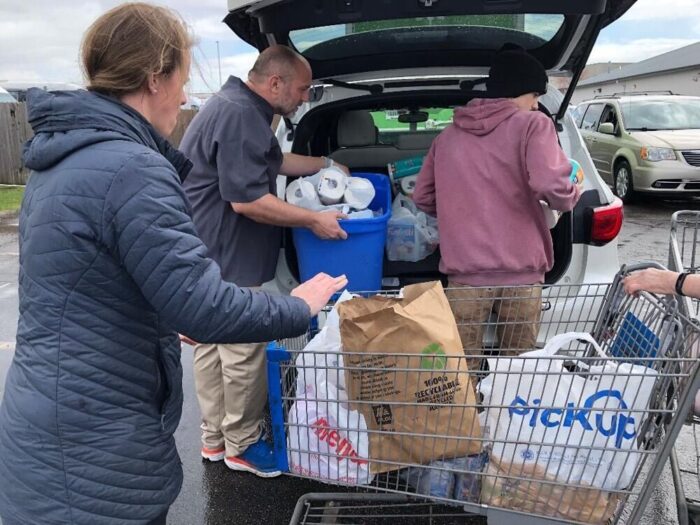
Outside the small, industrial-looking building off Commerce Road in Franklin, Indiana, a long line of cars waited in the rain to receive their groceries for the week.
Volunteers weaved between vehicles and raindrops, dodging exhaust fumes, to provide drivers with a menu to fill out. The list included protein options, canned, bagged and boxed foods, frozen fruit and soup, milk, eggs, deli meat, snacks, bread and coffee.
Behind the wheel of her old pickup truck, Angela Nelson circled the choices for her family of nine, stopping at the very last option, a line where she could write her “one wish list item.”
On Nov. 7, she asked for a birthday cake for her son.
At Interchurch Food Pantry of Johnson County, birthday cake is possible because of an intricate system the pantry calls “food rescue.” Rescuing food allows Executive Director Carol Phipps and her team not only to keep Central Indiana residents nourished and fed but also supplied with a little joy in the form of a sweet treat.
This is food pantry resilience, honed over decades of government shutdowns, swings in the economy, fluctuations in donors and funding and volunteers, and changes in federal food support—and in this way, the Interchurch Food Pantry is not unique.
Food pantries in Indiana and across the country look to local grocers, college students, churches, K-12 schools, restaurants and bakeries for donations of food, or grow their own on rooftop gardens, or spend hours writing grant requests to stay afloat.
Experts say this is how it has to be.
“Any sector you’re in, we are trying to figure out how to piece multiple streams of resources together to meet ever-growing needs,” said Chris Bernard, president and CEO of Hunger Free Oklahoma. “You need an array of resources to rely on because no single one can really meet that total demand. … It helps create stability, rather than up and down chaos, which is much harder to manage when you’re trying to meet basic needs.”
He added that benevolent support can vary depending on the political climate.
“When it’s a hot-button issue, you might have as many volunteers as you can handle and more. But when the public’s attention gets focused somewhere else, you might be struggling,” Bernard said. “The folks who do this, do it well. They understand logistics and they understand how to leverage resources.”
Volunteers at the Interchurch Food Pantry of Johnson County in Indiana help load food into a recipient’s car. The pantry feeds thousands of Hoosiers each week. (Photo/Courtesy of Interchurch Food Pantry of Johnson County)
Rural and urban needs in Washington
In Washington state, food scarcity is rural and urban, and food pantries all over have been straining to meet spiking needs, exacerbated by the 2020 COVID-19 pandemic, new enrollment requirements for the Supplemental Nutrition Assistance Program (SNAP) and the recent government shutdown. In Seattle, local efforts are creative. They thread through city neighborhoods and often join forces.
At the base of a dorm on the University of Washington Seattle campus, the Husky Food Pantry distributes food to over 700 students and faculty each week.
Most might assume that if a student can afford to go to college, they can also afford groceries. The Husky Food Pantry proves that isn’t true.
In fall 2022, the pantry saw about 300 unique visitors per week. In the 2024-25 school year, that number jumped to 600 visitors on average, and as of late October, the pantry had more than 730 visitors every week, according to River Elewski, the pantry’s student director.
The pantry buys the majority of its food in bulk from Costco with money gathered through its No Hungry Husky donation fund. Seven weeks into the fall quarter, the pantry had redistributed 16,156 pounds of food—rice, beans, milk, grab-and-go bars and more—according to internal data.
“We really do have limited capacity,” Elewski said. “We try to think about, ‘what are staples for folks that are going to stretch further?’”
An occasional pantry treat of fresh bread or cookies comes from Community Loaves, a nonprofit that connects folks baking at home with local pantries.
A contract with the UW Farm brings in fresh, local-grown produce each week.
Another 2,429 pounds of food has come from university sources, such as unsold food from on-campus cafes, markets and dining halls and food-drive donations. Last June, when the majority of UW’s students moved out for the summer, the pantry ran a drive that brought in 1,230 pounds of food in a week.
South of downtown Seattle, the IDIC Filipino Senior and Family Services Center offers hot lunch and food bank services every Wednesday and Friday. Seniors eat, receive food supplies and participate in Zumba and bingo.
But these services would not be possible without a series of fundraisers by program director Lanvin Andres. For example, he hosted a 54th anniversary gala last month to appeal to community members.
“We show them what happens in our program,” Andres said. “We tell them stories from people who benefited from the program directly and hopefully compel them to support the program more permanently.”
Andres said the food bank doesn’t just rely on fundraising, though. It has to look to a variety of sources, like in-kind donations from Seattle nonprofit Food Lifeline and private grants — supplemental funding that has become increasingly difficult to find.
“Nonprofits like us, and there’s tons of us, have to scour for limited sources,” he said. “So many nonprofits are currently in competition with each other. It’s somewhat of a rat race.”
Just south of Seattle, faith-based organization Praisealujah hosts monthly drive-thru food giveaways in Burien and SeaTac. The organization has a food service the first Sunday of each month. November’s service drew 3,600 people.
Praisealujah also receives in-kind donations from Food Lifeline but relies heavily on food rescue from grocery stores and local farms.
“We send 23 trucks out a day,” said the Rev. Kelly Crow, Praisealujah founder. “We bring in about 800,000 to 900,000 pounds of fooda month, and we have semi-trucks that rescue potatoes, onions and lettuce.”
The trucks drop off supplies at a Praisealujah warehouse where workers sort the food that will be transported to giveaway locations in nearby cities Des Moines and Kent.
“There’s more to it than just giving food, but building relationships,” he said. “You get to find out the other stuff that they need. We’re all humans, and we all need to be part of the solution.”
In north Seattle, adjacent to the University of Washington campus, the University District Food Bank has been operating since 1983 and distributes roughly 4 million pounds of food each year to more than 116,000 households.
The food bank sidewalk often is full of people with food—some with paper bags stuffed full, others with soup still hot from the pantry’s cafe.
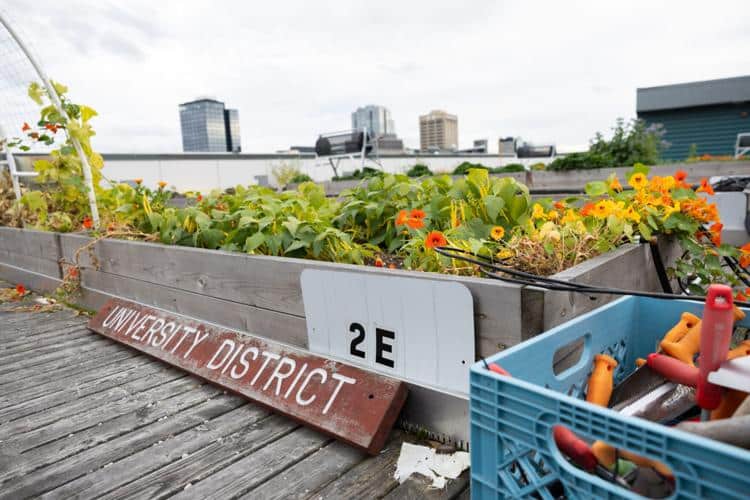
An elevator ride above the grocery, cafe and food storage spaces are dozens of beds of dirt. From donor money, the University District Food Bank opened its rooftop garden almost a decade ago. This year, volunteers and interns grew onions, tomatoes, peppers, cucumbers, nasturtiums and garlic and greens like spinach, chard, tatsoi, kale and romaine lettuce. Last year, they harvested 50 pounds of honey.
The 10,000 pounds of produce the garden contributes per year is a fraction of the food bank’s total distribution, but they’re not growing for poundage, executive director Joe Gruber said. It’s a project about building resilience, meeting wider customer needs, and doing the small, significant work that changes how people think about the food system as a whole.
“The work that we do is changing the food system that we live in,” Gruber said. “It is racist, it is classist. … If we’re intentional in how we engage in this work, how we talk about sustainability up here on the roof, … we can then bring this stuff downstairs and talk to customers about, ‘Hey, these tomatoes,’ or ‘here’s a plant start that we grew up on the roof—do you want it?’”
The University District Food Bank has its own vegetable garden, on the roof of its building, producing over 10,000 pounds of produce. Volunteers and interns work on tending the garden, growing onions, tomatoes, peppers, cucumbers, nasturtiums, garlic and greens. (Photo/ Evelyn Archibald of the University of Washington)
While metropolitan areas like Albuquerque offer residents more access to resources, rural areas face totally different challenges than many other regions of the nation.
Organizations in New Mexico face the unique challenge of dispersing food over a large, mostly rural state with small communities tucked away in mountains, deserts and plains. These rural areas are also where disparities emerge.
Despite these factors, New Mexico is also home to some of the wealthiest communities in the country. Extractive industries like nuclear, oil and gas have created a divide in the state. For example, Los Alamos County, home to Los Alamos National Laboratory, ranks in the top 25 richest counties in the nation according to Google’s Data Commons report. It also has the lowest rate of hunger, with the Los Alamos Food Depot stating that 8.2% of the county is food insecure. This is well below the 16.6% state average from Map the Meal Gap. On the opposite end of the spectrum, McKinley and Luna counties face rates of food insecurity of 23%, another Map the Meal Gap statistic.
Organizations large and small have to work differently from one another to feed people in their areas.
La Mesa Presbyterian Church helps residents of the International District of Albuquerque through its pantry, which sources from a variety of places. The pantry feeds over 400 people a month. Coordinator Roxie Bradley said it gets regular donations from the local food bank, Road Runner Food Bank, as well as from food rescue partners.
Businesses in the area, like Einstein’s Bagels, donate food that otherwise would have been thrown away. But the pantry sometimes lacks in-demand items like canned chicken, for which the church turns to its congregation members to purchase or donate to fill these food needs.
“The congregation has been so supportive,” Bradley said. “One month, we’ll have them donate chicken. Another month, we might have them donate peanut butter.”
Bradley said this direction motivates people to donate since they have clarity in what the pantry needs. The pantry also asks members for monetary donations and for smaller items they may have on hand, like unused utensils from take-out, travel-sized toiletries and plastic bags.
The pantry doesn’t give out pre-made bags of food but allows people to browse for what they want.
“They can choose from whatever’s on the shelf,” Bradley said. “So, if you have a food allergy, or if you’re allergic to something, don’t take it. Or if you don’t like tuna, don’t take tuna.”
To ensure everyone gets food, they ask people to come once a week, but they don’t turn away people who have to come more often. In its 20 years of serving the community, La Mesa Presbyterian has only had to close once due to low stock.
“Somedays, I get worried about what we’re doing and if we have enough, but it all works out,” Bradley said. “It’s like the loaves and the fishes, everyone somehow gets enough.”
McKinley and Cibola counties in western New Mexico, which include tribal lands like the Navajo Nation and several Pueblos, are, according to Data Commons, among the poorest counties in the state for per-capita personal income. As a result, these counties face some of the most extreme rates of food insecurity.
The Community Pantry serves over 5,000 families a month and operates two facilities in Gallup and Grants as well as several mobile distribution sites on Navajo and Pueblo land, making them one of the largest food assistance organizations in the area.
“The reservation lands are desert,” said Alice Perez, executive director and CEO of the Community Pantry. “There’s no running water, especially back then [when the pantry started], and there was very little electricity. So self-preservation wasn’t necessarily attainable, and it’s still not to this day.”
Perez said the Community Pantry gets 70% of its support from monetary donations, specifically through grant writing and county and foundation funding. It also does some community fundraising, but can’t fully rely on it.
“Fundraising right here is limited,” Perez said. “It’s hard to pull from the community members who are already economically stressed and ask them to give more money.”
The Community Pantry pairs these funds with existing programs, like the Commodity Supplemental Food Program and the Emergency Food Assistance Program, to enhance the food it distributes. When possible, the pantry also partners with an organization in Arizona to distribute water to households that don’t have access. But this water can be hard to get and is in high demand.
“The last one we did, and it was an entire semi load full, that’s almost all gone.” Perez said. “It doesn’t take long to not have water here.”
With federal funding cuts, the Community Pantry had to consolidate. It used to run 14 mobile distribution sites, but now it runs nine. Still, it’s determined to feed the community through collaborative efforts.
“We’re all in the storm together, but we all ride in different boats. Some people have big boats, some people have row boats,” Perez said. “That’s why it’s so important for communities to gather together and collaborate so that we’re not limiting our own resources.”
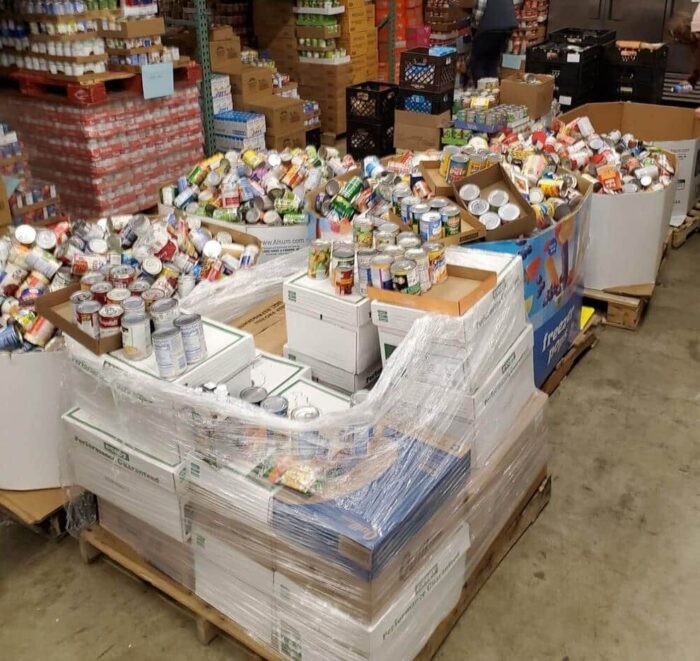
From schools to restaurants to grocery stores, Interchurch Food Pantry of Johnson County volunteers “rescue” food that would otherwise be thrown away to feed thousands of people in Central Indiana each week. (Photo/Courtesy of Interchurch Food Pantry of Johnson County)
In Marion County, the least rural part of the state, SNAP provides half of the meals for people who utilize food benefits according to Indy Hunger Network. On top of that, half of the county’s residents also told Indy Hunger Network they were facing food insecurity in a 2025 survey.
Interchurch Food Pantry of Johnson County, which is located just outside of Marion County, was serving about 1,000 households per week as of September, a 21% increase over last year.
The pantry helps families like Nelson, who visit for groceries and even sweet treats like a birthday cake.
As demand rises, the pantry has observed a noticeable lull in supply from Gleaners Food Bank, the food bank where Interchurch receives some commodities through The Emergency Food Assistance Program (TEFAP).
In 2024, the pantry received 10,000 to 41,000 pounds of food each month from Gleaners. So far this year, it has maxed out at about 20,000 pounds. This is largely because TEFAP and other federal food assistance programs had their funding slashed by President Donald Trump’s administration this year.
Phipps said if government commodities completely went away, the pantry would lose about $500,000 worth of food per year. But she has remained optimistic. She is able to call on her decades-long experiences with food rescue initiatives, which help Interchurch keep up with demand, despite fewer goods from government-backed sources.
This is exactly how her pantry does it:
Early in the morning, three days each week, two Interchurch volunteers will hop in a van and travel to schools in two central Indiana districts. Some mornings, they will make nearly 20 stops.
These volunteers, according to Phipps, are strategic. They work with food service coordinators to organize precise pickup times similar to the way buses pick children up for school.
The van drivers also have memorized routes they take to avoid morning traffic, which helps them stay on time. Phipps said drivers have to be on time because there is often cold or frozen food, like milk and or chicken nuggets, that schools don’t have room to store and need to be transported to the pantry in a timely manner.
While these routes are strategic and precise, pick-ups aren’t executed perfectly every day. Sometimes, a food service coordinator from a school will call Phipps if a driver is later than usual or seems to have missed their stop. Phipps then has to call the driver. In other cases, a school might not have anything for Interchurch to pick up, so the coordinator will contact Phipps, and she will relay to the driver not to stop there that day.
“There’s communication and things that have to happen to make this all work, but believe me, it is well worth it,” Phipps said.
When the vans return to the pantry from their trip, they unload and another team of volunteers does the more tedious work of sorting and repackaging food to make sure it is up to health department standards so it is ready to be distributed.
By the end of the day, Phipps said over 80% of food rescued from schools is sent to the homes of families who need it.
Interchurch also rescues food from local grocery stores, which is where birthday cakes, cheesecakes, cupcakes and other sought-after sweets come from.
Phipps said this type of food rescue takes a little more training for her volunteers.
Instead of driving a van, volunteers take box trucks so that they can transport larger quantities of food. Before a volunteer is able to do the grocery store route, they have to complete box truck training, which ensures they are able to back the truck into a loading dock and handle a larger vehicle.
Phipps only has six box truck drivers.
“Box truck drivers, we value them so much,” Phipps said. “I mean, these are all volunteers. These are not paid guys.”
The grocery pick-up route is similar to the school one. Each day of the week, there is a different driver who knows their specific route. They arrive at the pantry early in the morning and have to leave for their first run by 7 a.m.
They rescue food until the truck is full. It holds 12 pallets, which is usually over 1,000 pounds of food per pallet.
The driver takes the food back to the pantry, and a volunteer who is trained to use a forklift unloads the food from the truck. Then, usually, they have to go on another trip to stop by more stores.
Stopping at stores and schools helps Interchurch have more variety for Johnson County residents, but it also highlights the importance of the pantry having a variety of food sources.
The work of Interchurch benefits members of the community who do not even make the weekly trip to the food drive-thru.
“I share with a lot of people. (The pantry) can’t reach everybody, you know, so I got a place in my garage where my neighbors and people that I know are in need, they can come over and get it,” Chris Catt said.
Whether it is birthday cake, fresh produce, an Einstein’s bagel or Costco cheesecake, the creativity and resourcefulness of food pantries are touching more and more lives.
The Nov. 7 Interchurch drive-thru hosted Hoosiers who may have been furloughed or lost their SNAP benefits as a result of the government shutdown. One woman shed tears as a volunteer approached her with a menu.
She told him this was her first time using a pantry.
This article was produced through the Statehouse Reporting Project, a collaborative effort by collegiate journalism programs across the country.
Anna Cecil is a reporter for TheStatehouseFile.com, a news site powered by Franklin College journalism students. She led this student effort to find what makes food pantries so resilient in hard times.
Annika Hauer is a third-year student at the University of Washington in Seattle studying journalism and education policy.
Florian Knowles is a senior at the University of New Mexico studying journalism and a student intern at public radio station KUNM.
Elizah Lourdes Rendorio is a senior at the University of Washington studying journalism who recently completed an internship at Converge Media.