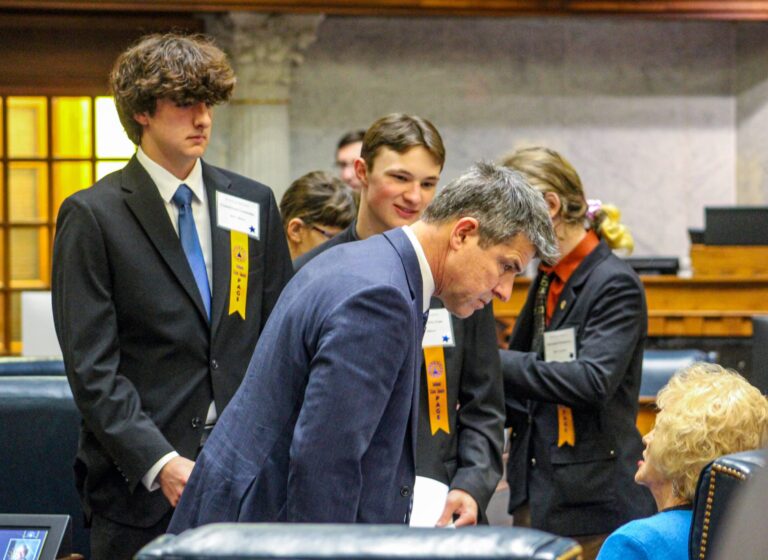
Indiana Senate President Pro Tempore Rodric Bray took a moment to speak with Sen. Vaneta Becker, R-Evansville, while the new Senate Pages were starting their first day. (Photo/Sydney Byerly of The Indiana Citizen)
By Chloe White and Anna Cecil
TheStatehouseFile.com
January 5, 2025
The Indiana House and Senate reconvened Monday afternoon for the first time in 2026, resuming the legislative session that technically began in December with a failed attempt to redraw Indiana’s congressional districts.
Both chambers met briefly to move bills forward with no discussion or debate.
While neither chamber majority leader gave remarks on the floor or after adjournment, Democrats were outspoken about their priorities.
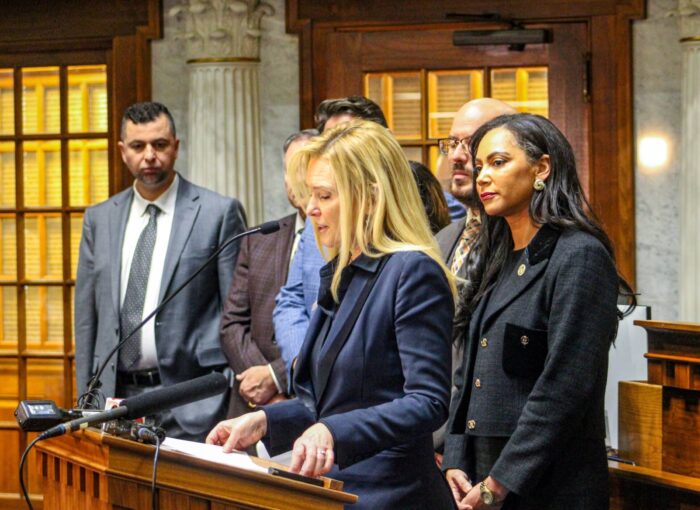
Indiana Senate Minority Leader Shelli Yoder outlined the Democrats’ plan for addressing affordability issues this legislative session. (Photo/Sydney Byerly of The Indiana Citizen)
After the Senate adjourned, members of the Senate Democratic Caucus held a press conference outlining their goals for the remaining eight weeks of the session. Sen. Shelli Yoder, D-Bloomington, said her party’s biggest priority is affordability for Hoosiers, which is “not about politics.”
“The cost of living is rising, and it is getting harder to make their budgets work for them,” Yoder said. “Housing costs are climbing, child care is increasingly out of reach, health care is remaining inaccessible and unpredictable, utility bills keep rising, often without clear explanation. These pressures are not theoretical. They show up every month when families are sitting down at the kitchen table to look at their bills.”
To address the rising cost of housing, Sen. Andrea Hunley, D-Indianapolis, said Senate Bill 205 would allow unused land to be turned into affordable housing by existing faith-based institutions and developers.
“This is a forward-thinking approach that we are excited to bring because it doesn’t rely on speculation or sprawl. It uses existing land, existing infrastructure and existing community partners to help address a real housing need,” Hunley said. “This is about modernizing our housing policies so that Indiana can grow in a way that is fair, that is affordable and that is rooted in communities that people already call home.”
For Hoosiers who need affordable child care, Sen. Rodney Pol, D-Chesterton, said Senate Democrats hope to create the Hoosier Family Insurance Program through Senate Bill 186, which would allow parents to take paid time off to care for new children, including adopted or foster children, as well sick family members. He said the program would operate just like insurance, allowing workers to contribute and employers to match funds.
“This is a smart, practical approach to child-care affordability, and it’s good for today’s workforce,” Pol said. “It helps people stay employed, it helps businesses obtain experienced workers and it strengthens our economy.”
Sen. La Keisha Jackson, D-Indianapolis, addressed proposed new postpartum care options for mothers on Medicaid, which would ensure that new moms have their appointments scheduled within 60 days of giving birth.
“When postpartum care is missed, serious complications can happen,” Jackson said. “New mothers should be able to navigate complicated health-care systems during one of the most critical and vulnerable periods of their lives. … This is how we make health care affordable—by getting care right the first time.”
Sen. J.D. Ford, D-Indianapolis, outlined the Democratic caucus’ plan to lower utility costs for Hoosiers. They hope to cap utility costs at 6% of household income and cap annual rate hikes at 3% per year.
Senate Bill 152 would stop utilities from passing corporate expenses onto households and protect them from service shutoffs during extreme weather. Ford added that new legislation aims to increase transparency for utility bills and, through Senate Bill 79, new data centers, so their growth “does not come at the expense of our existing customers.”
“These proposals reflect a simple expectation,” Ford said. “Hoosiers should be able to afford their utility bills, understand what they’re paying for and trust that decisions are being made in the public interest.”
‘Nickled and dimed’
On Monday, House Democratic Minority Leader Phil GiaQuinta, D-Fort Wayne, re-established the party’s focus for the upcoming seven-week session.
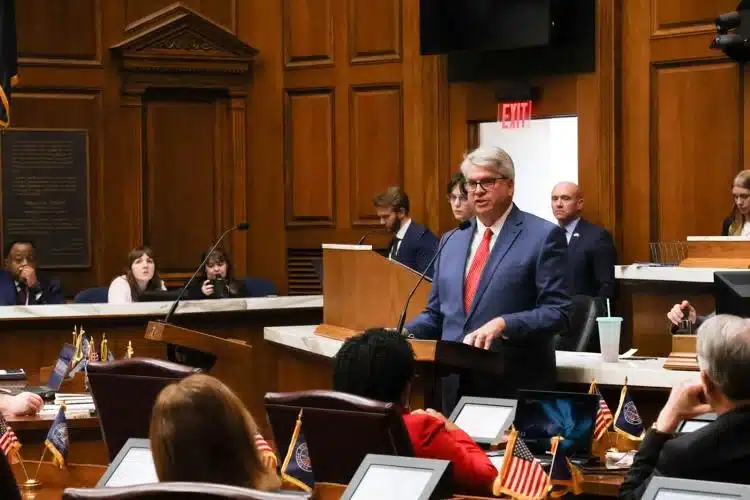
Following a brief introduction from Speaker Todd Huston, GiaQuinta spoke on the traditional point of privilege for the House minority leader, during which he highlighted the working-class Hoosier and focused on the issues of affordable health care, utilities and home ownership. Notably, no House Republicans spoke during the meeting.
Indiana House Minority Leader Phil GiaQuinta addressed the chamber during the Jan. 5, 2026 session. (Photo/Arianna Hunt of TheStatehouseFile.com)
“Hoosiers are getting nickled and dimed to death,” said GiaQuinta. “It’s time to reel in corporate greed, put an end to taxpayer-funded handouts, cap skyrocketing rate highs, and end appointed political cronies as consumer watchdogs.”
Later, GiaQuinta addressed the media alongside Indianapolis Democratic Reps. Cherrish Pryor, Carey Hamilton and Greg Porter. In the meeting, GiaQuinta explained that the Democratic Party will be continuing its previous Working Hoosier Agenda, originally proposed in 2025 and focused on the aforementioned issues.
“You might be feeling some deja vu right now looking at our agenda. … Didn’t House Democrats focus on utilities, housing, health care, child care and public safety last year?” said GiaQuinta. “The answer is yes, our priorities haven’t changed.”
This session, the House Democrats aim to create a property tax credit that would give Hoosiers up to $350 in savings each year. Additionally, there is a push to create a public-private program to split the costs of child care between employers, parents and the state.
“We’ve heard and we know very clearly that child care is a major crisis for families and for our economy,” said Hamilton. (There is a) $4.2 billion annual economic impact from not having affordable child care across the state, so this should be an issue we can work together on.”
Both the Indiana House of Representatives and the Indiana Senate will meet again on Tuesday.
TheStatehouseFile.com is a news site powered by Franklin College journalism students.