By Sydney Byerly
The Indiana Citizen
January 22, 2026
A bipartisan group of Indiana lawmakers are trying again this year to shift the state away from straight-ticket voting – but say they are running into familiar roadblocks that are likely to stymie their hopes of changing how Hoosiers cast their ballots in time for this year’s midterm elections.
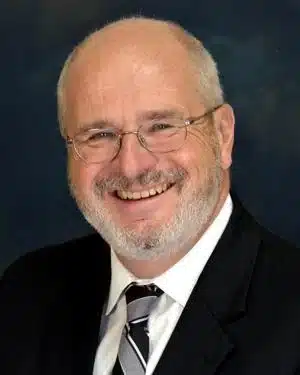
Reps. Ed Clere, R-New Albany, and Cory Criswell, R-Middletown, both proposed bills that would eliminate straight-ticket voting, which allows voters to back a party’s entire slate of candidates by marking one box on their ballots.
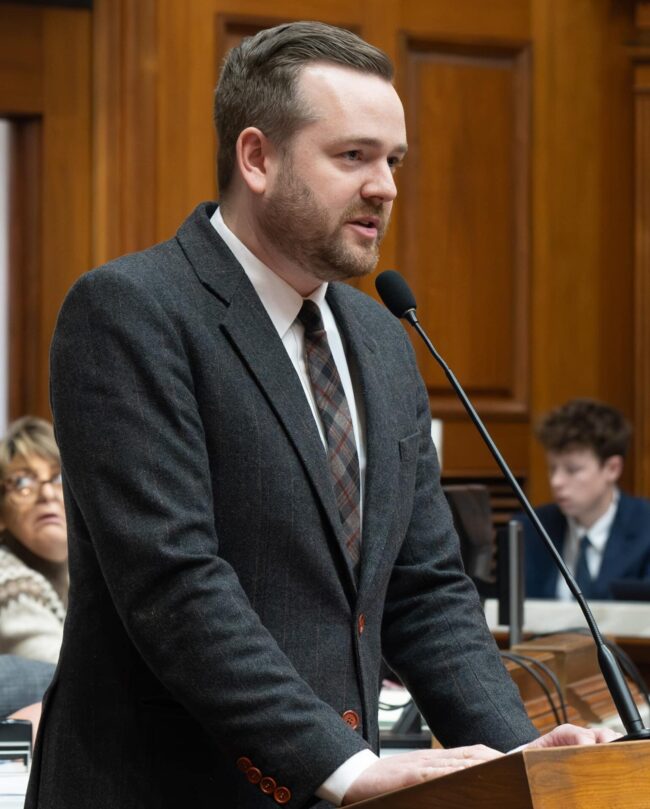
But so far in the General Assembly’s 2026 legislative session, the only bill related to straight-ticket voting to advance in committee is one authored by Rep. Zach Payne, R-Charlestown – and it moves in the opposite direction. Payne’s bill would allow party-line votes to count in some local at-large races, where voters currently are required to select candidates individually. It would undo a change lawmakers made to the state’s voting laws a decade ago.
Asked why years of efforts by lawmakers and advocates for change can’t gain traction at the Statehouse, Clere pointed to the opposition of Lt. Gov. Micah Beckwith and resistance from Rep. Tim Wesco, the Osceola Republican who chairs the House Elections and Apportionment Committee.
“I asked Rep. Tim Wesco to hear the bill, and he told me he wasn’t planning to hear it,” Clere said. “Unfortunately, time is short in this very short session.”
Wesco did not respond to The Indiana Citizen’s multiple requests for comment about his position on straight-ticket voting.
Indiana is one of just six states that allow straight-ticket voting, along with Alabama, Kentucky, Michigan, Oklahoma and South Carolina, according to the National Conference of State Legislatures. While the General Assembly partially eliminated the practice in 2016 by abolishing straight-ticket voting for at-large races, lawmakers and election experts say the resulting hybrid system has only added confusion.
“Voters don’t always understand that they still have to select individual candidates for at-large races when they vote straight ticket,” Clere said. “So they choose not to vote at all.”
Clere, now in his ninth term, said he has authored or co-authored versions of the bill multiple times, first filing it jointly in 2023 with former Rep. Rita Fleming, D-Jeffersonville. He said the issue has only grown more urgent as political divisions have intensified.
“There’s simply too much division,” Clere said. “Partisanship is a big part of what’s driving it. We need to move away from that and try to find ways to come together as elected officials and unite our constituents, our communities.”
Clere’s House Bill 1218 would require voters to make a selection in each race rather than casting a single vote for all of a party’s nominees.
“We should be voting for candidates rather than voting for a party,” Clere said. “Party affiliation is certainly a factor a voter could rely on, but at least the voter would have to make a selection in each race.”
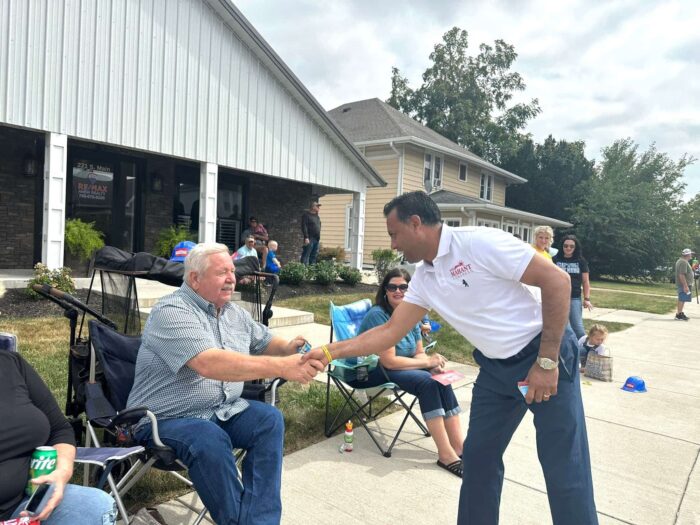
The bill has drawn bipartisan support, including from Rep. Wendy Dant Chesser, D-Jeffersonville, who succeeded Fleming and whose district borders Clere’s.
Dant Chesser said eliminating straight-ticket voting would better reflect voters’ actual preferences and encourage them to learn more about individual candidates.
“I just think it’s time for Indiana to respect our voters and their ability to speak for themselves,” she said. “Just because they have a letter behind their name — an R or a D — they don’t know everything about that candidate.”
She pointed to a personal example from her first campaign in 2024.
“I had a neighbor who came to me and said, ‘My husband is a Republican, but he likes you and he would like to vote for you,’” she said. “He did not know that he could vote for a Democrat because he affiliated with the Republican Party.”
Dant Chesser said that misconception may be more common than many realize.
“If people think they have to choose one or the other based on party, they’re less likely to learn about the other candidate,” she said. “If we encourage them to do so, we will start seeing value in people who may be in a different party than we are.”
Resistance to eliminating straight-ticket voting is not new. Former state Rep. Tom Saunders, R-Lewisville, who served in the House from 1996 to 2022, said he authored similar legislation in 2021 and came close to moving it out of committee before the effort stalled.
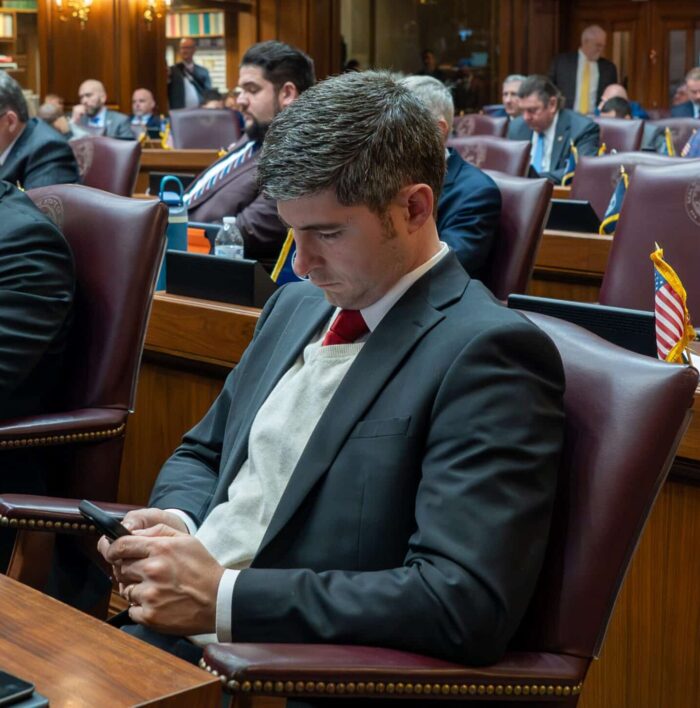
Saunders said the bill appeared to have the votes to advance until, just before a scheduled committee vote, Wesco received a phone call that Saunders believes contributed to the decision not to move the legislation forward. He didn’t offer additional details on who had called or what they had told Wesco.
“I always felt people needed to educate themselves and see who they were voting for to represent them,” Saunders said. “If they just go in there and vote straight party, sometimes they don’t get the best candidate.”
Beckwith has criticized the proposal, making it one of the few bills he has publicly opposed this session.
Beckwith declined an interview request but addressed the issue during a recent episode of his “Ask Micah Anything” segment on his YouTube channel.
In response to a question about why he opposes eliminating straight-ticket voting, Beckwith said the growing ideological divide between the Republican and Democratic parties makes party-line voting a useful tool for voters.
“The ideologies of the Republican and Democrat parties have become so far apart,” Beckwith said. “Straight-ticket voting helps voters know, in general, that they’re voting for the ideology they believe that party represents. If you don’t know what to do, it can be a last resort.”
Clere dismissed the criticism as emblematic of the problem his bill seeks to address.
“The lieutenant governor engages in the sort of hyper-partisan, highly divisive politics that most people are sick of,” Clere said. “His attack on my bill is yet another example of why this legislation is more important than ever.”
Other straight-ticket voting proposals have been filed this session, though only one has advanced to a committee vote so far.
House Bill 1133, authored by Criswell, would eliminate straight-ticket voting outright and make technical corrections to election statutes. Criswell said he filed his bill after constituents raised the issue in a pre-session survey.
After hearing from voters about the issue, he said he included a question on a districtwide survey asking whether straight-ticket voting should be eliminated. About 60% of respondents supported eliminating the practice, Criswell said, prompting him to draft the bill after additional constituents encouraged him to pursue the issue.
“I’m not one to just make rash decisions,” Criswell said. “I’ll ask my district.”
Like Clere, Criswell said he was told by Wesco that his bill was unlikely to receive a hearing this session. Still, he said growing support could help keep the issue alive.
“We have differences of opinion,” Criswell said, “But the more support we can get behind the issue, I think the better off we are.”
Criswell recently signed on as a co-author of HB 1218, and Clere co-authored HB 1133, a symbolic show of support that will likely not affect the bills’ progress this session.
House Bill 1377, authored by Payne, co-authored by Wesco, would expand the use of straight-ticket voting by allowing a single party-line vote to apply to certain at-large races, rather than requiring voters to pick each candidate one by one. The committee unanimously approved that bill on January 14, and it was amended to extend straight-ticket voting to include school board races on the House floor on January 20. It has not yet received a final vote in the House.
Clere said he appreciates the stated intent of Payne and the committee members who supported the bill to reduce voter confusion, but he strongly disagrees with their approach.
“I believe very strongly that the best way to reduce confusion is to eliminate straight-ticket voting and in so doing make it clear to voters that they need to cast a vote in each race in which they want to vote,” he said.
Outside the Statehouse, election reform advocates say eliminating straight-ticket voting is central to improving Indiana’s competitiveness and voter engagement.
Nathan Gotsch, executive director of the nonprofit Independent Indiana, said his organization’s recent study — which analyzed polling, election data and interviews — identified repealing straight-ticket voting as the top recommendation for restoring competitive general elections.
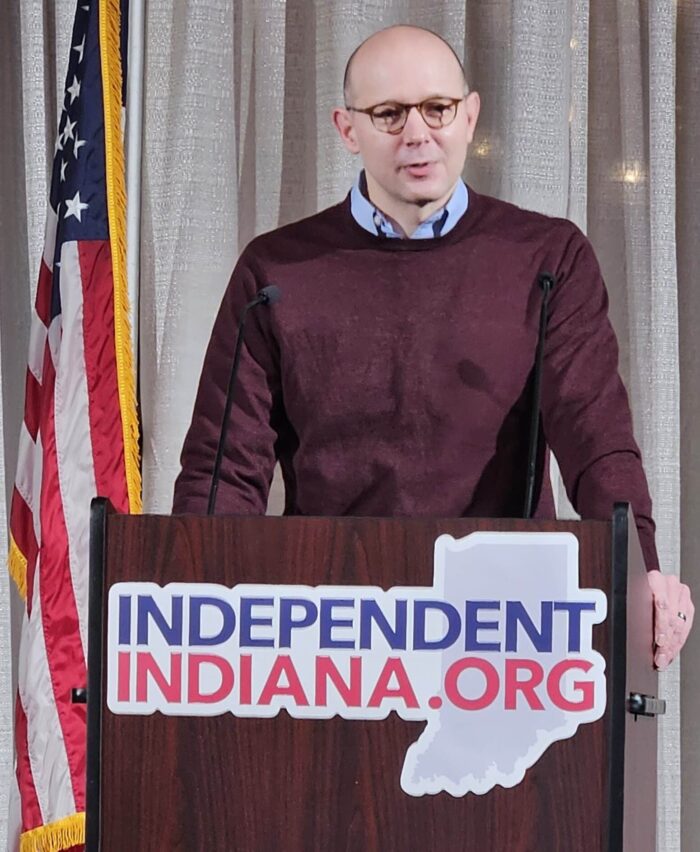
“Most people don’t realize that Indiana is one of only six states that still has it,” Gotsch said. “But we don’t really have true straight-ticket voting. We have this very confusing hybrid.”
That hybrid system, Gotsch said, allows straight-ticket voting in some races but not others, a structure he described as a holdover from older voting technology. The result, he said, is widespread voter confusion and undervoting – voters skipping certain races – particularly in at-large and school board races.
“There’s real concern that voters think straight-ticket votes apply to school board races when they do not,” he said. “That can lead to significant undervotes, and the people who don’t vote straight ticket end up deciding those races.”
Gotsch said his push to eliminate straight-ticket voting is rooted in broader concerns about competition and voter choice — concerns his organization has documented in recent research.
Independent Indiana has underscored those concerns with a new study drawing on polling data, election results and interviews that examines not only straight-ticket voting but the broader decline in competitive races in Indiana. The nonprofit found that over the past two election cycles, 244 independent candidates ran in partisan contests across the state and 52% of them won, despite barriers that make it harder for independents to get on the ballot.
The report also found that a large majority of Hoosiers — including majorities of voters who lean Republican and Democratic — say they would likely support an independent candidate if they agreed with the person’s positions and thought they could win.
“Straight-ticket voting only hurts bad elected officials who aren’t being responsive to their constituents,” Gotsch said. “It doesn’t have any negative effect on good ones.”
Gotsch also said the practice contributes to voter apathy and low turnout in heavily partisan districts, where outcomes are often decided in primaries rather than general elections.
“When one party dominates, what we see is increased voter apathy, lower turnout and oftentimes worse government,” he said. “Elected officials feel more indebted to primary voters, who skew more extreme than the majority of the constituents they’re supposed to serve.”
Sydney Byerly is a political reporter who grew up in New Albany, Indiana. Before joining The Citizen, Sydney reported news for TheStatehouseFile.com and most recently managed and edited The Corydon Democrat & Clarion News in southern Indiana. She earned her bachelor’s in journalism at Franklin College’s Pulliam School of Journalism (‘Sco Griz!).
The Indiana Citizen is a nonpartisan, nonprofit platform dedicated to increasing the number of informed and engaged Hoosier citizens. We are operated by the Indiana Citizen Education Foundation, Inc., a 501(c)(3) public charity. For questions about the story, contact Marilyn Odendahl at marilyn.odendahl@indianacitizen.org.