By Sydney Byerly
The Indiana Citizen
January 22, 2026
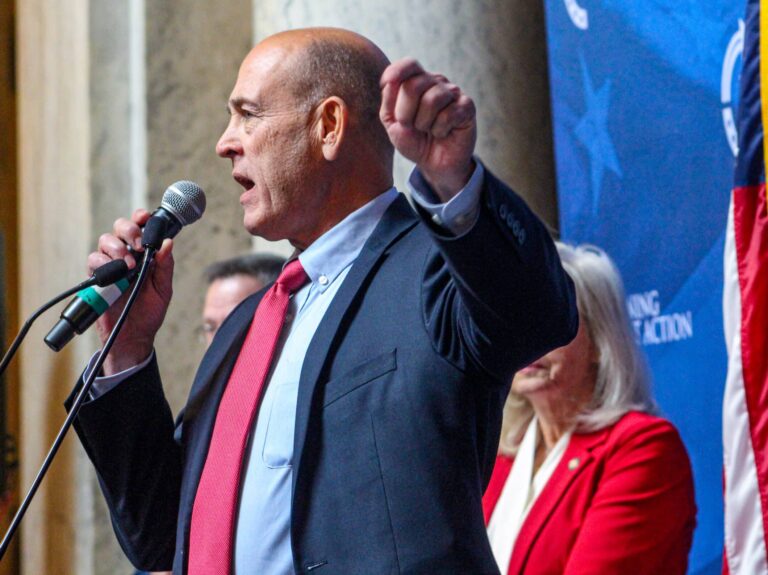
Indiana Senate Republicans are advancing a measure that would require public schools to teach students to wait until marriage to have children and require public colleges to accept an entrance exam that includes Christian thinkers, despite criticism from opponents who argue the proposal reflects Christian nationalist values.
Following a contentious hearing in the packed state Senate chamber on Tuesday, the Senate Education and Career Development Committee voted 7-3 on party lines to send Senate Bill 88 to the full Senate, with all of the committee’s Republicans supporting the bill and the Democrats who were present for the vote opposing it.
The bill’s author, Sen. Gary Byrne, R-Byrneville, did strip some of the bill’s most controversial elements ahead of the vote. Byrne’s amendment struck a provision that would have required middle school civics courses to address the meaning and significance of a list of historic documents that includes the Ten Commandment. It also would have mandated a comparative discussion of political ideologies, including communism and totalitarianism, and restricted how civics instruction could address race, gender identity and systemic inequality.
Add the Classic Learning Test, a conservative-backed standardized exam that emphasizes classical literature and Christian thinkers, to the list of college entrance exams state colleges and universities are required to accept, alongside the ACT and SAT.
Expand statutory language on “good citizenship” instruction, requiring schools to teach students the importance of obtaining high school degrees, securing full-time jobs and waiting until marriage to have children.
When asked by The Indiana Citizen after the vote about criticism from church-state separation advocates who characterized the bill as reflecting Christian nationalist values, Byrne rejected the label.
“This is to teach the history of our country,” he said. Byrne defended the stripped language requiring civics courses to address the Ten Commandments, arguing they reflect Judeo-Christian beliefs that influenced the nation’s founding.

Sen. Spencer Deery, R-West Lafayette, said he acknowledged that the civics course requirements that were removed from the bill Tuesday were “controversial and probably needed some more work.”
But he said he rejected criticism of the bill as reflecting Christian nationalist values.
“It should not be controversial to tell kids, ‘Don’t have kids before you’re married.’ It should not be controversial to tell kids to finish school. It should not be controversial to tell kids, ‘Get a job,’” Deery said. “And if that’s controversial, then society is in worse shape than we think.”
But Senate Minority Leader Shelli Yoder, D-Bloomington, said she is concerned about the provision linking citizenship instruction to waiting until marriage to have children.
“How will we instruct that?” she asked. “What does that lesson look like?”
Committee Republicans framed the bill as grounded in social science and anti-poverty policy, while Democrats argued it risks stigmatizing students and imposing moral instruction under the guise of civics education.
During Tuesday’s hearing, Deery defended the “success sequence” embedded in the bill — the idea that finishing school, working and marrying before having children increases economic stability.
“That research is bipartisan and decades old,” he said, citing studies from the Brookings Institution and the American Enterprise Institute. “One of the jobs of schools is to tell kids the truth. Avoiding the topic because it may be uncomfortable does a disservice to students, particularly those growing up in poverty.”
Opponents, however, raised concerns about the impact on students whose families do not fit that model.

“It stigmatizes how students view their own identity within their families,” Yoder said.
She described the language as “fraught with shame” and questioned whether it belongs in civics courses, adding that it sends a “complicated message” about who qualifies as a good citizen.
Sen. Fady Qaddoura, D-Indianapolis, repeatedly pressed Byrne on how he determined what constitutes “good citizenship” and why certain values would be codified with this bill, while others were excluded.
“Who decides what good citizenship looks like?” Qaddoura asked, questioning whether the legislature should be defining those standards rather than educators and local communities.
He also asked why the bill emphasizes family structure and marriage but does not address skills such as conflict resolution or social-emotional learning.
Byrne said lawmakers could amend it in the future if additional elements are needed, but said it was not unreasonable to advance the bill as written.
During 90 minutes of public testimony, home-school parents and classical school representatives praised the Classic Learning Test, arguing it aligns with classical curricula.
“This gives our students a fair shot,” one advocate said, noting the test’s rigor and growing college acceptance.
Educators and other opponents spent little time on standardized testing, focusing instead on the civics and citizenship language.
Multiple speakers warned that tying instruction to family structure or moral behavior risks marginalizing students and families whose experiences differ from the bill’s framework.
“This is not civics — this is moral instruction,” one educator told lawmakers.
Sydney Byerly is a political reporter who grew up in New Albany, Indiana. Before joining The Citizen, Sydney reported news for TheStatehouseFile.com and most recently managed and edited The Corydon Democrat & Clarion News in southern Indiana. She earned her bachelor’s in journalism at Franklin College’s Pulliam School of Journalism (‘Sco Griz!).
The Indiana Citizen is a nonpartisan, nonprofit platform dedicated to increasing the number of informed and engaged Hoosier citizens. We are operated by the Indiana Citizen Education Foundation, Inc., a 501(c)(3) public charity. For questions about the story, contact Marilyn Odendahl at marilyn.odendahl@indianacitizen.org.