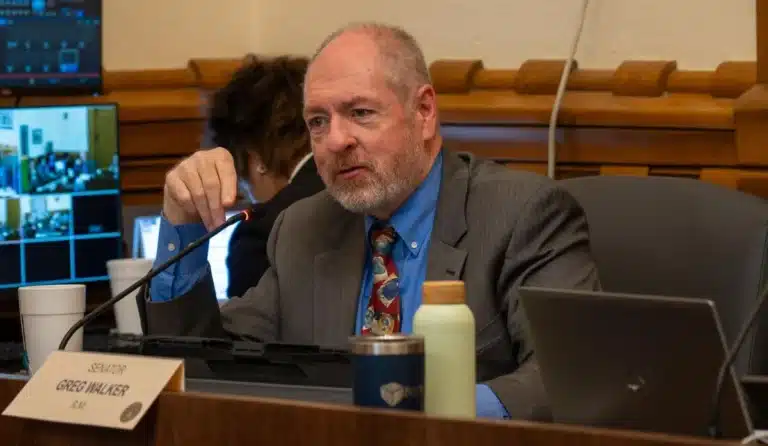
During the Senate Elections Committee hearing, Sen. Greg Walker, R-Columbus, said ranked-choice voting could sow confusion among voters. (Photo/Connor Burress of TheStatehouseFile.com)
This story was originally published by TheStatehouseFile.com.
By Luke Shepherd
TheStatehouseFile.com
January 19, 2026
Ranked-choice voting has grown in recent years, now used in 52 different U.S. cities, counties and states, most notably in Alaska, Maine and New York City.
Indiana’s only cases of using ranked-choice voting came in primaries or nominations, once in 2020 and also 1912. However, the state is making quick progress on a bill to ban it.
Senate Bill 12, which would set a statewide prohibition on ranked-choice voting, passed committee and its second reading in the Indiana Senate, and it now heads for a final vote on Tuesday.
Ranked-choice voting is when you as the voter can rank all candidates on the ballot in your order of preference. For example, if you were to rank your candidates 1 through 4, whoever you put as first on your ballot would count as your vote.
However, if that candidate were eventually unable to win, your vote would be given to whoever ranked second on your ballot. If that candidate also failed to stay in the race, your vote would then count for the next candidate, and so on.
Additionally, if one candidate does not end up receiving a majority of the first-place votes, whoever has the least first-place votes is eliminated. Those are the first ballots that then go down to the next ranked candidate.
Proponents of ranked-choice voting say it can potentially limit any special primary elections as well as reduce polarization or negativity in campaigns. If someone spends their entire campaign attacking their opponent rather than discussing policy, it might be harder to win an election on a ranked-choice ballot than in a normal voting process where it is essentially one candidate versus the other.
Critics however, have pointed to issues related to some ballots not counting due to mistakes in how they are filled out. For example, if someone had chosen or forgotten to rank one of the candidates on the ticket, that ballot would not count at all. A lack of clarity on the rules for voters could potentially impact elections in unprecedented ways.
Right now, seven states have laws authorizing or mandating the use of ranked-choice voting, but 17 states have prohibited it.
In the Senate Elections Committee
Sen. Blake Doriot, R-Goshen, author of the bill, referred to the 17 other prohibitions across the country as a “movement to stop ranked-choice voting.”
“In the United States, we have always been about one vote, one person,” Doriot said.
Speaking on behalf of the League of Women Voters, Barbara Tully argued against the bill and offered her support for ranked-choice voting, describing it as a way to limit the “toxicity of negative campaigns” and relieving the pressure of choosing between parties.
“Banning ranked-choice voting in Indiana is bad for public policy and may very well be informed by most studies lacking intellectual rigor,” Tully said. “Indiana should be better than to rely on using flawed research to make policy decisions.”
Heritage Action lobbyist and Allen County Councilman Paul Lagemann testified in support of the bill. Lagemann pointed out that voters could feel disenfranchised with their vote potentially not counting.
“Ranked-choice voting fundamentally changes the election process and is part of the problems,” Lagemann said. “Ranked-choice voting is a gimmick that would undermine Hoosier elections and all the hard work done over many years to ensure voter confidence.”
Committee member Sen. Greg Walker, R-Columbus, pointed out that in 2020, the Republican Party successfully used ranked-choice voting to select statewide delegates for candidacy, and Walker said it went “very smoothly.”
“My concern has always been the fact that it had difficulty passing at the state level,” Walker said. “I didn’t want to see voters going to the polls one year and having ranked-choice vote as an option and, in the subsequent year, when there are other municipal elections happening, having no such options.”
However, Walker ultimately voted “yes” to the bill to “get it over with.”
The bill ended up passing 7-2 along party lines and headed to its second reading.
In the Senate
During its second reading in the Indiana Senate, Walker reminded his fellow senators that this bill would ban ranked-choice voting for any sort of nomination or election process and that the Republican Party did implement ranked-choice voting in 2020.
Sen. Andrea Hunley, D-Indianapolis, proposed an amendment that would delay the ban until July 2027. The amendment also urged the legislative council to pursue a strong study in how ranked-choice voting actually affects elections.
Sen. Chris Garten, R-Scottsburg, questioned Hunley on her knowledge of issues in the counting process in ranked-choice voting. Garten cited examples where he believes ballots were being “trashed” in elections using ranked-choice voting.
“I look forward to receiving your support on this common sense amendment to just allow us to study something and not rush to making rash decisions that might be based off facts that we don’t fully understand,” Hunley said.
The amendment ultimately did not pass despite seeming to receive bipartisan support. The bill now heads to its third reading in the full chamber.
Luke Shepherd is a reporter for TheStatehouseFile.com, a news site powered by Franklin College journalism students.
📩 Sign up to have the top stories from around Indiana sent to your inbox every week.