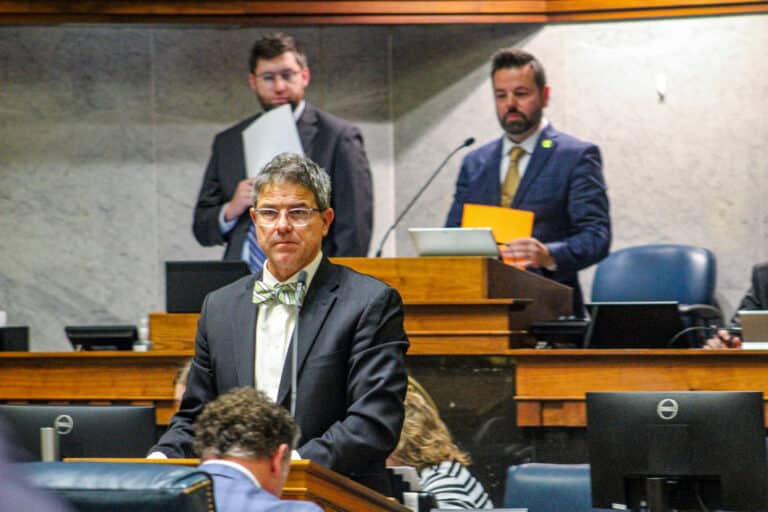
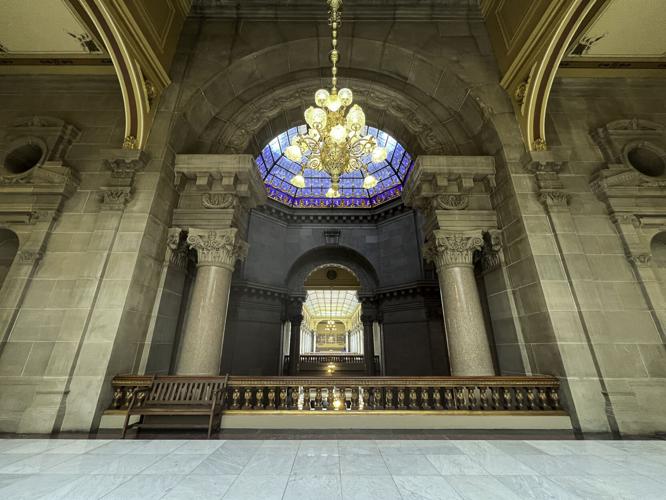
Senate President Pro Tempore Rodric Bray, R-Martinsville, addressed the Senate on the eve of when the chamber is expected to vote on redistricting. (Photo/Sydney Byerly)
By Anna Cecil TheStatehouseFile.com December 10, 2025
On the third day of redistricting discussions in the Indiana Senate, Democratic lawmakers proposed three amendments, all of which failed along party lines in voice votes.
Amendment authors Sen. J.D. Ford, D-Indianapolis, Sen. Faddy Qaddoura, D-Indianapolis, and Sen. Lonnie Randolph, D-East Chicago, gave only brief introductions and closing statements for their amendments. Qaddoura and Ford have said several times this week that they will save their full arguments for Thursday’s third reading in the Senate, which will take place before House Bill 1032’s final vote in that chamber.
Qaddoura’s amendment would have deleted the contents of HB 1032 completely and added language to prohibit mid-cycle congressional redistricting.
Ford’s amendment would have required county clerks to submit their expenditures for implementing HB 1032 to the state for reimbursement. Marion County Clerk Kate Sweeney Bell told the Senate Elections Committee Tuesday that her county alone could incur costs of up to $1 million to enact the bill.
Randolph’s amendment would have removed sections of HB 1032 that require legal challenges to go directly to the Indiana Supreme Court. As the bill is written, the Supreme Court has “mandatory and exclusive jurisdiction over any appeal,” meaning the bill could not be contested in any lower courts.
Sen. Mike Gaskill, R-Pendleton, was also brief in urging no votes from the chamber.
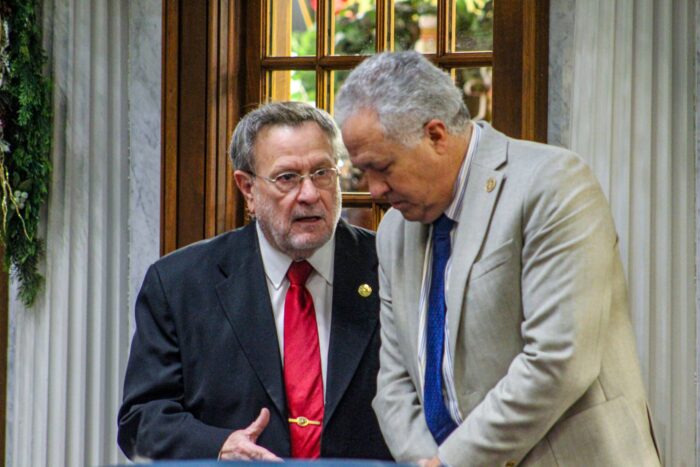
Sen. Michael Young, R-Indianapolis, talked to Sen. Mike Gaskill, R-Pendleton, off to the side of the Senate chamber during the discussion of amendments to the redistricting bill. (Photo/Sydney Byerly)
Sen. Michael Young, R-Indianapolis, on the other hand, took to the podium for his third point of personal privilege this week and gave a long speech in favor of the bill, providing lawmakers with a handout with data from the 2024 presidential election between former Vice President Kamala Harris and President Donald Trump.
Young said that based on that data, the Republicans in Congress are being hurt by 20 seats and the Democrats are being helped by 10.
He accused anti-redistricting protesters, several of whom were standing at the Senate chamber’s public viewing window, of being paid protesters and not a true representation of how Hoosiers feel about redistricting.
“They’re only Democrats because they can get off work and are paid to be there,” Young said. “I don’t see any Republicans doing that. You know, our guys are working. … I want people to have to take off work to come to town and see me.”
After the session adjourned, Ford told TheStatehouseFile.com that he was disappointed in Young’s remarks.
“Some of those folks, you know, that were out there were friends and family members and colleagues who also took time off from their day to come down and exercise their First Amendment rights,” Ford said. “I think no matter where you fall on this issue down here, or on any issue, people have the right to come down here to express their thoughts and feelings. We want that. We welcome that.”
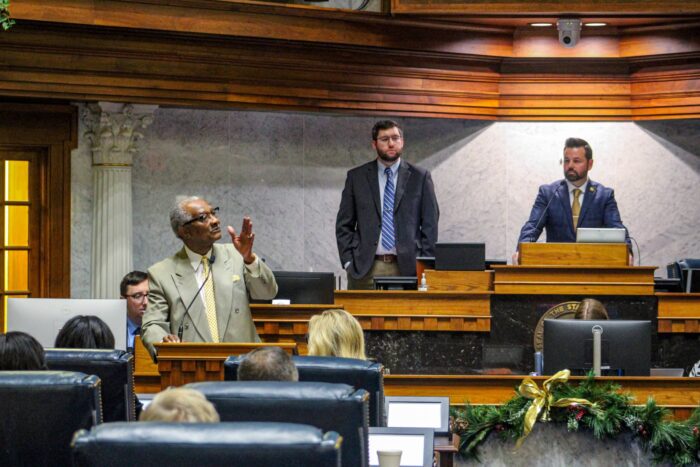
Sen. Lonnie Randolph, D-East Chicago, offered an amendment to remove the provision in the redistricting bill that gives jurisdiction to the Indiana Supreme Court. (Photo/Sydney Byerly)
Judy Wilson, a protester who has been at the Statehouse nearly every day for the past two weeks, said Young’s accusation made her “act out.”
“I lost control of my signs,” she said, “obviously flustered beyond belief.”
TheStatehouseFile.com also reached out to Laura Merrifield Wilson, associate professor of political science at the University of Indianapolis, for a broader perspective.
“I could not speak to whether protesters opposed to redistricting are paid in any capacity, but several successive polls conducted throughout the fall suggest a majority of Hoosiers do not support redistricting, so there is no reason to believe this kind of protest is manufactured or anything short of genuine and honest,” she said in an email.
“Claiming that is an easy attack because it is nearly impossible to prove or counterprove, for that matter, but it immediately challenges the authenticity of disagreement and aims to reinforce the belief that no one could truly be opposed, … so they would have to be hired, bussed in, staged, or paid in order to do so.
She added: “The veracity of these claims are further undermined by our terse political climate in which it seems nearly every issue is a divisive one, with as many people in support of a measure as those who are opposed to it. For redistricting in Indiana, Hoosiers are very much divided on the issue, so we undoubtedly have many people who are angry, energized, and would certainly turnout to the Statehouse to vocalize their opinion.”
Anna Cecil is a reporter for TheStatehouseFile.com, a news site powered by Franklin College journalism students.