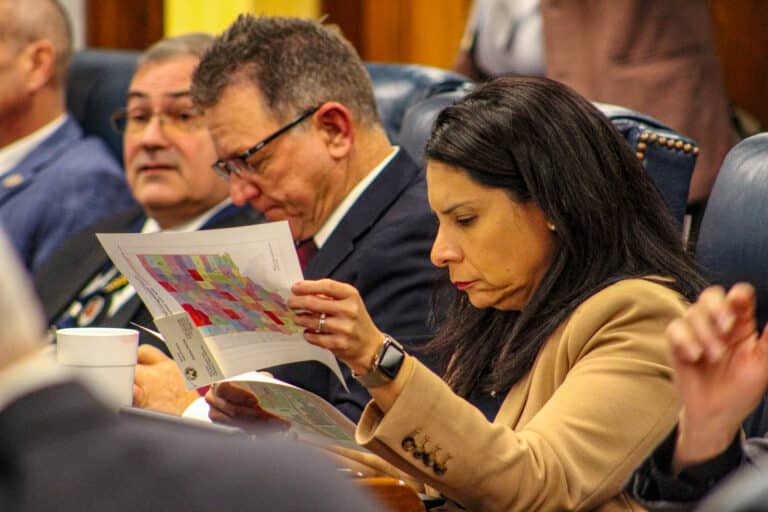
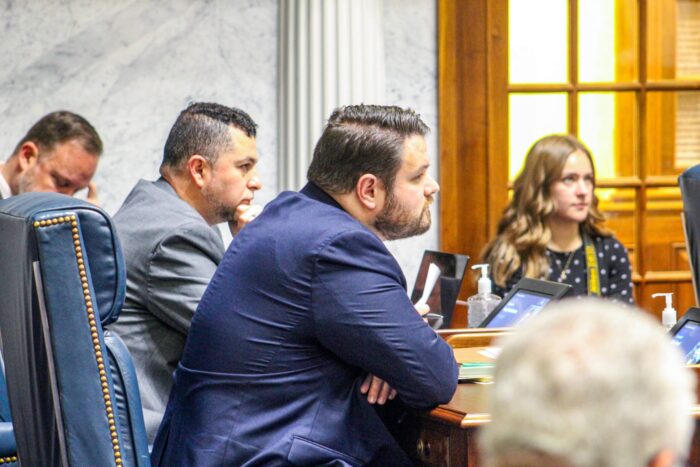
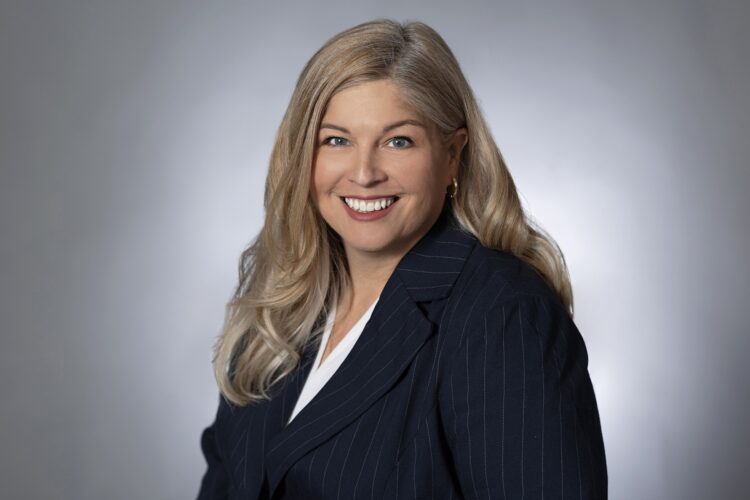
Sen. Cyndi Carrasco, R-Indianapolis, and other Republican lawmakers examined the proposed map during the Senate debate on redistricting. (Photo/Sydney Byerly)
By TheStatehouseFile.com and The Indiana Citizen December 11, 2025
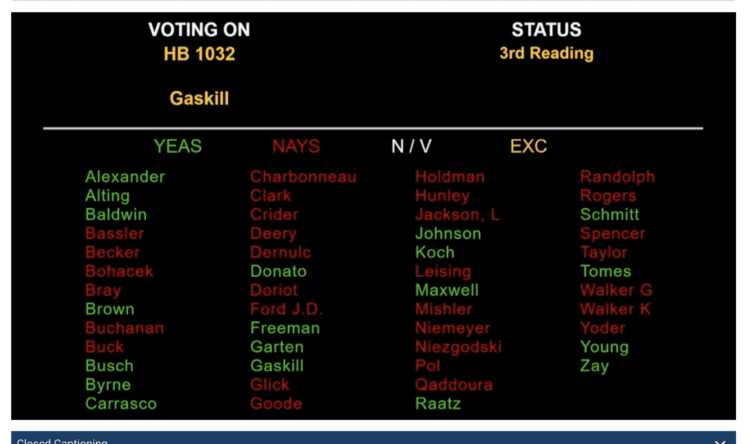
Voting 31-to-19 against redrawing the state’s congressional district map, the Indiana Senate brought to a close on Thursday a four-month brawl over redistricting that split the Republican supermajority and drew the ire of President Donald Trump.
Senate President Pro Tempore Rodric Bray, R-Martinsville and six members of the GOP leadership joined all the Democrats in voting down House Bill 1032, the redistricting legislation.
The three-plus hour senate session was tense with the split in the Republican caucus on display. Some members of the supermajority rose to speak in support of redistricting, painting a dire picture of the country if Indiana did not send the “legislative cavalry” to Congress. Other members of the GOP caucus warned redrawing the map would sow distrust in the integrity of elections and democracy.
Gov. Mike Braun, who supported redistricting and pushed the issue by calling the legislature into special session especially to consider reconfiguring the state’s congressional map, said, after the vote, that Indiana could face retribution from the White House.
“I am very disappointed that a small group of misguided State Senators have partnered with Democrats to reject this opportunity to protect Hoosiers with fair maps and to reject the leadership of President Trump,” Braun said in a statement. “Ultimately, decisions like this carry political consequences. I will be working with the President to challenge these people who do not represent the best interests of Hoosiers.”
After the vote, Senate Minority Leader Shelli Yoder, D-Bloomington, said she was relieved and happy for Hoosiers
“Today the real winners are Hoosiers,” Yoder said. “Hoosiers have continued to make their voices known and have been very definitely working hard to organize and mobilize from (Republicans) to (Democrats) to (Independents) to the younger generation who haven’t really rallied around anything, but when it came to this bill, it really struck a nerve, and we we heard that out in the state house today, and we certainly have heard it for the last almost five months. So it’s been a win for Hoosiers.”
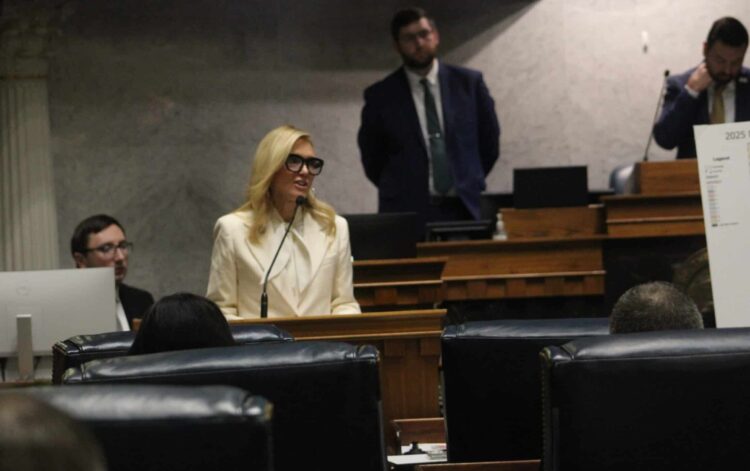
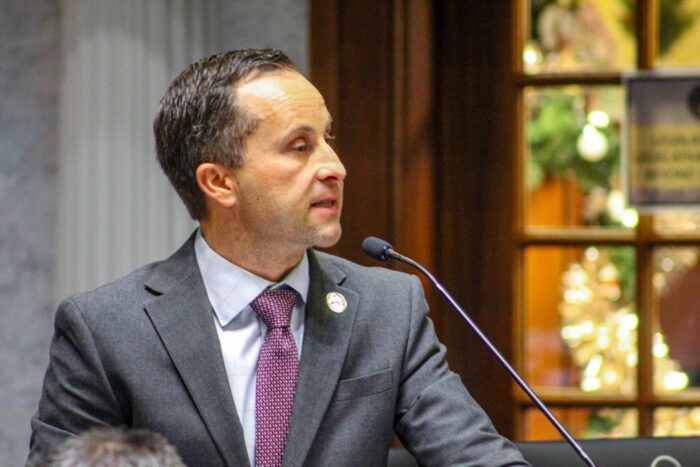
Senate Minority Leader Shelli Yoder, D-Bloomington, spoke against redistricting during the debate in the Indiana Senate on Dec. 11. (Photo/Sydney Byerly)
‘We can put this mess behind us’
Seven of Indiana’s nine seats in the U.S. House are currently held by Republicans. The Trump administration has been pressuring the Hoosier State to change its map to give all the seats to the GOP in order to counter the blue wave that is expected to sweep the 2026 mid-term November election.
Bray said Indiana Republican senators want the GOP to stay in the majority on Capitol Hill, but many in his caucus were not convinced that redrawing the map mid-cycle would guarantee that outcome. Further, he said, the Republican caucus are supportive of Trump “on important issues like immigration enforcement and public safety.”
Even so, Bray defended the senate vote, saying the supermajority extensively reviewed the redistricting bill, took a lot of public testimony and fully vetted the legislation in committee before culminating in Thursday’s debate.
“We finally have a resolution now,” Bray said following the vote. “It really comes down to an issue of having the same goal, but a different way to process that. … There are some concerns that going this (redistricting) route is not the best way to get more conservative representation in Washington, D.C., from the state of Indiana.”
Lawmakers had to wait until Dec. 1, the first day of the early session, before the new redrawn map was unveiled. The reconfiguration targeted the 1st and 7th Congressional Districts, which are held by Democratic Reps. Frank Mrvan and Andre Carson, respectively, and home to the state’s largest minority populations.
Marion County, which comprises most of the 7th district, was split among four separate congressional districts, including two which stretch all the way down the state to the banks of the Ohio River. Lake County, which is part of the current 1st district in northwest Indiana, is separated from Porter and LaPort counties and lumped in with several rural counties in the north central part of the state.
Repeatedly throughout the session, Rep. Ben Smaltz, R-Auburn, who authored the redistricting bill, and GOP lawmakers supporting the new map have said the districts were redrawn solely for the purpose of giving Republicans a political advantage. House Democrats, particularly members of the Indiana Black Legislative Caucus, hammered on concerns that the reconfiguration would dilute minority communities and disenfranchise minority voters.
Applauding the outcome, the IBLC immediately pivoted to the economy, reiterating the theme of Indiana Democrats throughout the redistricting battle.
“For four months, the conversation has been centered around whether Republicans in the Indiana General Assembly will redraw our congressional maps,” Rep. Cherish Pryor, D-Indianapolis, said in a statement. “Finally, we can put this mess behind us to focus on what Hoosiers really need, like more affordable utilities, healthcare, childcare, housing and groceries.”
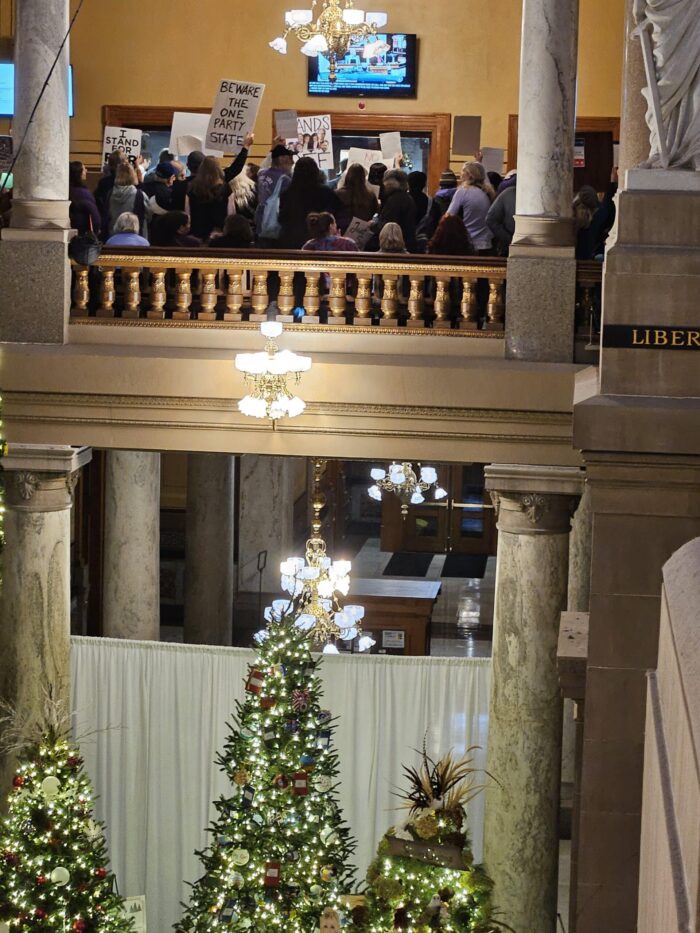
Opponents of redistricting crowded outside the Indiana Senate chamber as lawmakers debated and eventually defeated House Bill 1032. (Photo/Marilyn Odendahl)
Opposition screamed in delight
The energy outside the Indiana Senate following the historic 19-31 vote on HB 1032 was electric. After four hours of nonstop chanting, the voices of many members of the crowd were growing hoarse as the final vote was taken.
Protestors clothed in purple outfits and plastic pig noses held their breath as lawmakers voted on the controversial bill on mid-cycle redistricting.
When the final count was announced, people in the crowd screamed in delight, cried, and embraced friends and strangers alike.
Julia Vaughn, policy director at Common Cause Indiana, has worked nonstop for the past four months to prevent mid-cycle redistricting. She spoke to TheStatehouseFile.com with tears in her eyes following the vote.
“I am so relieved, so happy. I know we have worked so hard for four months, and there was so much on the line,” said Vaughn.” “I am so proud of Hoosiers for standing up to this, I am so proud to be a Hoosier today—to be the first state to take a stand to the Trump administration and say no, we’re not going to cheat.
“It means everything. This is the biggest win I’ve ever had at the General Assembly,” she said.
Mark Smith was among the loudest protestors outside the Indiana Senate; he screamed, stomped and chanted things like, “Hoosiers don’t cheat,” and “Just vote no.”
“They were trying to rig our elections so we would be silenced, but no, this is what happens when people unite, stand up and fight back. We can accomplish everything,” said Smith. “They forgot that we have the power, the country was built on ‘we the people’ having power.”
Gerrie Bonarrigo, Angie Forman, and Sandra Jonasen met this March at a rally and have been attending political events ever since. The trio agreed they felt excited following the Senate vote.
“We’re elated, but know we still have a fight to achieve and accomplish,” said Forman.
Michael Burton is a father and a disabled veteran who began protesting the current administration when he said Veterans Affairs began to be affected within the state.
“It’s the first step back to where our country needs to be,” he said. “We’ve got the most corrupt administration in D.C. at this time. This is a good step, I’m surprised, I’m impressed, and I would even thank the Republican senators who voted no.”
Outside the Senate, hundreds of Hoosiers across demographics had reacted to the testimony of Indiana senators with comments and chants that could be heard inside the chamber and on the Indiana General Assembly’s website livestream.
The rally, organized by MADVoters Indiana, encouraged Hoosiers to “pack the Statehouse in purple for fair maps.” One protester explained that the choice of purple was intentional and meant to represent both the Democratic and Republican parties.
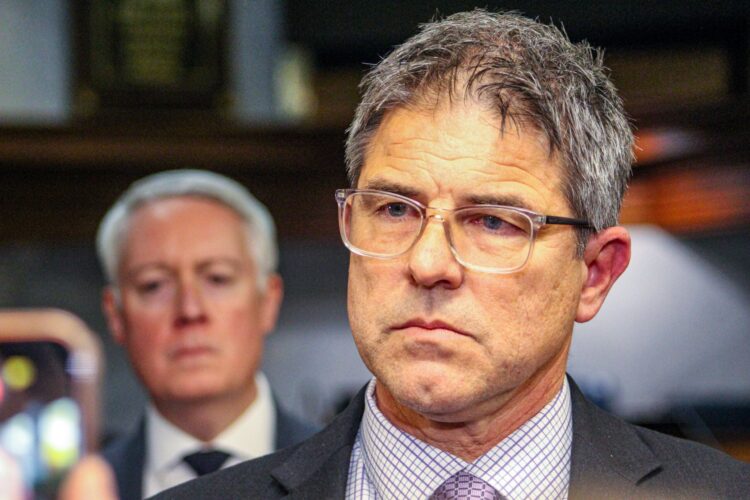
Indiana Senate President Pro Tempore Rodric Bray, R-Martinsville, said after the vote, “It’s time to turn the page.” (Photo/Sydney Byerly)
A reversal on reconvening
For weeks, Bray said the Republican caucus in the upper chamber did not have the votes to pass a new map. In mid-November, he rebuffed Gov. Mike Braun’s call for a special session by announcing the Senate would not be reconvening to debate redistricting.
However, two days before the Thanksgiving holiday, Bray and House Speaker Todd Huston, R-Fishers, said the legislature would start the 2026 legislative session early by returning in December. Topping the agenda was redistricting.
Bray said the Senate reversed course because the state was “feeling a lot of strife” over whether the legislature would consider this issue. Legislators felt starting the session early and tackling redistricting was appropriate, he said.
When lawmakers returned Dec. 1, individuals and voter-advocacy groups who had been rallying and protesting against redistricting for months, were at the Statehouse in force. Leaders of those organizations gathered outside the upper chamber on Thursday to make a final plea shortly before the senators took the final vote on HB 1032.
“What we’re witnessing now is a rushed mid-cycle process that breaks that trust and threatens to silence the communities already fighting the hardest to be heard,” said Rev. David Greene, president of the Concerned Clergy of Indianapolis.
“Let’s be clear, this is not about data. It’s about domination. It’s not about representation. It’s about control. When maps are drawn behind closed doors without genuine public input, the harm is not theoretical. It’s real. It lands on real neighborhoods, real families, and especially on black communities, whose political voice has been chipped away for decades.”
Sen. J.D. Ford, D-Indianapolis, was among the first Democrats to rise in opposition of the bill Thursday afternoon. Sen. Faddy Qaddoura, D-Indianapolis, sits to his left. (Photo/Sydney Byerly)
Democrats talk about merit
Sen. J.D. Ford was among the first Democrats to rise in opposition of the bill Thursday afternoon. During his speech, he emphasized the need for “merit” in elections.
“Like so many of you, I believe in the power and importance of merit, and I trust the people of our state,” Ford said. “ I know in my heart that those two things should be the driving determinant of who wins an election.”
Sen. Faddy Qaddoura, D-Indianapolis, also used the term “merit” in his speech.
“I’ve always believed, always believed, that any political party on earth,that cannot run and win based on the merit of its ideas, is unworthy of governing,” Qaddoura said.
Back in January, Gov. Mike Braun signed an executive order to eliminate diversity, equity and inclusion and replace it with “merit, excellence and innovation” in state government agencies.
Braun was an outspoken supporter of redistricting, which Ford said Thursday would eliminate merit in elections.
Sen. Mike Gaskill, R-Pendleton, urged lawmakers to vote for redistricting to counter efforts by blue states to send more Democrats to the U.S. House. (Photo/Sydney Byerly)
‘Vote of critical, epic proportion’
The handful of Republican senators who took to the podium to urge their colleagues to vote yes on redistricting argued the country’s future was hanging in the balance.
“The vote we are about to take is not simply procedural,” Sen. Chris Garten, R-Charlestown, said. “It’s not just about lines on a map. It’s a vote of critical, epic proportion that will define Indiana’s role in the recovery of this republic.”
Supporters of redistricting have said throughout the months of wrangling that Indiana needed to redraw its congressional map to counter blue states that are sending Democrats to Capitol Hill. They have warned that a Congress under Democratic control would block President Trump’s agenda and, in their view, put America on a downward spiral.
Garten spoke at length, blaming the Biden administration for the opioid epidemic, an open border that let illegal drugs and human trafficking in the country, and a “relentless and ideological war on coal” that has caused utility costs to skyrocket. Also, he praised Trump’s actions to secure the border and said Indiana could “guard that progress” by sending two additional Republican representatives to Washington, D.C.
At times visibly angry, Garten dismissed concerns about the unprecedented move to redistrict mid-decade.
“We have the constitutional right and, I would argue, the moral obligation to draw the districts that reflect the political will and the values of the people who elected us,” Garten said. “I’m not here to argue the legalities. I’m here to argue the necessity. The White House, our partners in Washington, have asked us for help.”
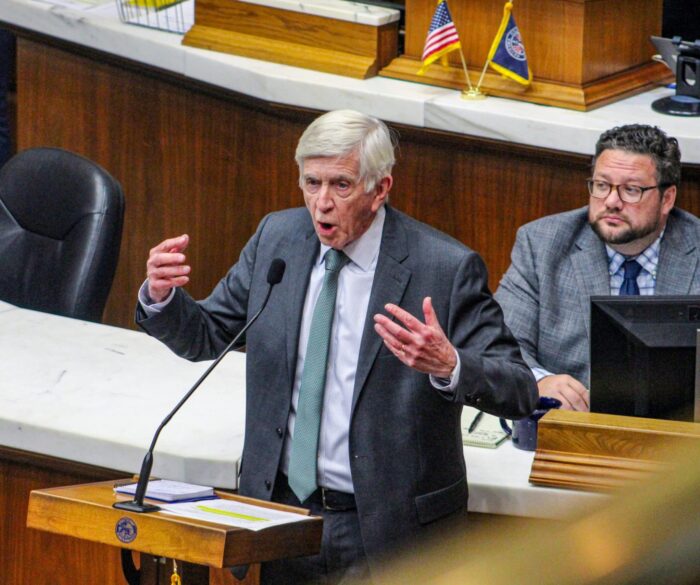
Sen. Mike Gaskill, R-Pendleton, sponsored the redistricting bill in the senate and was the last legislator to speak before the chamber voted. During his remarks, he invoked his religious beliefs and described himself as a “little country boy conservative from Pendleton” who runs on sweet tea and potatoes.
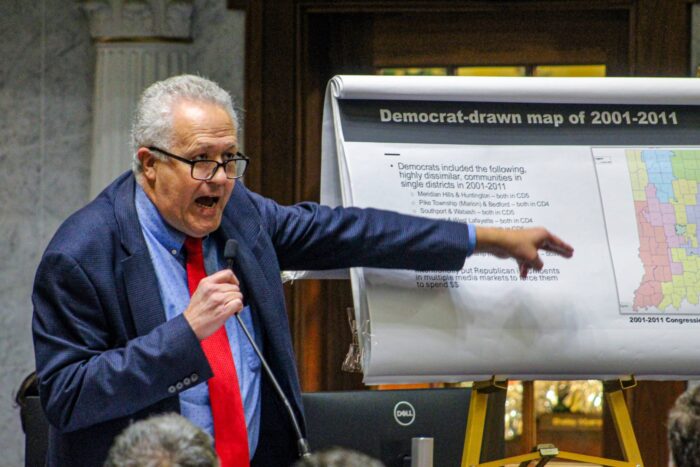
Gaskill used an oversized display to show what he claimed were congressional districts drawn to give the electoral advantage to Democrats in states like Illinois, Massachusetts and New Mexico. He said Republican-led states like Texas and Missouri were finally fighting back and that Indiana needed to stand up as well.
“Look what the voters of Indiana have told the Democrat Party in recent years, but they’re determined to win anyway,” Gaskill said, referring to Democrats failing to win statewide offices in the past several election cycles. “Do you have the will to stand in the gap and fight back? I’ll submit to you even further; I’ll double down on the war analogy. I’m going to submit to you that the second U.S. Civil War has already started.”
Sen. Spencer Deery, R-West Lafayette, told the Senate Thursday that his no vote on redistricting did not contradict his conservative values. (Photo/Sydney Byerly)
Opposition driven by conservative principles
During the debate, Sen. Spencer Deery, R-West Lafayette, took the podium after being seen writing and revising a statement during debate over the bill.
He said his vote against redistricting is in line with his conservative religious, constitutional and fiscal values.
“I have no problem telling you what a woman is and that men should not be playing in female sports,” Deery said. “My opposition to mid-cycle gerrymandering is not in contrast with my conservative principles. My opposition is driven by them. The power to draw election maps is a sacred responsibility directly tied to the integrity of our elections and the people’s faith in our constitutional system.
He continued: “That is not what conservatives stand for, nor do we believe that the federal government should have the ability to dictate by threat, or other means, what should happen in our state. We are a co-equal force of government, or at least we are supposed to be, and as long as I have breath, I will use my voice to resist a federal government that attempts to bully, direct, and control this state or any state.”
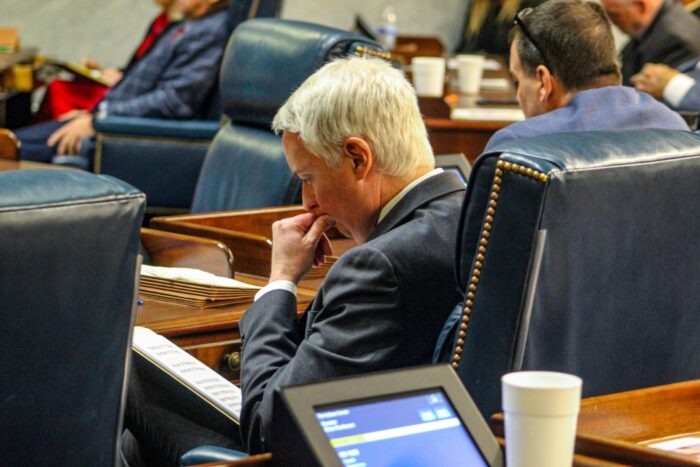
Sen. Greg Goode, R-Terre Haute, reviews his remarks before his floor speech during the Senate debate on redistricting. (Photo/Sydney Byerly)
Lawmakers threatened with political violence
Sen. Tyler Johnson, R-Leo, rose in favor of the map and dismissed the power of the threats his colleagues have received.
“Threats are easy for me,” he said. “Easy.”
He told the Senate that if they could step away from the “emotion of this moment,” their decision to vote yes should also be easy.
As of Dec. 11, nearly a dozen Indiana Republican lawmakers were subject to threats or swatting attempts. Wednesday night, the eve of the Senate vote, Rep. Ed Clere, R-New Albany, was threatened with a pipe bomb in his home.
Sen. Jean Leising, R-Oldenburg, told NBC that she would not let threats stop her from serving her constituents. She crossed party lines to vote no Thursday afternoon.
Additionally, Sen. Greg Goode, R-Terre Haute, said the pressure and threats of violence that have surrounded the redistricting debate affect more than just members of the Senate.
“Friends, we’re better than this,” he said. “Are we not?”
Rep. Ed DeLaney, D-Indianapolis, lashed out at Republicans on the first day of the early session. (Photo/Sydney Byerly)
Hoping public engagement continues
Rep. Ed DeLaney, D-Indianapolis, told TheStatehouseFile.com that he sat in a room by himself, trying not to listen to the debate.
“I’m exhausted from this,” he said.
After the vote was final, DeLaney said he felt gratified.
“What I really thought was that we belong here,” he said. “The people participated, the town halls participated, social media participants—we had massive public participation.”
He added that it took a lot of courage for some lawmakers to vote the way they did.
“Republicans voted their conscience or showed bravery or both,” he said. “Whoever voted today in the Senate marked their career, one way or another. … I don’t think I’ve seen any bigger votes than this one in terms of revealing the soul of the state.”
Despite today’s victory, DeLaney said Hoosiers still have to prove that they won’t let the federal government “step on” them.
“Let’s hope the public picks that up and the universities who lose grants pick it up and the hospitals who lose grants pick it up and everybody else,” DeLaney said. “The federal employees who don’t get paid, I want them to complain. I’m sick of complaining. I want to do something useful.”
Final vote tally in Indiana Senate on the redistricting legislation. (Photo/screenshot)
Anna Cecil and Chloe White of TheStatehouseFile.com and Sydney Byerly and Marilyn Odendahl of The Indiana Citizen contributed to this report.
TheStatehouseFile.com is a news site powered by Franklin College journalism students.
The Indiana Citizen is a nonpartisan, nonprofit platform dedicated to increasing the number of informed, engaged Hoosier citizens.