By Marilyn Odendahl
The Indiana Citizen
December 10, 2025
Standing away from the redistricting opponents, who were waving signs and yelling outside the Indiana Senate chamber on Monday, Brian Pease offered a simple remedy for the state legislators who are against redrawing the map.
“They need a spine,” Pease said.
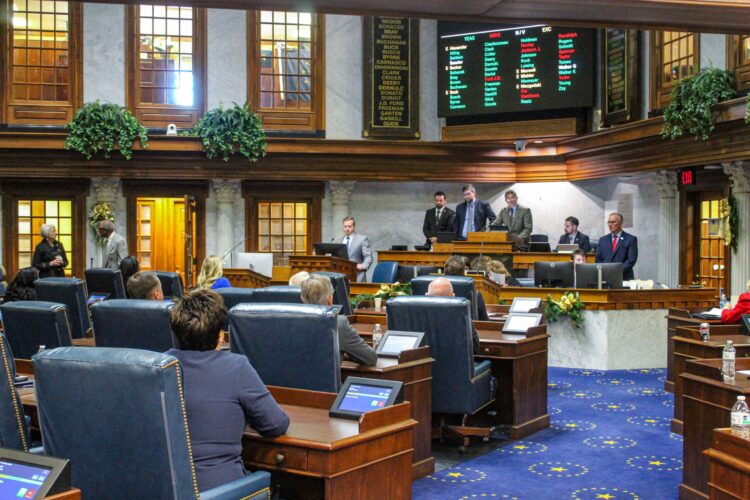
As chair of the Indiana Freedom Caucus, Pease traveled from Evansville to the Statehouse this week to speak in support of House Bill 1032, which would reconfigure Indiana’s nine congressional districts in order to boost Republican candidates and eliminate Democrats from the state’s delegation to the U.S. House. He was among a sizable contingent of redistricting advocates who filled nearly an hour of the Senate Elections Committee hearing, urging lawmakers to vote for the new congressional map.
Supporters of redistricting have only started becoming more visible and more vocal, even though the battle over redrawing the state’s congressional district map has been raging since early August. Only two people testified in favor of the new boundaries when the House Elections and Apportionment Committee heard the bill last Tuesday, but on Friday, while the members of the House were debating and taking a final vote on the new map, supporters gathered at the Statehouse for the Turning Point Action rally.
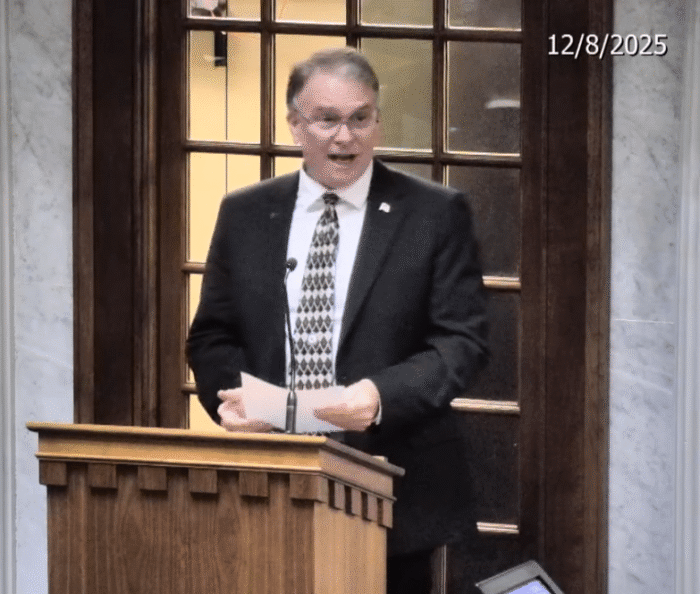
Pease conceded the proponents of redistricting might be getting a late start compared to their counterparts, who have been rallying and encouraging lawmakers to vote against redrawing the map for months. However, he said the supporters are taking a different approach, because they are much more conservative, reserved and not as strident as the opponents.
Pease said he is “cautiously optimistic” that he and the other supporters will convince the Indiana Senate to follow the House and vote to redistrict ahead of the 2026 mid-term election.
Both opponents and supporters of redistricting say the fight is about more than a map.
Hoosiers against redrawing the congressional districts mid-cycle see this as a battle to preserve democracy by ensuring that every voter has an equal voice. Conversely, proponents contend conservative voices will be drowned out on Capitol Hill unless red states like Indiana counter the blue states, which are sending only Democratic representatives to Congress.
“The people here who say, ‘Oh, it’s not fair,’” Pease said, gesturing to the opponents. “Well, we haven’t been treated fair. This is politics and it’s dirty work, unfortunately. (How much longer are Republicans)“just going to stand and get beaten up? We cannot afford to lose our country.”
Also, among the supporters speaking to the Senate on Monday were local members or “sentinels” of Heritage Action, according to Paul Lagemann, a lobbyist based in Indiana for the organization. He said he and the members have been talking with legislators for about the past two months to encourage them to pass a new congressional map.
Primarily, Lagemann said, redistricting supporters want to give President Donald Trump a Republican Congress for another two years, so the administration can continue enacting policies that are “most conservative in nature.” As a “pretty deep red state,” he said, Indiana should be sending more Republicans to Capitol Hill, just like it is electing Republicans to the legislature and statewide offices.
Lagemann rejected the assertion by opponents that redistricting in the middle of the decade instead of traditionally after the decennial U.S. Census is cheating and rigging the upcoming election.
“Particularly in Indiana, … we’re not changing any laws, we’re not changing the (Indiana) Constitution and it doesn’t require a referendum,” Lagemann said. “I think we are working to reflect the political outlook of most Hoosiers by making the decision to move those districts around.”
The Indiana Freedom Caucus was founded in Evansville this year and, according to a video of Pease on its website, it is a mutual benefit, nonprofit private organization. It is not a 501(c), Pease said in the video, so it is “not gagged or restricted by the federal government in the things we can support or say or expose.”
The group’s mission statement said it will fight “to preserve Christian Conservative values” and will “oppose all threats to our God given freedoms and Constitutional rights.”
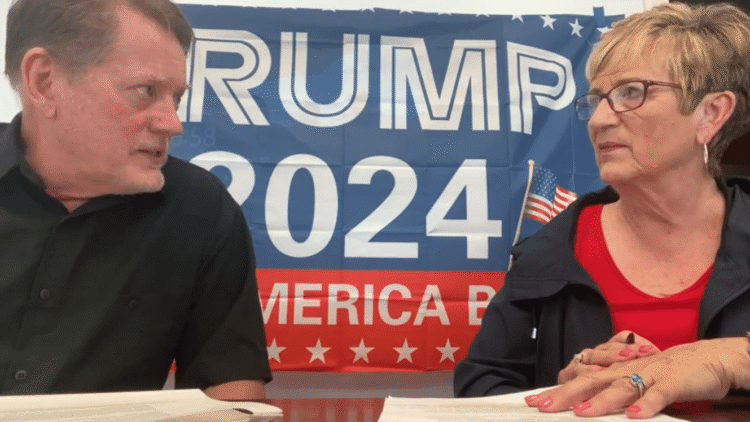
Accompanying Pease to the Statehouse on Monday were Ken Colbert and Cheryl Batteiger-Smith, conservative activists who founded the Indiana Freedom Caucus and, after being booted from the Vanderburgh County GOP party, started a podcast called “Republicans in Bad Standing.” The trio said they have “the ear” of Lt. Gov. Micah Beckwith, who was a guest speaker at one of their events.
Colbert testified during the Senate hearing, applauding the “bold and necessary redistricting reform.” He said the new map would ensure Indiana’s delegation to Congress would be entirely Republican. Although Hoosiers have “voted decisively for Republican leadership,” he told the Senate committee, the state’s 1st and 7th Congressional Districts “remain an unfair Democratic stronghold.”
In particular, Colbert supported cracking Marion County – most of which comprises the entire 7th Congressional District and is represented by Andre Carson, a Democrat – into four separate districts. He said the district’s focus on city priorities overshadows “the broader concerns of families, farmers, and small towns” across the state. Splitting Marion County and putting the pieces into different congressional districts, he said, would heightened accountability by requiring representatives answer to urban as well as rural voters.
Speaking after his testimony, Colbert said, “Marion County is not reflective of Hoosier values at this point.”
A strong anti-Democratic Party sentiment runs through supporters of redistricting.
Pease, Colbert and Batteiger-Smith all said Indiana had to redraw its congressional map to help keep Congress in Republican hands. Should Democrats win the U.S. House in 2026, they said, President Donald Trump’s agenda will stall and Hoosier needs and concerns will be dismissed.
“Do you want our state to have a voice in Washington about federal matters, about our nation?” Pease asked. “I believe that redistricting helps secure that voice. Otherwise, it could be silenced. It could be ignored.”
Colbert and Batteiger-Smith described the redistricting fight as not necessarily Democrat versus Republican but rather “good versus evil.” Batteiger-Smith was reluctant to even agree that there are Democrats who are good people.
“I don’t see how a person who says they have Christ in their heart can be a Democrat,” she said. “They’re pro-abortion. Let’s start there.”
Batteiger-Smith said she came to the Statehouse in the summer of 2022, when the legislature convened for a special session and passed a near-total ban on abortion. “I sat up here for days and we watched them scream they have their right to kill babies,” Smith said. “How can they have Christ in their heart and understand exactly what that means?”
During the Turning Point Action rally on Dec. 8, Heritage Action had a table filled with “Pass the Map” stickers and information about contacting lawmakers. Lagemann, wearing a bow tie, greeted the attendees and answered questions.
Heritage Action is a partner organization of the conservative think tank The Heritage Foundation. Currently led by Tiffany Justice, co-founder of Moms for Liberty, Heritage Action has a mission to fight for conservative polices in Washington, D.C., and in statehouses across the country.
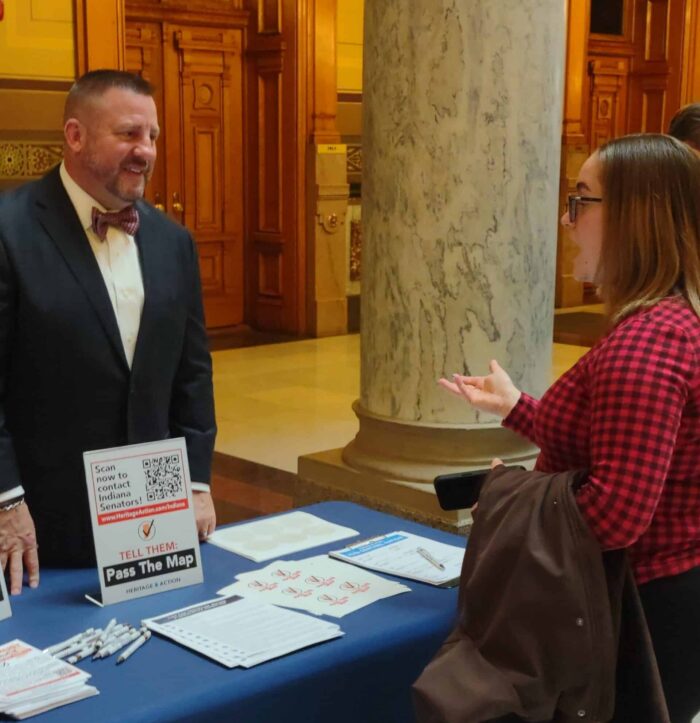
Lagemann said the organization has been coordinating with Turning Point USA in trying to get redistricting done this year in Indiana. Also, he said, Heritage Action has been relying on Hoosiers to call and have cordial conversations with lawmakers in their districts.
Despite the outward calm, Lagemann indicated the push for redistricting is a fierce battle. “This is an in-the-trenches fight, big time,” he said.
Reiterating the common argument that Hoosiers have to redistrict to help protect the GOP majority in Congress, Lagemann contended polling shows a majority of Republicans favor a new map.
A poll conducted for Independent Indiana by North Star Opinion Research and released in October, Lagemann. The survey of registered Hoosier voters found nearly 60% of Republicans support mid-decade redistricting, although a majority of all Indiana voters – 53% – were opposed to redistricting.
When asked why the GOP supermajority in the Statehouse has struggled with this issue and had not yet passed a new map, Lagemann blamed Hoosier congeniality. He said the Indiana General Assembly is a cordial group and many of the bills that land on the governor’s desk are passed with bipartisan support.
“I think we all like to get along and Hoosiers are sort of pleasant, reasonable people,” Lagemann said. “We don’t want to have a lot of conflict. It’s uncomfortable for sure.”
Dwight Adams, an editor and writer based in Indianapolis, edited this article. He is a former content editor, copy editor and digital producer at The Indianapolis Star and IndyStar.com, and worked as a planner for other newspapers, including the Louisville Courier Journal.
The Indiana Citizen is a nonpartisan, nonprofit platform dedicated to increasing the number of informed and engaged Hoosier citizens. We are operated by the Indiana Citizen Education Foundation, Inc., a 501(c)(3) public charity. For questions about the story, contact Marilyn Odendahl at marilyn.odendahl@indianacitizen.org.