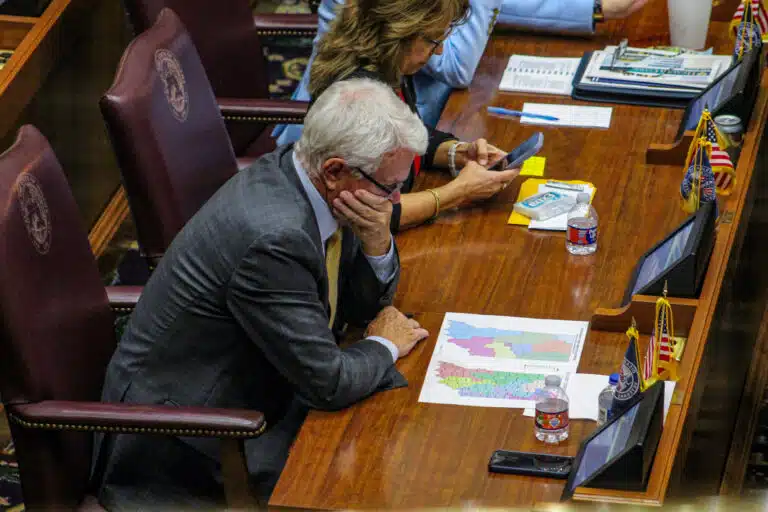
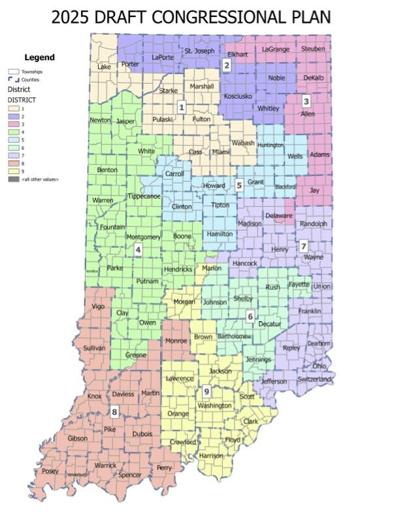
As expected, the proposed map breaks apart the 1st and 7th congressional districts, which are currently held by Democratic Reps. Frank Mrvan and Andre Carson, respectively.
Under the proposed reconfiguration, the 1st District stretches from Lake County southeast to Miami and Wabash counties. Meanwhile, Marion County, which at present is mostly included in the 7th District, is split between four congressional districts.
The Indiana Black Legislative Caucus blasted the new map and noted the two districts held by Democrats have the state’s highest concentration of minority voters.
“These maps, … they’re racially gerrymandered,” Pryor said during a news conference held by the IBLC on Monday after the House adjourned. “There is no ifs ands and buts about it.”
Lt. Gov. Micah Beckwith, a Republican, has been a strong proponent of mid-decade redistricting and applauded the new map, saying it will ensure Hoosiers’ voices are heard against Democratic states like Illinois and California.
Beckwith then prodded the Indiana Senate to follow the lead of the House. Previously, Senate President Pro Tempore Rodric Bray, R-Martinsville, has said the Republican caucus in the upper chamber of the legislature does not have the votes to pass a new congressional map.
“Hoosiers expect the Senate to stand with the House, stand with President (Donald) Trump and stand with Hoosiers who demanded a map that reflects the will of the people … not Washington elites or woke interest groups,” Beckwith said on social media.
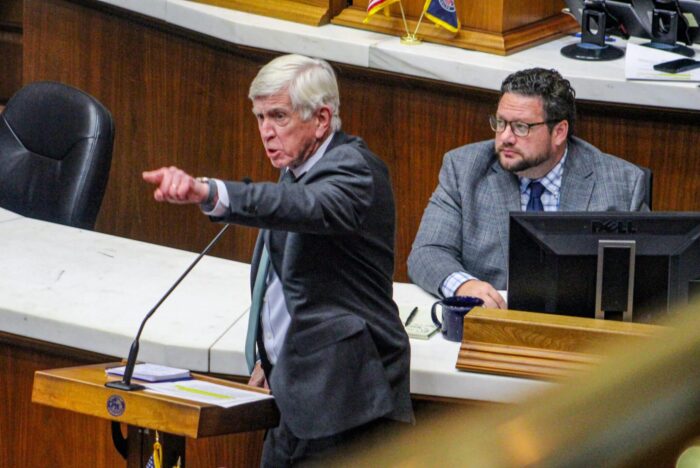
During the House session, Democratic lawmakers moved to defeat HB 1032, which would put the new map into effect.
Rep. Blake Johnson, D-Indianapolis, said the map is a Republican power grab and out of character for the Indiana General Assembly.
“Indiana isn’t like Washington, D.C.,” he said. “We don’t govern with chaos or dysfunction or malice. We don’t weaponize process. We don’t break the rules. We don’t treat politics like blood sport.”
He went on to say that if the General Assembly passes HB 1032, Hoosiers could be represented by people in Congress who are not informed about what their communities want.
He mentioned that Marion County will be split into four different districts spanning from the Ohio River to the border of Lake County. This means that many rural Hoosiers could be represented in Congress by someone from Indianapolis.
“While they may share kitchen table issues, what community interest binds them together? None,” Johnson said.
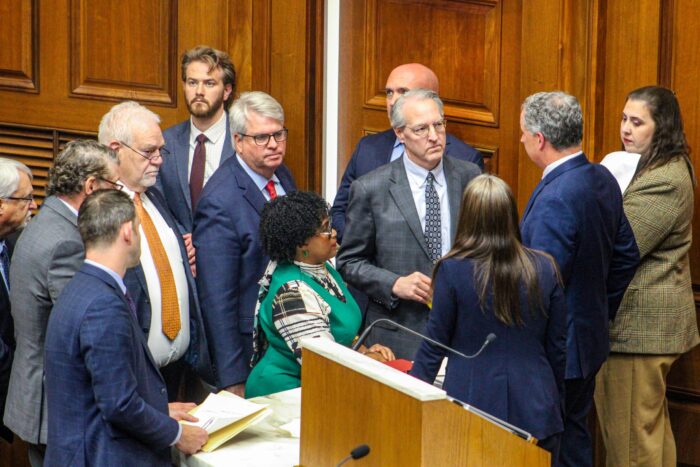
Smaltz returned to the podium to say that the bill was reasonable and Democrats should at least hear it.
“There have been many, many bills in my time here that I’ve seen on a bill list and make it to committee and at least have the opportunity to go to the very next step. You didn’t see the opposing party taking those bills from the minority party,” Smaltz said.
After Smaltz spoke, a member of the gallery shouted, “Cheaters,” prompting Huston to remind the gallery that it has to be quiet.
At the IBLC news conference, Rep. Earl Harris Jr., chair of the Black Legislative Caucus, also questioned how congressional representatives for the redrawn 7th and 9th districts, both of which stretch from Indianapolis to the Ohio River and include urban, suburban and rural communities, would be able to speak in Washington, D.C., for such diverse interests.
“How much harder does it make it for the congressional person to be able to represent everyone in their district when there’s a lot of distance and so diverse?” Harris, D-East Chicago, asked. He said if the proposed map is passed by the General Assembly, it will cause “some representation problems.”
The final speakers of Monday’s session, DeLaney and Pryor, told the House that the map’s gerrymandering seemed to erase any chances for minority voices to be heard.
“You want to eliminate me. Let me just ask you, what the hell am I doing sitting here?” he said. “Why don’t you redistrict me?”
Pryor, a member of the Black Legislative Caucus, said the bill would silence the voices of Hoosiers who look like her and that compared to the 2021 congressional map, any communities of interest would be torn apart.
“This is gerrymandering on steroids,” Pryor said.
The motion to defeat HB 1032 failed 19-67. The bill will be read in the House Elections and Apportionment Committee on Tuesday and open for public testimony. The Senate will hear the bill on Monday, Dec. 8.