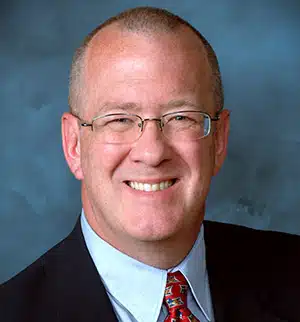
This is the second of two columns written by Don Knebel, president of ReCenter Indiana, providing a biblical perspective to the concerns of millennials and Generation Z. The first column examined biblical teachings on income inequality, health care and the environment.
By Don Knebel
ReCenter Indiana
February 26, 2026
We recently talked about income inequality, health care for all and protecting the environment and the importance of those issues to young people in America.
Today, we will look at how America treats “others,” specifically immigrants who come to this country as well as our place in the community of nations, as we examine young peoples’ views on immigration and the use of military force and what the Bible has to say about it.
In August of 2024, the Pew Research Center conducted a survey on this topic and found 64% of Americans believe that there should be a way for undocumented immigrants to stay in the country legally if certain conditions are met. Of Americans from 18 to 29, 77% shared this view.
Those who supported letting them stay were then asked what conditions should be mandated for that to happen. Only two conditions were identified as requirements by at least half of those respondents: passing a background check and having a job.
Last year, Gallup conducted its annual survey of Americans’ attitudes toward immigration and found the percentage who believe that immigration is a good thing for the U.S. increased to a record 79%, up from 64% a year earlier. The aggressive enforcement actions of the Trump administration may have made Americans as a whole more supportive of immigration.
According to an October 2025 Pew poll, more than half of Americans – 53% – now say the Trump administration was doing “too much” to deport immigrants living in the U.S. illegally. About the same number said that only some of those living in the United States should be deported, compared with only 31% who said that they should all be deported.
On perhaps no other issue are biblical teachings, as expressed in the New International Version, so aligned with the views of young Americans as on the issue of immigration. Among the strongest statements on this matter is found in Leviticus: “When a foreigner resides among you in your land, do not mistreat them. The foreigner residing among you must be treated as your native-born.” — Leviticus 19:33-34
Deuteronomy established for the Israelites an income-redistribution system, requiring the rich to make loans to the poor, which were then to be forgiven. — Deuteronomy 15:8-9 One aspect of that income-redistribution system was expressly granted to strangers. “When you are harvesting in your field and you overlook a sheaf, do not go back to get it. Leave it for the alien, the fatherless and the widow, so that the Lord your God may bless you in all the work of your hands.” — Deuteronomy 24:19 “When you beat the olives from your trees, do not go over the branches a second time. Leave what remains for the alien, the fatherless and the widow.” — Deuteronomy 24:20
The Christian New Testament confirms the continued importance of treating aliens with respect. Hebrews includes this advice: “Do not forget to show hospitality to strangers, for by so doing some people have shown hospitality to angels without knowing it.” — Hebrews 13:2
In his famous parable about the Son of Man separating the sheep from the goats, Jesus made hospitality to strangers one of the things on which people would be judged. — Matthew 25 “Those who showed such hospitality would be granted eternal life, but those who did not would earn eternal punishment.” Id.
Respecting and welcoming the immigrants among us has a solid foundation in biblical teachings.
Lastly, we will look at our nation’s use of military force to obtain national objectives – and what many young Americans think about that.
In March 2023, the Chicago Council on Global Affairs published the results of a survey about attitudes of Americans toward global engagement. The data “show[ed] that the youngest two generations of Americans — millennials and Generation Z — are most likely to question U.S. global engagement at a policy level and are especially hesitant to endorse a foreign policy dominated by military approaches.”
Millennials and members of Gen Z also were more likely than those in earlier generations to be interested in international cooperation on global problems and less likely than those of earlier generations to be concerned about the physical defense of the country.
These different views were reflected in the survey takers’ responses about the level of defense spending. Twice as many millennials and members of Gen Z want to reduce defense spending as do those in the two oldest generations of Americans: The Silent Generation and baby boomers. On the other hand, only about half as many of the millennial and Gen Z generations want to increase defense spending.
As Robin Meyers, a minister in the United Church of Christ, colorfully writes in his book “Why the Christian Right is Wrong”: “The Christian Right … seems to have accepted war as inevitable if regrettable and sex as regrettable if inevitable. These were not the priorities of Jesus, of course, but when was the last time anybody asked, ‘What would Jesus do?’ and regarded it as anything other than a rhetorical exercise?”
Can the case be made that the reluctance of millennials and members of Generation Z to use military force to achieve national objectives is supported by biblical teachings? Rev. Meyers certainly believes so: He titles the chapter in his book in which he made the above statement: “Christians Don’t Start Wars, They Try to Stop Them.”
It is easy to find express teachings of Jesus that favor peacemaking over war.
In his Sermon on the Mount, Jesus said: “Blessed are the peacemakers, for they will be called sons of God.” — Matthew 5:9 Later in the same sermon, Jesus said: “You have heard that it was said, Eye for Eye, and tooth for tooth. But I tell you, do not resist an evil person. If someone strikes you on the right cheek, turn to him the other also. And if someone wants to sue you and take your tunic, let him have your cloak as well.” — Matthew 5:39-40
In his letter to the Romans, Paul wrote: “Repay no one evil for evil. Have regard for good things in the sight of all men. If it is possible, as much as depends on you, live peaceably with all men.” — Romans 12:17-18 In support of this mandate, Paul quoted from Proverbs: “If your enemy is hungry, feed him; and if he is thirsty, give him a drink; for in so doing you will heap coals of fire on his head.” — Romans 12:20, quoting from Proverbs 25:21-22 To this, Proverbs adds: “and the Lord will reward you.” — Proverbs 25:22
In each of the issues of concern to America’s young people that we have examined in these columns – income inequality, the right to health care, protecting the environment, immigration, and the use of military force – biblical principles, including the express teachings of Jesus, align with their perspectives.
So why do so many of our young people turn away from Christianity, whose express teachings support their own views? In my opinion, the answer is simple: They have been misled. They have been misled by people who claim that the Bible cares only about eliminating abortion, restricting gay rights and putting Bibles and the Ten Commandments in schools.
It is time they learn the truth. Christians who look to the Bible, and not to their own self-interest, for guidance believe in reducing income inequality, protecting the environment, respecting immigrants, providing adequate health care for all, and reducing the use of military force.
Don Knebel is an attorney and member of Northminster Presbyterian Church as well as the president of ReCenter Indiana, Inc. a nonpartisan nonprofit dedicated to reminding all elected officials to center on the priorities of the people.
Dwight Adams, an editor and writer based in Indianapolis, edited this article. He is a former content editor, copy editor and digital producer at The Indianapolis Star and IndyStar.com, and worked as a planner for other newspapers, including the Louisville Courier Journal.
The views and opinions expressed do not necessarily reflect the views of The Indiana Citizen or any other affiliated organization.