By TheStatehouseFile.com and The Indiana Citizen
February 27, 2026
7:30 p.m.
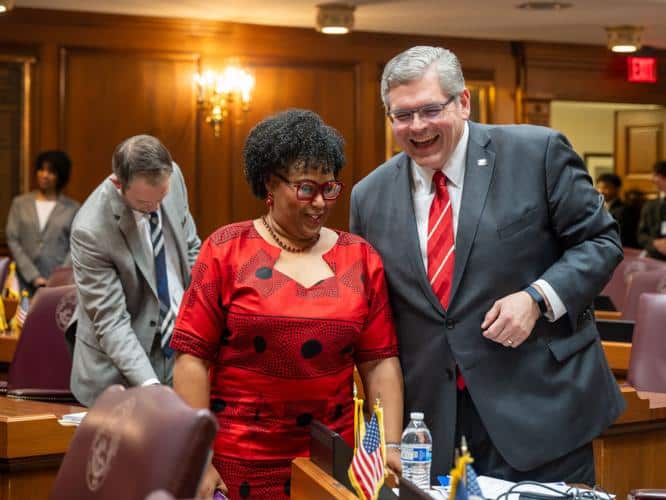
Democratic Minority Leader Rep. Phil GiaQuinta, D-Fort Wayne, summarized the session with a sports metaphor.
“Since we’ve got baseball season coming up, it just seems like we hit a lot of singles, and not a lot of home runs,” he said.
GiaQuinta said his party’s biggest win of the session was what didn’t happen—redistricting.
“If you remember, we did this back in December, and we were very happy to see it [redistricting] defeated,” said GiaQuinta. “I think we could have ended the session there or would have been perfectly happy.”
The minority leader commended the General Assembly’s efforts towards child-care legislation and day-care waitlists but said that there is more work to be done.
“While those are nice steps, again, I mentioned that we had a lot of singles … not good enough in my opinion, to really make a dent in the wait list and to help those providers that are closing.”
—Chloe White The Statehouse File
7:15 p.m.
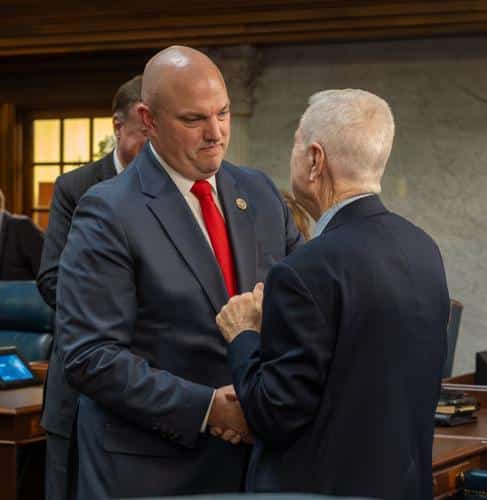
Following the gavel and subsequent Sine Die, Indiana House Speaker Todd Huston, R-Fishers, said that while the session was short, he considered it a success.
One successful bill he highlighted was House Bill 1408, also known as “Hailey’s law,” named Hailey Buzbee and focused on child safety, social media usage and the Amber Alert system
“I think a lot of us are concerned about the amount of time—it’s not just screen time, it’s what takes place during the screen time,” said Huston. “I think it had a huge impact on the alert system; unfortunately a terrible situation, but we were able to address a couple of things.”
Huston noted that he considers the advancements on affordability to be his biggest success of the session.
“I felt like we accomplished … progress on affordability, and we did that in House Bill 1001 and 1002, around housing and utility costs, and then in 1003 and 1004 streamlining government,” said Huston.
—Chloe White The Statehouse File
7 p.m.
After the end of the 2026 legislative session early Friday evening, Senate Minority Leader Sen. Shelli Yoder, D-Bloomington, said the party’s biggest win this year was standing up for Hoosier affordability.
“We’ve been relentless in talking about the bills that we filed,” she said. “We brought amendments to bills, we have debated on the floor, and each and every moment, we’ve brought it back to make sure that Hoosiers’ lives are affordable living in this state and aren’t becoming more and more out of reach. We’re always going to fight to make sure that Indiana is a state that they can afford their lives and a life of dignity.”
The early end of the session was due to the General Assembly’s early reunion in December when President Donald Trump pressured lawmakers into a failed attempt at mid-cycle redistricting.
“It was definitely a win,” said Yoder. “I mean, my goodness, what a way to send a signal to the rest of the country that Indiana is about listening to Hoosiers. That at the end of the day, we’re not about mimicking what Washington, D.C., is asking of us. We’re going to listen to Hoosiers and make sure that we do right by them.”
Yoder said a concern from the session is Senate Bill 76, which now heads to the governor’s desk. It will prohibit governmental bodies, colleges and universities from limiting or restricting the enforcement of federal immigration law.
“We are now, in Senate Bill 76, asking our schools, our pre-K centers, and our universities to step in and serve as an arm of the federal immigration enforcement,” Yoder said.
—Arianna Hunt, The Statehouse File
7 p.m.
Sen. Gary Byrne, R-Byrneville: “The session ended, I think, on a positive note for the, you know, whole Senate. … It started off a little shaky, of course, but you know, that’s the way government’s supposed to work. That’s why we vote.”
Sen. Stacey Donato, R-Logansport: “I’m very excited that the session is over. I have challenged my colleagues and myself to really get in deeply to DCS because the children are the most vulnerable of the state of Indiana, and we need to take care of them.”
Rep. Jake Teshka, R-South Bend: “It was a quick session, things moved a lot faster than I think I even thought they would, given the last two weeks that we shaved off the session. It was a lift for sure, but then again I think we did a great job. …
“I think we did a lot of great stuff this year for kids. You look at Senate Bill 78, the cell phone ban in schools, the social media stuff. The free range kids bill, House Bill 1035. That’s all the stuff that I came for, so for a short session I think we really knocked the ball out of the park.”
Rep. Cherrish Pryor, D-Indianapolis, on what she would have told herself at the beginning of the session: “Be a little bit more patient. Don’t get stressed out towards the end because the end of the session really started to get far more frustrating for me than I have ever been.”
Sen. J.D. Ford, D-Indianapolis, who plans to run for Congress: “I kind of felt like a little bit of a senior today, a little bit of, ‘Gosh I’m going to miss this place’, but at the same time, I’m off to bigger and better things. I’m really excited to have this session over. I think we did some good stuff for Hoosiers, I think we did some not-so-good stuff for Hoosiers, and missed some opportunities. But I’m certainly doing a lot of reflecting as I leave the building today. …
“I feel that Hoosiers are going to have a choice this May, and I think that’s great. Our campaign is out talking with Hoosiers, and we’re raising money to get our voice and message out there. I feel good about where we’re at and what we’re doing. I feel like I’m the best suited candidate to take on Victoria Spartz in November. I’m looking forward to having more of those conversations as we get further down the road.
“I did the very best that I could for Hoosiers. I’m proud to be the voice of some of Sub District 29, and to be able to carry their voices forward. I felt I got some amendments attached to different bills to make things better, fought against bills that I thought were going to harm my community. So today I’m just walking away very grateful.”
—Amirah Curry, Hope Moring & Luke Shepherd, TheStatehouseFile.com
4:30 p.m.
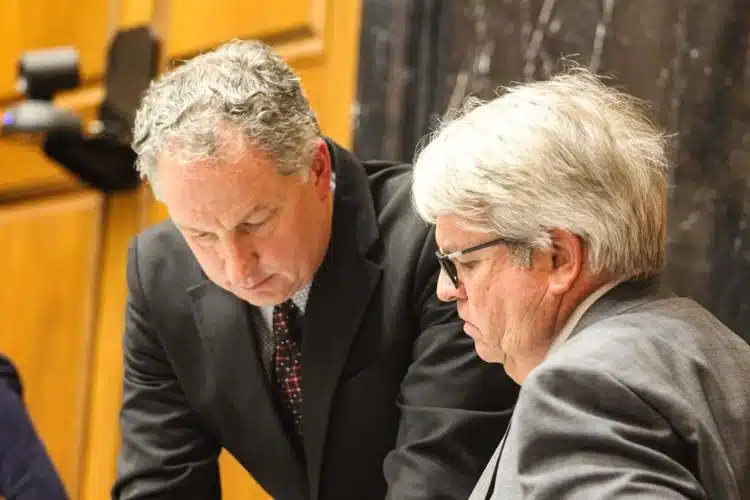
When the Senate convened this afternoon to discuss committee reports, Senate Bill 144, authored by Sen. Scott Alexander, R-Muncie, and others would tighten pre-existing laws on the sale of tobacco to minors.
In current law, if a tobacco product is sold to someone under the age of 21, they will receive a class C misdemeanor. With the new legislation, the level would increase to a class B infraction after one sale.
In addition, the legislation would prevent the advertisement of e-liquid or vapor products within 1,000 feet of school property.
The bill’s first conference committee report was passed unopposed with 96 yeas.
—Chloe White, The Statehouse File
2:05 p.m.
The Indiana House of Representatives continued working through conference committee reports as the final day of session continued.
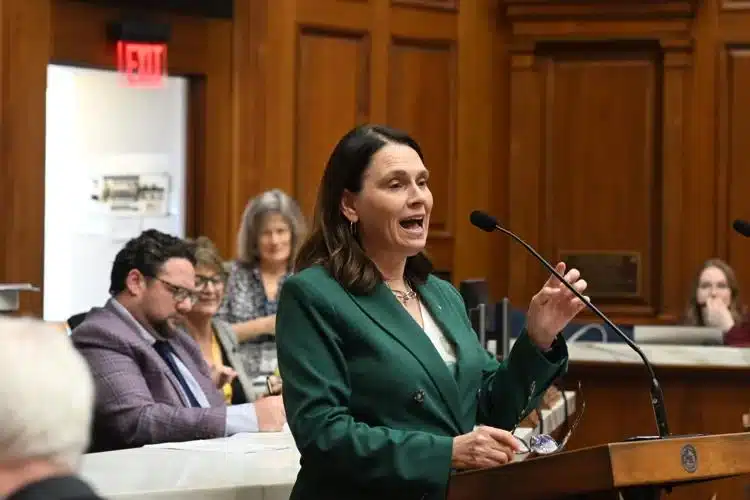
House Bill 1343 drew some of the strongest rhetoric of the late morning. It includes changes affecting public safety policy and law enforcement provisions.
During debate, Rep. Ed Delaney, D-Indianapolis, warned the measure “completely steps on local control of the simple, most important local government institution,” adding, “What is more important to a citizen than the safety brought to them by their local authorities who live and work with them?”
Delaney also called it “the biggest attack in this state” on local authority.
The bill ultimately advanced 65-29, with the House adopting the conference committee report.
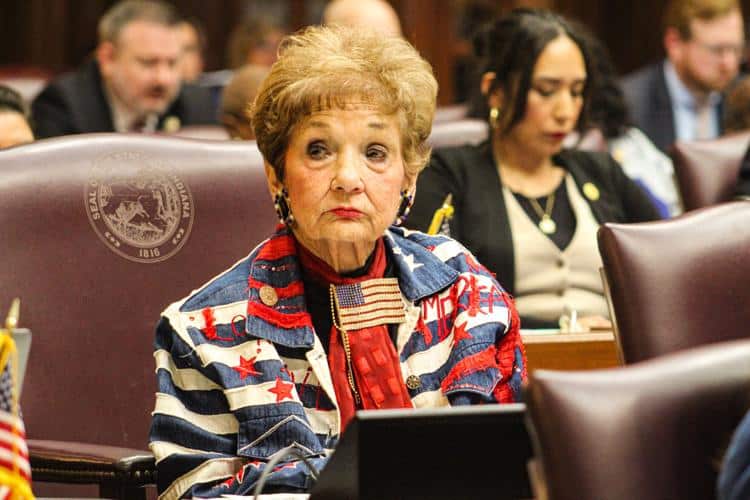
House Bill 1268 addresses state military and defense-related coordination, including provisions affecting Indiana’s organized militia and related state defense structures. It focuses on internal state readiness and administrative alignment rather than foreign land ownership or adversary restrictions. The measure passed 94-1 and now moves to enrollment.
Senate Bill 14 increases the line-of-duty death benefit for public safety officers, providing additional financial support to families of first responders killed in service.
During debate, Rep. Chuck Moseley, D-Portage, thanked Reps. Jake Teshka, R-South Bend, and Jeff Thompson, R-Lizton, and Sen. Linda Rogers, R-Granger, for working across chambers to secure the increase, calling it a promise made to local public safety officers and saying the change “is going to be a great benefit to their families.”
The unanimous vote reflected bipartisan support.
Senate Bill 71 updates probate procedures and revises certain stakeholder processes to improve efficiency. After very brief discussion, the conference committee report was adopted with a 93-2 vote.
Senate Bill 256 addresses national security concerns by creating new registration requirements for certain foreign agents and placing restrictions tied to foreign adversaries, including provisions affecting land ownership.
Rep. Victoria Garcia Wilburn, D-Indianapolis, said the subject “really means a lot to our national security, as it should,” but expressed “a bit of trepidation” about land ownership provisions, particularly a compromise limiting certain purchases to a half acre.
Garcia Wilburn said there are “nuances of the bill” that still raised concern and emphasized the need to monitor implementation carefully.
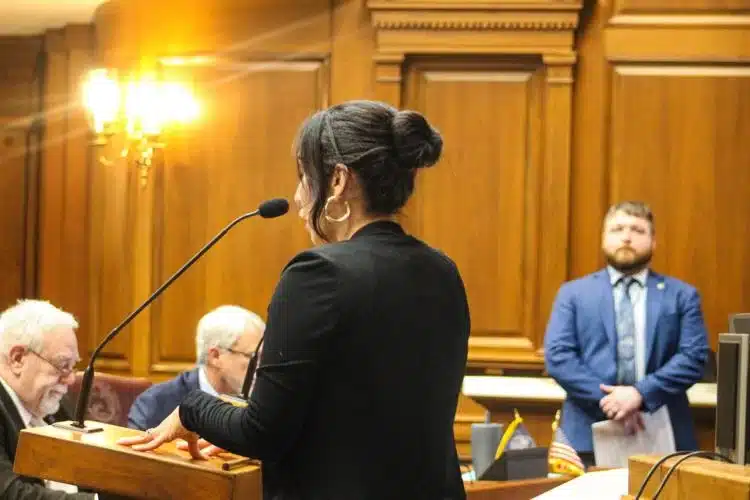
Debate also touched on a separate provision requiring additional background checks at public universities.
Rep. Matt Pierce, D-Bloomington, questioned why the requirement would apply only to state-funded institutions and not private universities with similar technical programs.
Rep. Carey Hamilton, D-Indianapolis, called it “a duplication of effort” and warned it would create new administrative and fiscal burdens on state campuses when federal visa screenings already exist.
After she finished addressing her colleagues at the podium, Hamilton walked shaking her head, saying, “It’s just so dumb” when talking about duplicating efforts. She did ultimately vote in support of the bill for other reasons but wanted to express her frustrations with this component of the bill.
Despite concerns, the conference committee report was adopted 82-13.
Throughout the morning, lawmakers repeatedly suspended rules to speed adoption of conference reports.
The House is now in recess until after Rules and caucus meetings conclude, with members expected to return for final procedural steps before adjournment.
—Sydney Byerly, The Indiana Citizen
2:30 p.m.
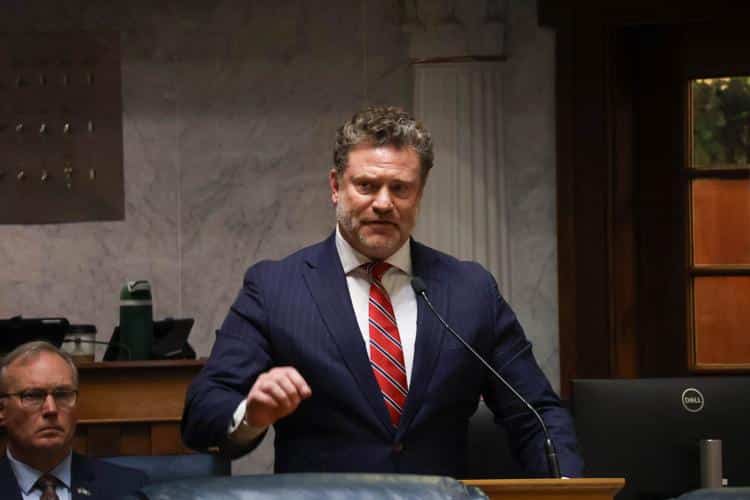
The second education bill on the Senate roster this morning was met with minimal push back.
Adolescents under 16 would need verifiable parental consent under House Bill 1408 to create a social media account on a platform with “addictive features” such as infinite scroll, content likes and livestreaming, but would not restrict social media that is exclusively for messaging.
Although he voted yes, Sen. Michael Bohacek, R-Michiana Shores, questioned the bill’s sponsor Sen. Jeff Raatz, R-Centerville, at length over the provision that a company must generate over $1 billion in gross revenue to be under these restrictions.
“The ones [social media companies] that I am concerned about, as we all should be, are the small startups … because they’re gonna be doing everything they can to grow their daily average users,” he said.
After questions about what if young people take their parents ID’s to verify their accounts, Garten spoke on the bill.
“We can’t what-if the risks of addictive behavior to our children from social media, you can’t what-if the parents of a child who’s committed suicide because of something that has happened on social media,” Garten said.
According to the U.S. Department of Health and Human Services, youth who spend more than three hours a day on social media have double the risk of experiencing mental health problems like depression and anxiety.
The Senate approved the conference committee report, as did the House, clearing the measure for enrollment before sending it to the governor.
—Arianna Hunt, The Statehouse File
10:30 a.m.
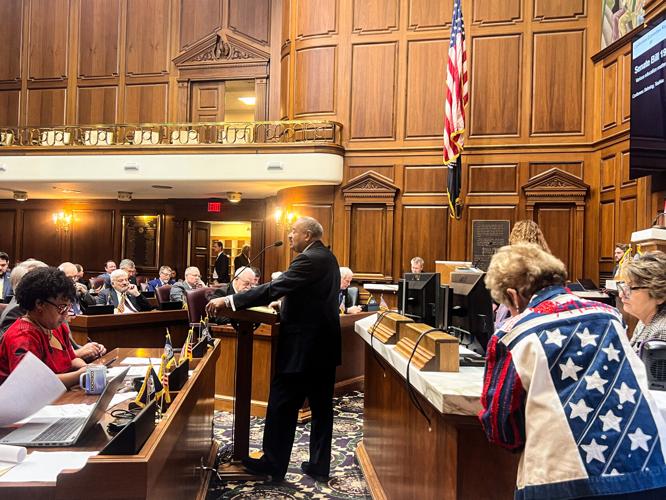
The Indiana House of Representatives worked through a slate of major conference committee reports Friday morning as lawmakers pushed toward adjournment.
House Bill 1038 reshapes how a new casino license could be awarded in Indiana. It removes Wayne County from consideration as a relocation site and allows any U.S.-based brick-and-mortar casino operator to apply for the license. Applicants must commit at least $50 million—the cost of an inland gaming license—and may include financial support for the horse racing industry in their proposal.
The measure also requires Allen, DeKalb and St. Joseph counties to put a public question on the 2026 general election ballot. If voters in a county reject casino gaming, the Indiana Gaming Commission would be barred from awarding a license there. The debate reflects ongoing tension between economic development interests and local control over gambling expansion.
The House passed the conference committee report 55-37, after which it moved to the Senate, which did the same. The bill now heads to enrollment—the final step of preparing and signing the official copy—before it is sent to the governor.
Senate Bill 4, a wide-ranging fiscal bill that makes adjustments to state and local fiscal oversight—including changes to how certain local government and library budgets may be reviewed and approved—also includes administrative updates affecting dedicated state funds and allows the state to use reserve funds to help stabilize the Child Care and Development Fund voucher program. The bill’s conference committee report passed the House unanimously Friday morning, and the Senate later adopted it as well, clearing the measure for enrollment and sending it to the governor.
SB 176 addresses regulations related to shooting ranges and included conference committee revisions to language referencing judicial officers, clarifying how judges and other judicial officials are treated under the statute. The bill passed the House 67-25 and was subsequently approved by the Senate, moving it to enrollment before heading to the governor.
SB 199, which makes changes to school accreditation processes and career and technical education pathways, was the only bill that sparked extended debate on the House floor during the morning session.
Rep. Vernon Smith, D-Gary, spoke at length against the measure, warning about what he described as unintended consequences for both teacher mobility and workforce training programs.
“Sometimes I need to save my breath for my dying bed,” Smith said. “But there are two things that concern me deeply.”
Smith focused first on accreditation changes, arguing that allowing the state to effectively evaluate itself could create problems if Indiana standards diverge from national benchmarks. Accreditation, he said, is meant to ensure consistency across states. If Indiana alters that structure, he warned, teachers certified in Indiana could face barriers being recognized elsewhere.
He also raised concerns about how the bill treats certain career pathways, particularly lower-paying trades. Smith said research shows students are less likely to pursue career and technical education programs if the associated occupations are perceived as undervalued or financially limiting.
The bill ultimately advanced 62-32 along party lines. The Senate later adopted the conference committee report as well, clearing the measure for enrollment before sending it to the governor.
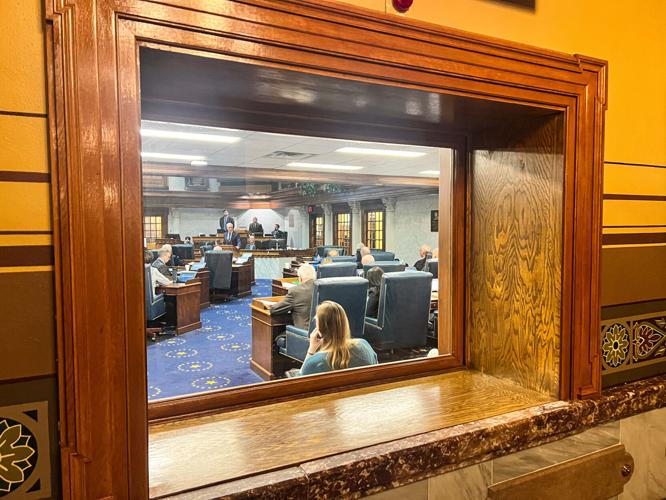
HB 1368, on carbon matters, briefly stalled when it was withdrawn from House concurrence this morning after a question about the rules. The bill has been one of the session’s more controversial environmental measures, dealing with carbon-related regulatory authority and underground storage policy.
The measure has had a rocky path this week, including an earlier failed concurrence vote for a lack of a constitutional majority before being brought back for reconsideration—an uncommon late-session development that underscored lingering divisions over the policy.
The House recessed mid-morning and is expected to return before noon for a Rules Committee announcement as lawmakers work toward adjournment.
—Sydney Byerly, The Indiana Citizen
TheStatehouseFile.com is a news website powered by Franklin College journalism students.
The Indiana Citizen, a nonpartisan, nonprofit platform dedicated to increasing the number of informed, engaged Hoosier citizens.