By Sydney Byerly
The Indiana Citizen
February 10, 2026
An Indiana House committee advanced a measure that would allow counties to continue operating syringe exchanges on Tuesday — but only after shortening what would have been a 10-year extension to just two years, and requiring those seeking new needles to trade used ones in.
Members of the House Public Health Committee also amended the bill to require those seeking clean needles to show identification, and to impose geographic boundaries on who would be eligible to participate in the exchanges.
The changes came amid consternation from conservatives over continuing a program launched in 2015, in response to a historic HIV outbreak fueled by drug use in Scott County. At the time, some Republicans, including then-Gov. Mike Pence, dropped their long-standing opposition to syringe exchanges, as public health experts argued that such programs lower the risk of transmitting HIV and hepatitis C. A decade later, with the existing program set to expire on June 30 and Republicans holding supermajorities in the state House and Senate, some conservatives’ initial concerns about enabling drug use have resurfaced.
“We’re putting really bad stuff in these clean needles, and we’re giving out more needles than what we’re taking in,” said Rep. Matt Hostettler, R-Patoka, who supported the changes to Senate Bill 91.
The amendment imposing new one-to-one exchange and identification requirements was approved on an 8-5 vote, but only after a heated debate in which opponents warned it would deter people from using the exchanges in the six counties that currently operate them.
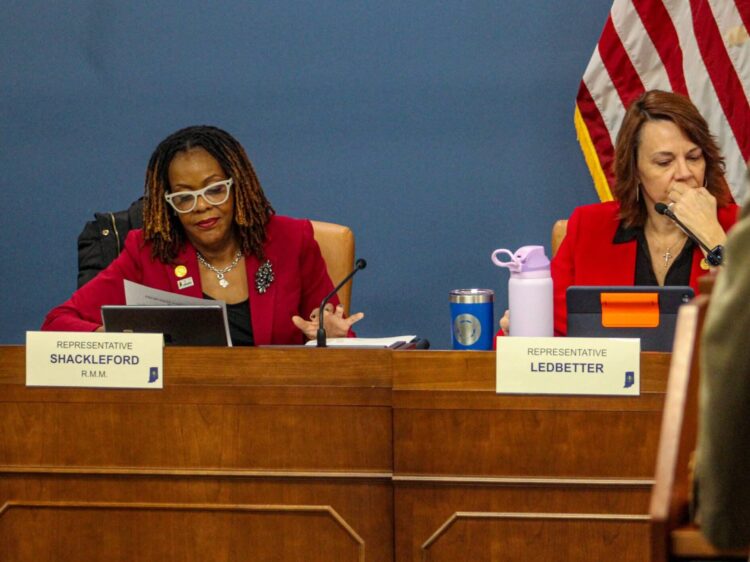
Several committee members raised concerns about the ID provision. Reps. Robin Shackleford, D-Indianapolis; Victoria Garcia Wilburn, D-Fishers; and Cindy Ledbetter, R-Newburgh, questioned whether requiring identification would discourage participation, create privacy risks and undermine the effectiveness of the program.
Shackleford said she did not see the need for an ID requirement, arguing that people passing through Indiana — such as truck drivers — would be barred from using the exchanges.
“Adding in ID requirements and one-to-one (exchange requirements) — that is going to affect the integrity of the program,” Shackleford said.
The committee’s chairman, Rep. Brad Barrett, R-Richmond, who proposed the amendment, defended the changes.
“This is an amendment that is saying there’s got to be accountability from an overall public health standpoint in this arena,” Barrett said.
Sen. Michael Crider, R-Greenfield, the bill’s author who already shepherded it to passage in the Senate, urged lawmakers to focus on the human impact behind public health data.
“The one thing I’d ask you to keep in mind is each one of those numbers represents a human, a person who, if they’re lucky enough to make it out of addiction, still have lots of problems to deal with,” Crider said.
A co-sponsor of the bill, Rep. Ed Clere, the veteran Republican lawmaker now running as an independent for New Albany mayor, said after the committee’s vote that he is “very concerned” about the addition of identification and one-to-one syringe exchange requirements.
“They threaten to undermine well designed and well established programs that reduce the spread of infection and connect people to recovery and other resources, and as a result have saved and changed countless lives and made communities throughout Indiana safer,” Clere said.
Advocates and medical professionals repeatedly described syringe exchange programs as critical entry points into health care, treatment and recovery services during Tuesday’s committee hearing.
“We don’t enable drug use — we enable surviving drug use,” said Kylie Kimbrough, president of the Indiana Recovery Alliance. “We don’t normalize addiction, we normalize not having to die because of it.”
Dr. Ryan Singerman, president of the Indiana State Medical Association, warned that ID and one-to-one requirements could exclude the people most in need of services.
“It’s unlikely that everyone who crucially needs these services will be able to present valid ID,” Singerman said. “Not everyone who struggles with addiction has this structure in their life.”
Opponents of extending the syringe exchange program focused on what they described as the proliferation of syringes.
“There’s an increase in the amount of needles, but not all of them are coming back,” said Chris Daniels of the Indiana Prosecuting Attorneys Council.
Countering that, Alan Witchey, president of the Damien Center, which runs an exchange program in Marion County, said syringe services remove needles from communities and protect law enforcement from needle-stick injuries. He noted syringes are already widely available through pharmacies and online retailers.
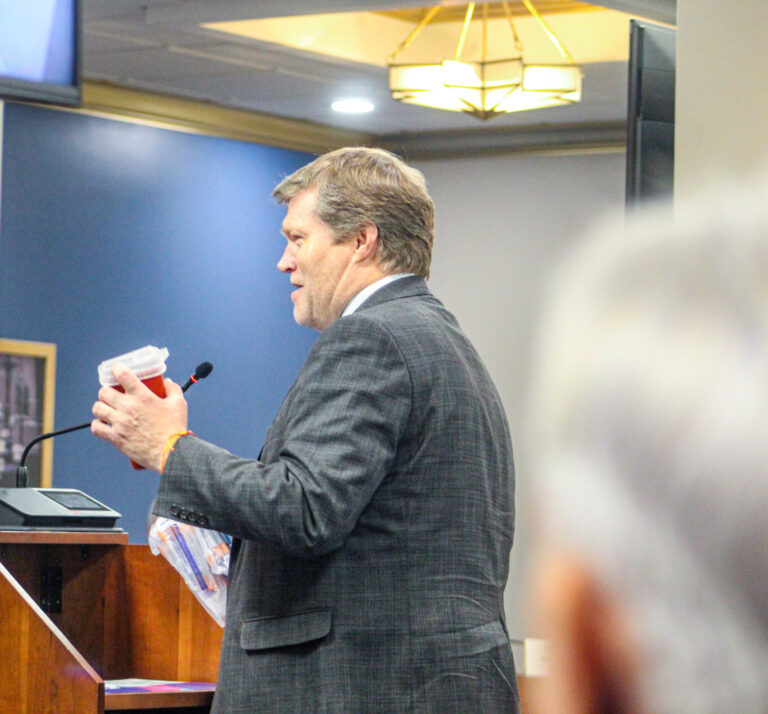
“I bought these needles on Amazon.com and had them delivered to my house. Not one single question was asked of me,” Witchey said, holding up a bag of unused syringes.
Nicholas Boyles, who said he is a Hoosier and was among the speakers at Tuesday’s committee hearing, urged lawmakers to reject the amendment entirely, arguing that “anonymity is key” to recovery culture.
“I’m asking you to drop these amendments and see a different way forward,” Boyles said.
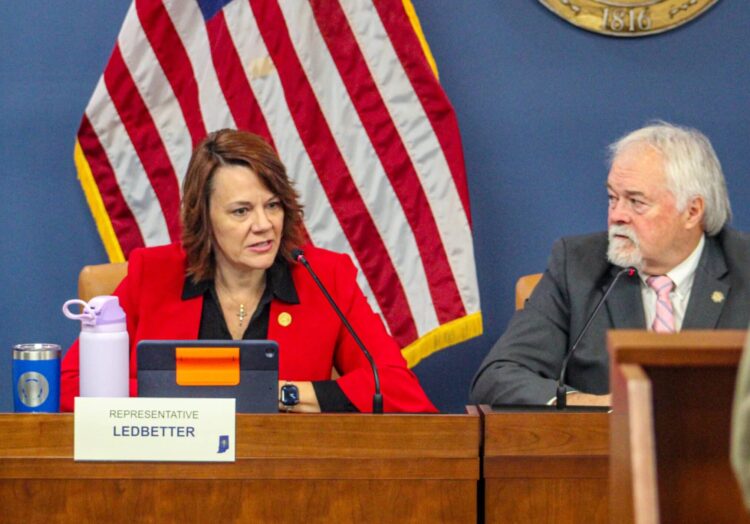
Later in the hearing, Ledbetter, the Newburgh Republican, referenced Boyles’ testimony while noting the limited support for the changes introduced by Barrett. Ledbetter also said some lawmakers were concerned about the origins of the amendment.
“I just have to be curious to say we have an amendment we’re voting on that nobody testified in favor of, and we don’t know where it came from — I think it might be a friend of Bill’s,” Ledbetter said, drawing laughter from audience members, before she voted against the amendment. “Friend of Bill’s” is a euphemism in recovery communities for maintaining anonymity but allowing participants to acknowledge their addiction.
The committee advanced the measure Tuesday on a 9-4 vote.
“We’ve heard from doctors, we’ve heard from addicts, and everybody in between,” Barrett said. “I think the enemy of good is better. The enemy of idealism is the loss of a program. So I’m a yes.”
Still, some lawmakers who backed it said they want to see more changes.
Ledbetter said she voted to move the bill forward despite concerns about unintended public health consequences.
“I am so concerned many of these counties have backed away from these exchange programs because we’ve seen a reduction in HIV,” she said, warning the amended bill could contribute to rising syphilis rates. “Yes, because I want something to move forward.”
Sydney Byerly is a political reporter who grew up in New Albany, Indiana. Before joining The Citizen, Sydney reported news for TheStatehouseFile.com and most recently managed and edited The Corydon Democrat & Clarion News in southern Indiana. She earned her bachelor’s in journalism at Franklin College’s Pulliam School of Journalism (‘Sco Griz!).
The Indiana Citizen is a nonpartisan, nonprofit platform dedicated to increasing the number of informed and engaged Hoosier citizens. We are operated by the Indiana Citizen Education Foundation, Inc., a 501(c)(3) public charity. For questions about the story, contact Marilyn Odendahl at marilyn.odendahl@indianacitizen.org.