By Marilyn Odendahl
The Indiana Citizen
December 8, 2025
After the Indiana House passed a new congressional district map on Friday, Indiana Attorney General Todd Rokita issued a strong, partisan statement applauding the action and saying the map would withstand a legal challenge from anyone “silly enough” to file a lawsuit.
Rokita, a Republican, has been supporting mid-decade redistricting since the debate began in Indiana in early August. On Friday, he echoed the common argument for redrawing the map to favor Republican candidates by claiming the Hoosier State has to counter Democrat-leaning states that are also reconfiguring their congressional districts to advance “their own leftist gains.” He said Hoosier voices are being drowned out on the issues of the day and the country needs to be “saved from the radical Left.”

“We can no longer bury our heads in the sand while other states redraw their maps so the Left can destroy what we built over the last 250 years,” Rokita said in his statement. “No more bringing a knife to a gunfight. The Indiana House has acted decisively, and now it’s time for the Senate to follow suit.”
House Bill 1032, which allows the state to amend the congressional districts ahead of the 2026 mid-term election, passed through the lower chamber in the legislature on a 57-to-41 vote. Twelve Republicans joined Democrats in opposing the bill.
Rep. Matt Pierce, D-Bloomington, dismissed Rokita’s statement, saying it was not surprising, because the state’s top lawyer “really likes to pander” to the MAGA base of the Republican party.
“As usual the attorney general is playing politics, and that’s what he does best,” Pierce, who also is a lawyer, told The Indiana Citizen. “He doesn’t really spend too much time doing the job of attorney general as far as protecting consumers or other things. He’s just out showboating, trying to attract attention.”
New congressional maps that have already been passed this year in states like Texas, Missouri and California were immediately challenged in court. Voter-advocacy groups and state legislators have acknowledged Indiana would likely face a lawsuit against any map the General Assembly might pass this year.
However, on Friday, Rokita said the map contained in HB 1032 does not violate the law or the U.S. Constitution.
“This specific map is legally solid,” Rokita said in his statement. “If any group or individual is silly enough to sue, we will defeat their attack in court.”
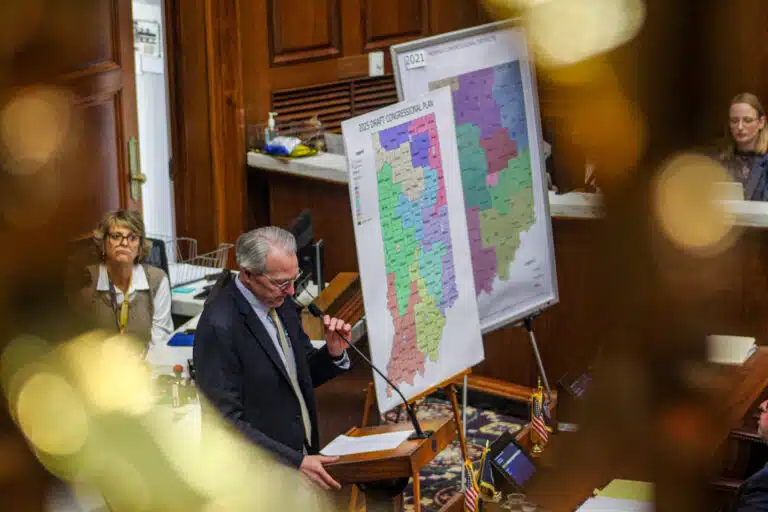
The new map reconfigures Indiana’s nine congressional districts with a goal of flipping the 1st and 7th districts from blue to red. Currently, Republicans occupy seven of the state’s nine seats in the U.S. House and supporters of mid-decade redistricting want Indiana’s GOP to make a clean sweep by winning all of the seats in next year’s election.
To tilt the advantage to Republicans, the new map focuses on redistricting in Lake and Marion counties, which are the state’s most racially diverse, according to data in the 2020 U.S. Census.
The new configuration extends the 1st Congressional District so that Lake County, in northwest Indiana, is lumped in with several farming counties in the north central part of the state. Marion County in central Indiana, most of which comprises the 7th Congressional District, would be sliced apart and divided among four congressional districts that stretch into rural counties, including two districts that reach all the way to the Ohio River.
When Rep. Ben Smaltz, the author of HB 1032, introduced the new map to the House Elections and Apportionment Committee on Dec. 2, he repeated several times that the redrawn congressional districts were created to give a political advantage to Republicans in the coming election.

“These (individual congressional district) maps were specifically drawn for a political advantage,” Smaltz, R-Auburn, told the committee in response to concerns from Democrats that the new boundaries are discriminatory and would diminish minority voices at the ballot box. “We did not look at any other information other than what created a political advantage.”
In his statement, Rokita addressed only the political intent of the new map. He did not mention the concerns that Democrats have about the new congressional districts potentially being racially gerrymandered and possibly violating federal laws, which prohibit diluting minority votes.
“As the United States Supreme Court emphasized once again last night, redistricting for political reasons is constitutional,” Rokita said, referencing the Dec. 4 ruling which allows the new Texas congressional map to remain in place while litigation continues. “In fact, the Court has said that redistricting belongs in the legislature – in the hands of the people’s elected representatives, not judges.”
The U.S. Supreme Court ruled in 2019 that disputes over partisan gerrymandering were beyond the jurisdiction of federal courts. In Common Cause v. Rucho, a 5-4 majority of the court held that while the practice of drawing state legislative and congressional maps for political advantage was distasteful, the matter should be handled by politicians and the political process, rather than the courts.
Pierce pointed out that opponents of Indiana’s new map could file a lawsuit in state court, challenging the political advantage that is being given to one party. He noted Article 2, Section 1, of the Indiana Constitution requires all elections to be “free and equal.” It would likely be a case of first impression, he said, because the Indiana courts have not set the criteria for determining whether a district map is constitutional.
“If you have become so extremely partisan that you’re attempting to try to wipe out the entire opposing party’s voice in Congress, I think you can argue that’s not a free and fair election,” Pierce said. “So, that would be a potential lawsuit and issue for the state court to consider.”
Also, Pierce said, the opponents could seek to block the new map in federal court by arguing the redrawn boundaries discriminate against racial minorities in violation of the Voting Rights Act of 1965. Section 2 of the VRA protects minority voters from disenfranchisement in the election process by prohibiting nationwide the denial or abridgement of he right to vote because of race or color.
Smaltz said during the committee hearing that the map was drawn by the National Republican Redistricting Trust and based solely on population data from recent elections. He said racial demographics and minority communities were not considered when determining the new congressional districts.
However, Pierce said not taking minority voting blocks into account could also be a violation of the Voting Rights Act.
“You can’t be motivated by racial things when making the maps, but at the same time, you have to consider how the map you draw might impact the voting power of minority districts, particularly if they’re a majority minority district,” Pierce said. “So, I think that there may be a legal issue in the fact that they didn’t at least consider how carving Marion County up into four different districts dilutes the voting power of racial minorities.”
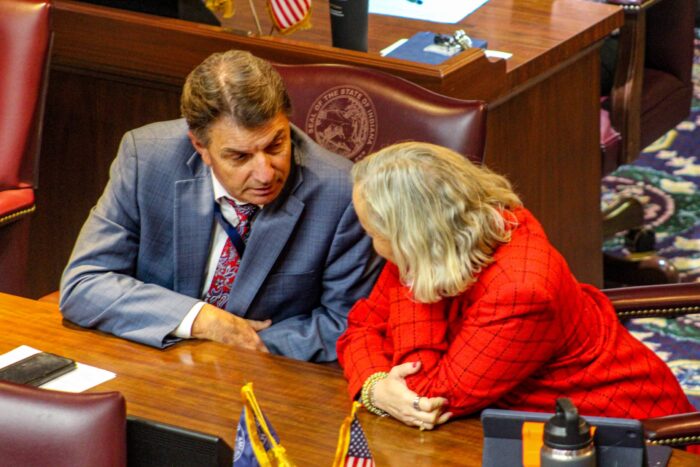
HB 1032 attempts to limit litigation if the new map is enacted into law. Saying that prompt rulings on apportionment issues are “critical for preserving election integrity, protecting voter confidence, and preventing chaotic disruption of the election process,” Section 3 of the bill bans a temporary restraining order from being sought or issued and gives the Indiana Supreme Court exclusive jurisdiction over any appeal of an order from a trial court that blocks the new map.
Pierce said the bill’s restrictions on future litigation are unusual and something he has never seen in any piece of legislation introduced into the General Assembly. Noting the upcoming February candidate filing deadlines for the 2026 election, he said the Republican supermajority appears to be trying to prevent a court from delaying or halting the implementation of the new map.
“I think that when you have a situation where they’re anticipating some type of specific litigation and they’re trying to essentially manipulate the rules to make it more likely that they can win, I think that’s something that might very well concern the court,” Pierce said.
Even so, Pierce said he is not spending a lot of time thinking about litigation and legal questions, because the new map might fail to win approval in the Indiana Senate.
A portion of the Republican caucus in the upper chamber have publicly stated their opposition to mid-decade redistricting and Senate President Pro Tempore Rodric Bray, R-Martinsville, has said the upper chamber does not have the votes to pass the new map. In a sign of the GOP split over redistricting, 12 Republicans joined Democrats in voting against the map.
“I feel like this is almost kind of part of a theater just to show the president that they’re trying, but I don’t think any of them really want it to pass,” Pierce said. “So, this is kind of a ‘Twilight Zone’ experience, where you have people, these zombies, … walking through the motions, and I think they’re hoping that the thing will just, you know, crash.”
Dwight Adams, an editor and writer based in Indianapolis, edited this article. He is a former content editor, copy editor and digital producer at The Indianapolis Star and IndyStar.com, and worked as a planner for other newspapers, including the Louisville Courier Journal.
The Indiana Citizen is a nonpartisan, nonprofit platform dedicated to increasing the number of informed and engaged Hoosier citizens. We are operated by the Indiana Citizen Education Foundation, Inc., a 501(c)(3) public charity. For questions about the story, contact Marilyn Odendahl at marilyn.odendahl@indianacitizen.org.