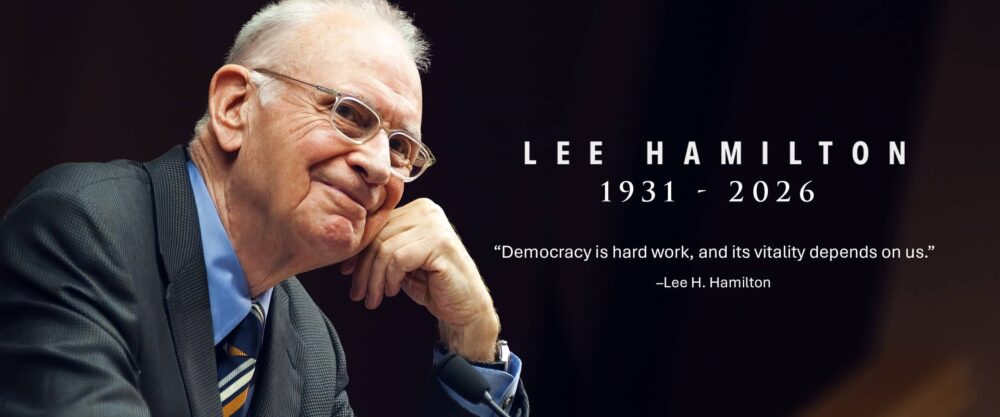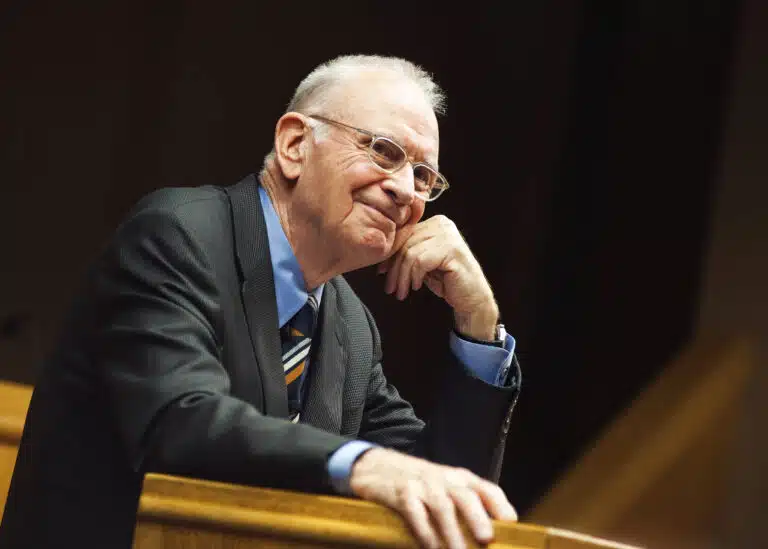
Lee Hamilton represented Indiana’s 9th Congressional District from 1965-1999 in the U.S. House of Representatives. He died Feb. 4 in Bloomington at the age of 94.
By Lee Hamilton
January 27, 2026
I know there are a lot of screaming national headlines right now competing for your attention, but I want to take a break from all that to talk about friendship.
Why? Because no step is more important right now than re-establishing Congress’s ability to assert itself as a robust and effective branch of government that can weigh in on—and even shape—policy both domestic and foreign. And I’m convinced that unless individual members of Congress can build relationships with one another that transcend both party and the maneuvering for advantage that frequently marks relationships on Capitol Hill, that will be a lost cause.
Let me give you an illustration of what I mean. It starts back in 2019, during the first Trump administration, when Congress passed a War Powers Resolution to direct an end to US involvement in the conflict in Yemen. It was vetoed by President Trump and never took effect, but what matters about it were two of the key players: Democratic Rep. Ro Khanna and GOP Rep. Thomas Massie, who’d found common cause in their skepticism about US military intervention abroad.
If those names seem familiar, they should: Khanna and Massie were also key players last year in the congressional vote to release the Epstein files. In The Guardian late last year, Khanna credited the “muscle memory” he and Massie had built from their work together on other issues. “You’ve got to have people on the other side,” he said. “It doesn’t have to be a lot, but a few who you develop relationships of trust, where you can really text each other, call each other, be able to do more than just put your name on a bill.”
I come at this with my own memories from serving in Congress. I will never forget, early in my House career, watching a pitched debate between Hubert Humphrey and Barry Goldwater, two of the great ideological warriors of the era—and knowledgeable, passionate, deeply committed partisans. But I also remember what happened immediately afterward: They left the Senate floor joking with one another as they headed off to have a drink.
Scenes like that have been rare for a couple of decades, though there are certainly some cross-aisle friendships. There are any number of reasons for their decline, but there’s no question that it’s had an impact. A few years ago, political scientist Bryce Dietrich, who’s now at Purdue University, analyzed over 1,400 hours of video clips from C-SPAN from 1997 to 2012 to look at House members’ physical movements around the chamber. He found two things: members crossed the aisle less and less over those years; and the less they did so—that is, the more they stayed in their own party’s camp on any given day—the more party-line votes followed later that day.
Current members of Congress intuitively grasp that this is a problem. In an intriguing article about freshman members who are sticking around despite their concerns about Congress’s dysfunction—and the fact that an inordinate number of their senior colleagues are heading for the exits—NOTUS’s Riley Rogerson talked to five first-termers, of both parties. To a person, she writes, they “offered the same solution to make Congress a healthier place to work: prioritizing making relationships over making news.”
One key reason for this is that personal relationships undergird trust, and in Congress, trust matters. Without it, members default to messaging, a winner-take-all mentality, and leadership-written deals that leave no room for rank-and-file members’ input. With trust, members can bargain in smaller coalitions—and, with hard work, engage in durable policy-making. They can also do the unglamorous but necessary work that Congressneeds: engage together in the expertise-building and cross-fertilization that boost how well committees function, which in turn helps restore power to the broad base of regular members.
I don’t mean by any of this to imply that all Congress needs is friendship. It has deep-seated political and even structural issues that go back decades. But if it’s to regain its rightful place as one of the key legs on which our representative democracy rests, its members will have to join together in friendships that transcend the usual workday.