By Marilyn Odendahl
The Indiana Citizen
December 17, 2025
After months of getting brushed off by state agencies, members of an interfaith coalition seeking an end to the death penalty in Indiana got an encouraging response from Gov. Mike Braun’s office this week.
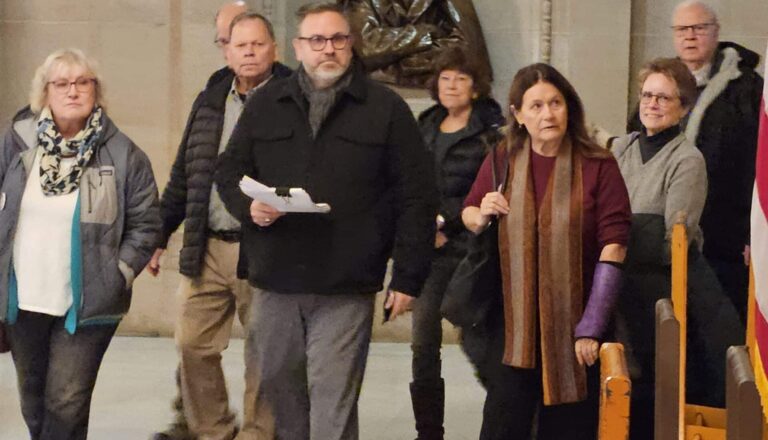
Indianapolis First Friends Quaker Meeting and Shalom Zone, an interfaith group, hand delivered dozens of letters, which called for the abolishment of capital punishment, to the governor’s office in the Statehouse on Tuesday morning. The small group walked silently into the office’s lobby and remained there for several minutes, while Molly Craft, Braun’s deputy chief of staff for communications, came out and spoke with them.
According to First Friends Associate Pastor Beth Henricks, Craft said she did not want the group to feel it was being put off. Also, Craft said she is working to schedule a meeting with the group in the coming weeks.
“It’s encouraging,” Henricks said. “It gives us hope.”
First Friends has been pushing for more information and calling for the repeal of Indiana’s death penalty statute amid the resumption of executions in the state. Since December of 2024, three men – Joseph Corcoran, Benjamin Ritchie and Roy Ward – have been put to death by lethal injection.
Until today, the requests from First Friends have been largely ignored. The members have not received any response from the Indiana Department of Correction about the drug cocktail used in the lethal injections and the cost of those drugs. They filed a complaint with the Indiana public access counselor but were told the details about the pharmaceuticals used in the state’s executions were not public record. Even their calls and emails to the governor’s office asking for a meeting went unanswered.
However, comments by Braun earlier this year that indicated he was open to discussing the relevance of the death penalty convinced First Friends to make their appeal directly to him. The Quakers reached out to other churches, including some in the Catholic, Lutheran, Methodist, Disciples of Christ, and Mennonite denominations, and invited them to write letters advocating for the elimination of capital punishment.
“The saying that Quakers have is there’s a piece of God in everybody and so to kill people, it’s kind of destroying that opportunity,” Jim Donahue, a member of First Friends who helped organize the letter-writing campaign, said.
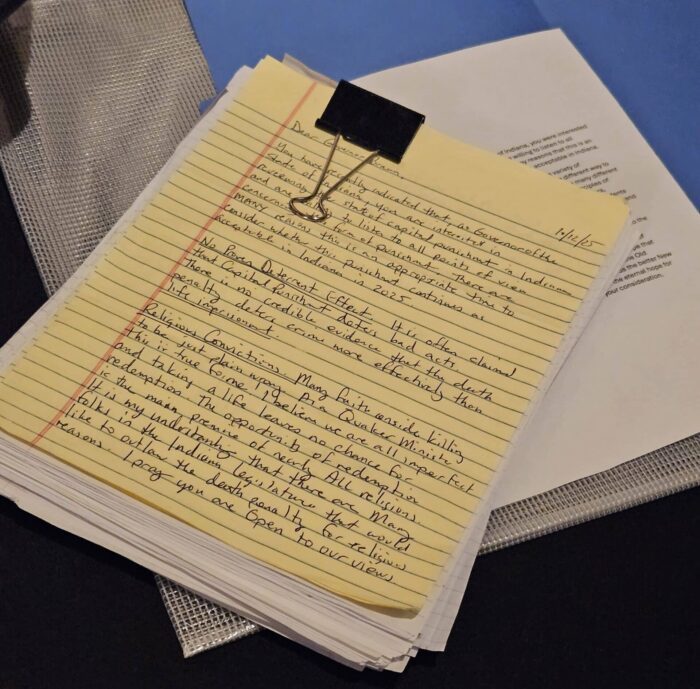
Some of the letters the group delivered were handwritten, while others were crafted on a computer and then printed out. Several letters focused on different aspects of the death penalty, including the high financial cost of executions, incidents of wrongful convictions and how capital punishment is not a deterrent to crime. Others spoke of the death penalty conflicting with religious teachings and moral values. A few told Braun to “be a hero” and have the courage to defy “party and social dogma.” One simply said, “We cannot end violence with violence.”
First Friends members acknowledged they could have just sent the letters electronically or through the postal service, but they felt that delivering them in person would make a stronger statement.
“From our perspective, the death penalty is a denial of the sacredness of life and forecloses any opportunity for redemption,” Phil Goodchild, a member of First Friends, said. “It just should not be part of a criminal justice system that is afflicted with error and bias.”
Although only the Indiana General Assembly can repeal the death penalty, the group noted Braun could stop the executions by granting clemency.
The legislature seems to have competing views.
Indiana Rep. Robert Morris, who said capital punishment conflicts with his pro-life stance, has indicated he intends to reintroduce a measure that would end executions in the state, according to First Friends. The Fort Wayne Republican offered House Bill 1030 during the 2025 legislative session, which would have repealed the death penalty and commuted all remaining death sentences to life in prison without parole. Even though the legislation did not get a hearing, it did attract bipartisan support.
Conversely, a bill already filed in the General Assembly this session would allow an execution to be carried out by firing squad if the drugs for lethal injection were not available. Sen. Mike Young, R-Indianapolis, authored Senate Bill 11, and Lt. Gov. Micah Beckwith championed firing squads in a post on the social-media platform X in June. Beckwith’s post inspired Rep. Andrew Ireland, R-Indianapolis, to respond on X, “Stay tuned.”
The members of First Friends said they are not discouraged.
“This is Indiana and we understand the realities, but we think our message is the right message, is the optimistic message, is the message for 2026,” Donahue said. He added the question for lawmakers is whether they favor the Old Testament teaching, “an eye for an eye,” or they favor the Christian thinking from the New Testament which stresses the hope of redemption.
Indianapolis criminal defense attorney Jodie English is a Quaker and has been a leader in rallying First Friends to take action on the death penalty.
English handled her first capital case in 1979 and her last in 2023, serving as either the attorney representing the defendant or as a mitigation specialist investigating the background of the accused. None of her clients, she said, were ever sentenced to death.
English said her experience taught her “there’s often things wrong” with the prosecutor’s case. Moreover, the time and money spent on the death penalty, she said, could be put toward reviewing unsolved crimes and tackling the backlog of untested rape kits.
“It’s time for us to just move our finite resources to something that gives us substantial justice, instead of occasional symbolic justice,” English said.
Dwight Adams, an editor and writer based in Indianapolis, edited this article. He is a former content editor, copy editor and digital producer at The Indianapolis Star and IndyStar.com, and worked as a planner for other newspapers, including the Louisville Courier Journal.
The Indiana Citizen is a nonpartisan, nonprofit platform dedicated to increasing the number of informed and engaged Hoosier citizens. We are operated by the Indiana Citizen Education Foundation, Inc., a 501(c)(3) public charity. For questions about the story, contact Marilyn Odendahl at marilyn.odendahl@indianacitizen.org.