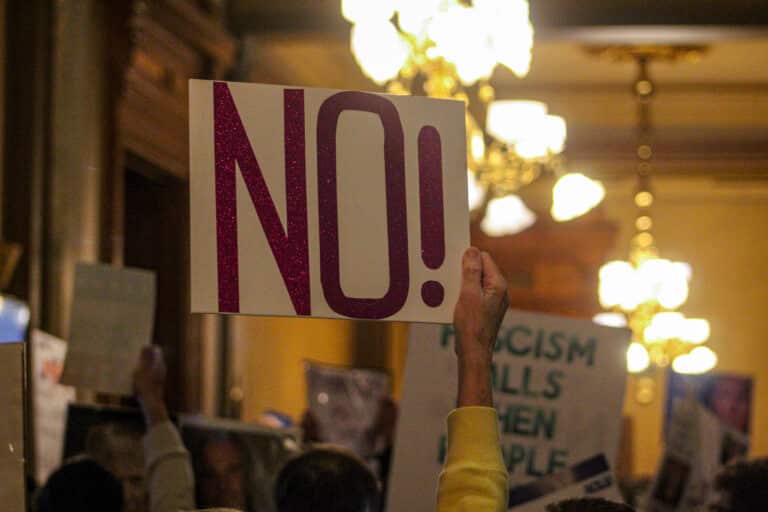
Opponents of redistricting crowded outside the Senate chamber as lawmakers heard public testimony on HB 1032. (Photo/Sydney Byerly)
By Colleen Steffen TheStatehouseFile.com December 8, 2025
People for and against Indiana’s mid-cycle redistricting bill came to the Senate chamber Monday afternoon torn between two perspectives—one national, one local.
In their remarks, proponents looked to other states and national politics—to Democratic states that have sought to redistrict early and to a 2026 mid-term election that could take away Republicans’ majority in the U.S. House.
Those against early redistricting talked issues closer to home—pothole-filled roads, unavailable child care and rising health-care costs—all being ignored, they said, by a General Assembly bent on political games.
Mediating the two viewpoints was a timer that dinged every two minutes, often cutting off speakers mid-sentence, and Senate Elections Committee Chair Mike Gaskill, R-Pendleton, the Senate sponsor of House Bill 1032, who seemed determined to run a more subdued, efficient meeting than the House saw last week. He opened with reminders to a packed chamber not to clap, boo or wave signs.
The second and likely final public hearing of the early-redistricting issue—the Indiana House’s Elections and Apportionment Committee heard public testimony last Tuesday, and the entire House passed the bill on Friday—attracted a large crowd outside the chamber as well. It wasn’t bound by the chair’s rules of decorum.
There, redistricting opponents held handmade signs, chanted, and yelled “cheater” and “shame on you” when pro-redistricting testifiers spoke—and those in favor of the bill dominated the first 45 minutes of the approximately four hours of testimony.
“Imagine what a Speaker (Hakeem) Jeffries or AOC (Alexandria Ocasio-Cortez) would do with the (U.S. House of Representatives) gavel,” said Michael Morris of Lafayette Citizens in Action, joining many of his fellow bill supporters in tying the Indiana Senate’s decision in Indianapolis now to possible dire outcomes in Washington, D.C., come November 2026.
“So much hangs in the balance,” said Cathie Humbarger, chiding General Assembly leaders for their lack of backbone. “This should have been the map under the 2020 census.”
Yvonne Koch said decisions made at the national level, such as driving up utility and other costs with federal regulations, are hurting Hoosiers. “Indiana needs representation in Washington that can effectively push back when federal decisions work against families,” she said.
“This bill ensures our state has a voice and the leverage we need at a time when national policies increasingly overlook the realities we face at home.”
More than one speaker—echoing the bill’s author, Rep. Ben Smaltz, R-Auburn, in his various speeches last week in the House—said redistricting as a concept should be taken up by Congress and forced into a fairer framework for all, but until that time, Indiana should use the same less-than-fair tactics they say Democrats are using in their states.
(Other testifiers and lawmakers against early redistricting have pointed out that the most recent push started in Texas, a Republican-majority state.)
Terre Haute constitutional lawyer James Bopp Jr. said he also wished there was a national law concerning the drawing of voting districts. “But I live in the real world,” he said.
Marion County resident Gregory Katter said he didn’t visit the Senate in the middle of a work day to compose a love letter to gerrymandering. But, he said, “there is no such thing as fair maps. Drawing maps is a political exercise no matter who does it.”
Coming to the opposite conclusion, Samantha Bresnahan, senior policy specialist for the American Civil Liberties Union of Indiana, said, “The promise of one person, one vote is at the heart of our democracy. That promise depends on fair maps that protect every community’s voice.”
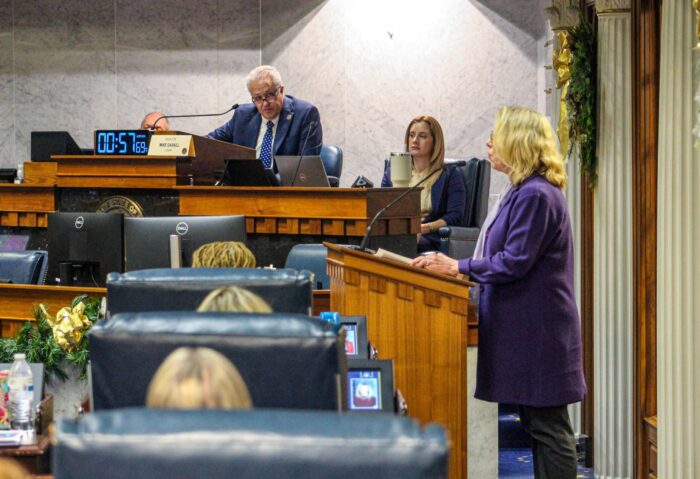
Republican Sen. Mike Gaskill, chairman of the Senate Elections Committee, listened as Julia Vaughn, executive director of Common Cause Indiana, spoke against redistricting. (Photo/Sydney Byerly)
Those opposed to early redistricting characterized it as a bullying attempt to bend Indiana to the will of the Trump administration and Washington, D.C.
“I know that behind our backs, the elite in D.C. who seek to divide us think we are country bumpkins easily manipulated so that they can drain our resources and add to their dragon’s hoard of riches,” said Leslie Nuss, a Valparaiso resident. “But that’s because they don’t live here, they don’t walk our streets, they don’t know our people, and they don’t care about our health, our communities and our future.”
Mother of a child with Downs syndrome, Nuss also joined Sen. Mike Bohacek, R-Michiana Shores, in finding President Donald Trump’s use of language to describe disabled people offensive.
“They’re trying to use fear as a weapon to intimidate us and you legislators,” said Jean Gaunt, referencing the swatting and other threats received by some dozen lawmakers in the last weeks.
A retired teacher, mother of 15 and grandmother of 55, she said, “Those of us who have raised teenagers are fearless. We are counting on you to be fearless.”
Drawing many of the same organizations that opposed the legislation earlier—MADVoters, Indiana Conservation Voters, Common Cause Indiana, Concerned Clergy of Indianapolis, the League of Women Voters, Indy Action Coalition—testimony also ran along similar lines, many speakers dwelling on the kitchen-table issues they said are being ignored in favor of the redistricting discussion.
Sarah Bartolo said spending so much time and money on a special session felt like a slap in the face for Hoosiers struggling economically.
“Families, real families with real challenges, are paying the price for your choices,” she said.
Two elections workers said the results of early redistricting would be, in the words of William Smith, “unbelievable chaos.” Marion County Clerk Kate Sweeney Bell, who also spoke before the House’s committee Tuesday, added to that testimony by estimating her county’s updates would cost some $1 million to enact.
“It will create havoc,” she said.
Speakers like Pastor David Greene, president of Concerned Clergy of Indianapolis, warned of the potential long-term impact on the democratic process, especially for minority communities that would feel their voices diluted.
“That shift does not strengthen democracy,” he said, “it destabilizes it.”
Yaqoub Saaddeh, community engagement coordinator for the Indiana Muslim Advocacy Network, said Muslims already feeling sidelined in Hoosier life fear being further silenced, while an Indiana grandmother broke down in tears describing her fears for her mixed-race granddaughter’s voting rights.
Mark Smith gave one of the briefest appearances at the podium. He mentioned the book “A Fever in the Heartland” by Timothy Egan, a recent nonfiction bestseller that recounts the 1920s resurgence of the Ku Klux Klan in Indiana and its connections to the state’s highest offices, including the governor. This year marked the 100th anniversary of the inauguration of Klan-compromised Gov. Edward Jackson, now widely considered the worst executive in the state’s history.
“The only thing that’s changed, you may not wear robes and hoods and burned crosses, but this bill is just flowery language of the same thing,” Smith said.
Kent Yeager, a farmer and former county councilor from Harrison County, expressed sympathy for the lawmakers who have received threats. But he quoted what he called an old hog farmer’s adage:
“Pigs get fed and hogs get eaten.”
Colleen Steffen is executive editor of TheStatehouseFile.com, a news site powered by Franklin College journalism students. She worked as a newspaper reporter and editor for more than 13 years and is now in her 10th year teaching college journalists.