By Marilyn Odendahl
The Indiana Citizen
February 5, 2026
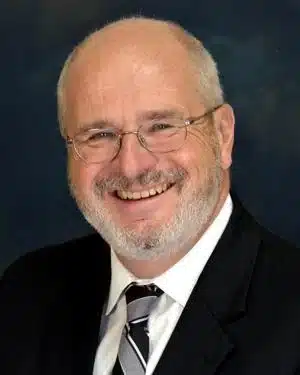
Lee Hamilton, who represented Indiana’s 9th Congressional District as a Democrat for more than three decades, is being remembered as a dedicated public servant who cherished American democracy, encouraged civic engagement and always strived to do the right thing.
Hamilton, 94, died Tuesday in Bloomington.
Indiana Democratic Party Chair Karen Tallian said Hamilton was a champion of working families and shaped foreign policy in Congress for decades. His legacy, she said, continues to be an example of how legislators can serve their constituents.
“It may be impossible to fill the shoes that Rep. Hamilton walked in, but his legacy has never been more important at a time when political divides continue to grow,” Tallian said in a statement. “May we carry on Rep. Hamilton’s vision of leadership that isn’t afraid of working across the aisle, even when it may be politically inconvenient.”
Hamilton served 34 years in the U.S. House of Representatives from 1965 until he retired in 1999 and served stints as chair of the House Intelligence Committee and House Committee on Foreign Affairs. Returning to the Hoosier State, he continued his work to strengthen democracy and improve Americans’ understanding of their country through his teaching at Indiana University and his service on several special commissions convened to address such issues and tragedies as the Sept. 11, 2001, terrorist attack.
Giving the Ubben Lecture at his alma mater, DePauw University, in 2011, Hamilton discussed major foreign policy issues, including U.S. intervention in the world. Also, he called upon Americans to be civically engaged and work to improve their communities as well as the country.
“What is more important than what we think about the nation’s future is what we do – that each of us do our part to make the country better and stronger,” Hamilton said. “My hope is that Americans will accept the economic, personal and political costs of being our world’s leader. Good outcomes in the world are possible, but they are not inevitable. The future could bring order. It could bring chaos. It could bring a mixture. It could bring something in between. But whatever the challenges we face, American leadership will count.”
Gov. Mike Braun has directed flags to be flown at half-staff in honor of Hamilton.
Born in Daytona Beach, Florida, Hamilton grew up in Evansville, where he starred on his high school basketball team and went on to play for DePauw University, graduating in 1952. Reflecting on his collegiate career in 2008, Hamilton said he was not the brightest student, but he praised liberal arts education and said his time at DePauw was “positive and constructive.”
“I graduated without having the slightest idea of what I was going to do,” Hamilton said. “I remember walking across the stage to get my diploma and saying to myself, ‘How in the world could you go through four years of college and not have any idea what you wanted to do when you graduated?’”
Hamilton went abroad and studied for one year at Goethe University in Frankfurt, Germany. When he returned in 1953, he enrolled in what is now Indiana University Maurer School of Law and earned his J.D. degree in 1956.
After practicing briefly in Chicago, Hamilton and his wife, Nancy, moved to Columbus, Indiana, where he started building his legal career and soon entered politics. He served a chair of the Bartholomew County Citizens for Kennedy in 1960 and as president of the Bartholomew County Young Democrats from 1963 to 1964.
Hamilton was elected to Congress in the Democratic tidal wave of 1964. Robin Winston, former Indiana Democratic chairman under Gov. Frank O’Bannon, noted Hamilton arrived on Capitol Hill at a tumultuous time in the country’s history and helped pass landmark legislation, including the Civil Rights Act of 1964, Voting Rights Act of 1965, the Medicare and Medicaid Act of 1965, and the Fair Housing Act of 1968.
Winston remembered asking Hamilton about being a part of President Lyndon Johnson’s legislative reform agenda, known as the Great Society.
“He said, ‘I simply did the right thing at the right time,’” Winston recalled Hamilton responding. “Now, it wasn’t like, ‘Hey look at me. I’m the star.’ He was just very humble.”
Winston said Hamilton’s impact can still be seen and felt in the federal funds and projects he secured for his southern Indiana district. That includes sewers, post offices, and schools along with the transformation of the former Indiana Army Ammunition Plant in Charlestown into an area of economic development. Also, Winston credited Hamilton with doing some of the early work that led to the construction of two new bridges connecting Clark County with Louisville, Kentucky.
Hamilton’s legacy, Winston said, will be his ability to find common ground and join with people across the political aisle to get things done.
“He worked with scores of Republican governors,” Winston said of Hamilton. “He worked, obviously, in both the majority and the minority in the U.S. Congress, but he was still able to get things done by doing the right thing.”
Judy O’Bannon Willsey, widow of former governor, spent a lot of time on the campaign trail with her late husband and Hamilton. Traveling from rally to rally on a bus, she remembered Hamilton was always “cordial and considerate of people.” He might relay a funny story about what happened at a campaign event, but he did not criticize anyone or grab the microphone and start blaming others for the hardships voters might have been facing.
“He was always very nice and thoughtful to everybody,” O’Bannon Willsey said. “There’s a lot of times when you’re in a campaign and it’s so intense … you get tired and it might be easy to flip some unkind joke about someone. He never did that. Never, ever did that.”
Although Hamilton retired from Congress at the end of his term in 1999, he returned to Washington, D.C., when presidents asked for his leadership. He served as vice chair of the 9/11 Commission in 2002 and co-chair of the Iraq Study Group , also called the Baker-Hamilton Commission, in 2006. Also, under the Obama administration, Hamilton was co-chair with former U.S. National Security Advisor Brent Scowcroft of the U.S. Department of Energy’s Blue Ribbon Commission on America’s Nuclear Future and was appointed to the President’s Intelligence Advisory Board.
In 2015, President Barack Obama recognized Hamilton with the Presidential Medal of Freedom. Hamilton was described as “one of the most influential voices on international relations and U.S. national security.” Joining Hamilton in the 2015 class was another Hoosier, William Ruckelshaus, who was the first and fifth administrator of the U.S. Environmental Protection Agency.
Hamilton settled back in Indiana after he left Congress. He founded the Center of Congress at Indiana University, now known as the IU Center on Representative Government, in 1999 and served as its director until 2015.
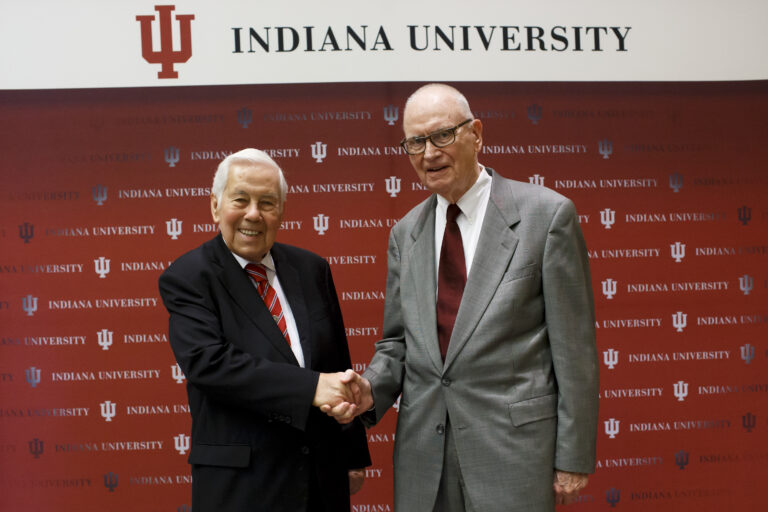
In 2018, Indiana University announced the School of Global and International Studies would be named in honor of Hamilton and U.S. Sen. Richard Lugar, a Republican. Then-IU President Michael McRobbie called the Indiana statesmen “two of the most revered voices in foreign policy in the United States.”
At an event in August 2025 hosted by the Hamilton Lugar School to celebrate the legacy of Indiana’s two legendary statesmen, Hamilton told the small gathering to think beyond their own interests.
“Don’t take the attitude of only worrying about what’s in it for you,” Hamilton said. “It’s OK to worry about that, but it’s also important to think about what you can do for your state, your country, and sometimes even your world.”
IU President Pamela Whitten remembered Hamilton’s impact and how he inspired generations of students through his teaching and mentorship.
“Few public servants have shaped our understanding of democracy, global engagement, and principled leadership as profoundly as Lee Hamilton,” Whitten said in a statement. “His lifelong commitment to public service reflects the very best of our democratic ideal and left an enduring impact on our nation.”
O’Bannon Willsey said Hamilton’s strength as an intellectual was his ability to make complex and complicated issues easy to understand. He often communicated his observations and ideas through his columns, which were published in newspapers and through a newsletter regularly dropped in inboxes.
Hamilton continued writing right up until his death. In a December 2025 column, he highlighted what he said was the duty Americans have to vote in elections and be civically active in their neighborhoods and communities.
“Representative government is only effective when we take seriously the duty of citizenship,” Hamilton wrote. “That means we need to inform ourselves, articulate our views and make clear what we value.”
O’Bannon Willsey hopes that as Hamilton is being remembered for his distinguished leadership, integrity and civility, more Americans will start reading his commentary and thinking about his message on democracy and the United States. His message, she said, still resonates.
“I think the fact that he was such a prolific writer in common words and common sense, that if we have the smarts to figure out how to use that at this critical time, it would be a real godsend,” O’Bannon Willsey said.
Dwight Adams, an editor and writer based in Indianapolis, edited this article. He is a former content editor, copy editor and digital producer at The Indianapolis Star and IndyStar.com, and worked as a planner for other newspapers, including the Louisville Courier Journal.
The Indiana Citizen is a nonpartisan, nonprofit platform dedicated to increasing the number of informed and engaged Hoosier citizens. We are operated by the Indiana Citizen Education Foundation, Inc., a 501(c)(3) public charity. For questions about the story, contact Marilyn Odendahl at marilyn.odendahl@indianacitizen.org.