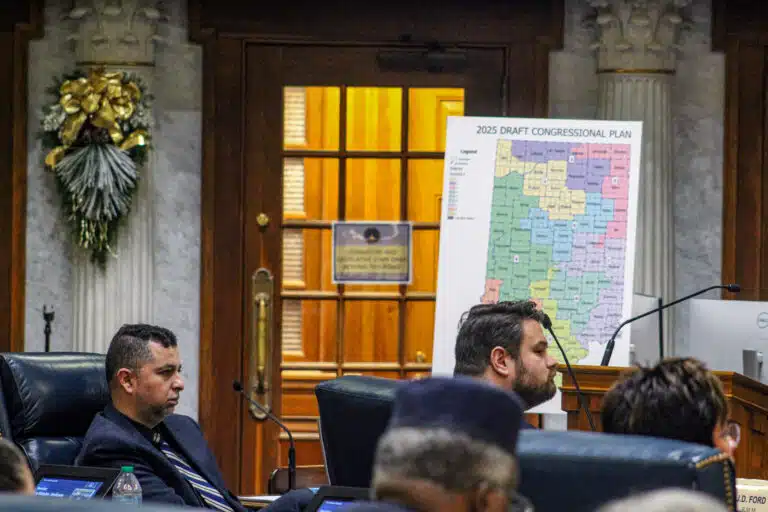
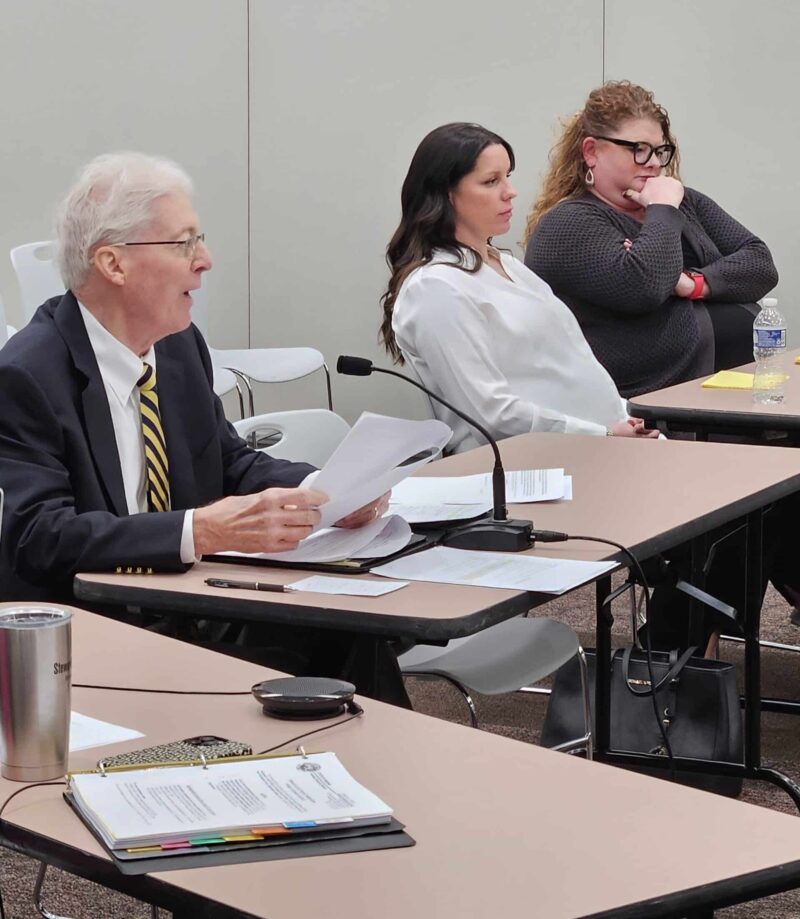
Democratic members of the Senate Elections Committee Fady Qaddoura and JD Ford, both of Indianapolis, offered amendments and raised questions about the redistricting bill during the Senate Elections Committee hearing on Monday. (Photo/Sydney Byerly)
By TheStatehouseFile.com and The Indiana Citizen
December 8, 2025
As the Indiana Senate took up the controversial redistricting bill on Monday, Senate President Pro Tempore Rodric Bray, R-Martinsville, was evasive about the level of support among the members of his Republican caucus.
Previously, Bray said Senate Republicans did not have votes to pass a new congressional district map this year. He even bulked at reconvening ahead of the traditional January start date, but shortly before the Thanksgiving holiday, he reversed course and said the upper chamber of the legislature would be returning Dec. 8.
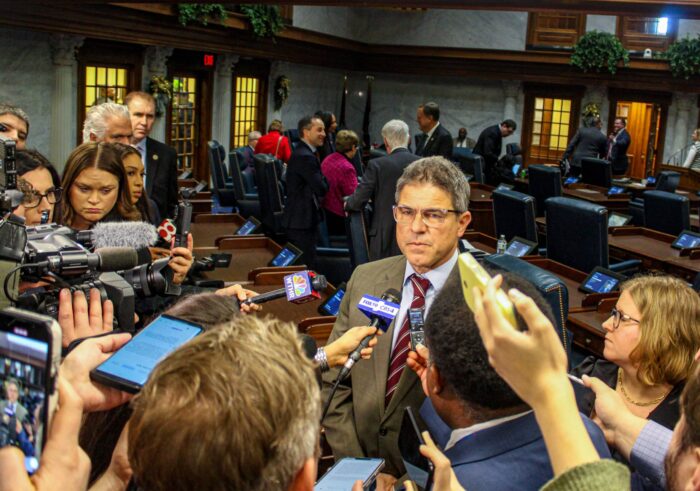
After Monday’s Senate session adjourned, Bray declined to provide any information on whether the Republicans will pass the redistricting bill when it comes up for a third reading this week.
“We’re all going to find out together on Thursday,” Bray said. “People are having a conversation about it. Senators know there’s going to be a chance to vote on it, so we’ll see Thursday.”
Senate President Pro Tempore Rodric Bray, R-Martinsville, spoke to a gaggle of reporters after the Senate adjourned on Monday. (Photo/Sydney Byerly)
At the start of the Senate session, Democrats tried to derail the process, just like their counterparts in the House attempted to do last week.
Senate Democrats protested that Republican leadership had run afoul of the chamber rules by not securing the minority leader’s consent prior to reconvening in December.
The effort was defeated on a party-line vote.
Five Republican senators were not in attendance for Monday’s session: Sens. Scott Alexander, of Muncie, Vaneta Becker, of Evansville, Jim Buck, of Kokomo, Randy Maxwell, of Guilford, and Ryan Mishler, of Mishawaka. Also, Democrat Sen. David Niezgodski, of South Bend, was not there.
Last Monday, House Bill 1032, which included the new map, was introduced just as the Indiana House began its early session. The bill’s author, Rep. Ben Smaltz, R-Auburn, emphasized that the congressional districts were redrawn solely to create a political advantage for Republican candidates.
Following a contentious debate,HB 1032 passed the House on Friday. The final vote was 57 to 41, with 12 Republicans joining Democrats in opposing the legislation.
HB 1032 is being sponsored in the Senate by Republican Sens. Mike Gaskill, of Pendleton, Chris Garten, of Charlestown, Liz Brown, of Fort Wayne, and Tyler Johnson, of Leo.
Sen. Mike Young, R-Indianapolis, addressed his colleagues during the Senate session Monday and defended the new congressional district map, saying it was fair and legal. He pointed to the Dec. 4 ruling from the U.S. Supreme Court that upheld the redrawn map in Texas and, asserting the Lone Star State has similar laws to Indiana, said no one in Texas raised concerns about the fairness or legality of the new configuration.
“For all those people who think they’re lawyers in Indiana, who think it’s against the law or it’s wrong, the Supreme Court of the United States says differently,” Young said.
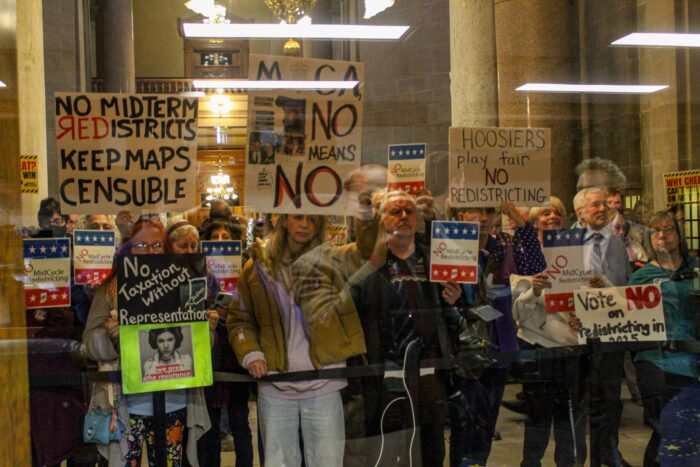
While Young was speaking, opponents of HB 1032 who were standing outside the chamber could be heard shouting “no cheaters” and “no redistricting.”
Lawmakers debate in the Senate Elections Committee
Unlike in the House Elections and Apportionment Committee last Tuesday, the public took the podium before lawmakers did Monday afternoon in the Senate Elections Committee.
When it was finally their turn, the two Democrats on the Elections Committee, Sen. Faddy Qaddoura, of Indianapolis, and Sen. J.D. Ford, of Carmel, proposed four amendments.
Amendment 18 by Qaddoura called for new maps to be drawn by the Legislative Services Agency instead of by the National Republican Redistricting Trust. It also would have created a process in which the General Assembly could not alter the nonpartisan-drawn maps until they were rejected twice. Finally, the amendment would have created a rule that would not allow the legislature to draw maps mid-decade.
Qaddoura’s amendment failed 2-7.
Amendment 21, also written by Qaddoura, would have required the General Assembly to consider communities of interest and the compactness of districts and to use non-political data when map drawing. It failed 3-6, with Sen. Greg Walker, R-Columbus, speaking openly in support of the amendment. He said he hopes to draft a bill with similar language later in the session.
Ford introduced Amendment 19, which would require hearings in each district before drawing new congressional maps and disclosure of who drew the map and how much money was spent on it.
Walker crossed party lines again for Ford’s amendment, but he was the sole Republican to do so. It failed 3-6.
Amendment 20 by Ford was the final amendment considered during the committee meeting and would require the state to reimburse county clerks and local governments for the cost of implementing HB 1032.
Sen. Mike Gaskill, R-Pendleton, told Ford that fiscal statements say the bill can be implemented with current resources and that no additional staff would be needed for county clerk offices.
The amendment failed 3-6.
Opponents of redistricting put in a long day on Monday, standing for hours outside the Senate chamber while the elections committee met. (Photo/Sydney Byerly)
After the amendments were discussed, the committee members could question Gaskill, a Senate sponsor of HB 1032.
Qaddoura focused on demographic concerns, asking Gaskill if census data was used for the new map and whether or not that data included race. Gaskill said 2020 census data was used but no racial information was considered.
Qaddoura said not using racial information could be violating Section 2 of the Voting Rights Act because it requires communities of interest to be maintained. Gaskill said it was up to lawyers to decide if that is the case should the bill be tried in court.
Ford asked Gaskill who made the map and how much it cost the state.
According to Gaskill, the map was drawn by Adam Kincaid, the National Republican Redistricting Trust’s executive director. As for the strain on Hoosier tax dollars, Gaskill said, “I have no idea how much it cost, but for the people who are interested in that, I think they will probably have the ability to find out.”
“So basically you’re saying a FOIA request to the legislature would be the best route to get the cost?” Ford asked.
“I’m not qualified to give that advice,” Gaskill responded.
Ford also asked Gaskill if he thought it was fair for there to be zero Democratic representation in Congress. Gaskill said it is fair because some states don’t have Republican representation in Congress.
“Can you imagine how a basketball game would turn out if you told one team, ‘You can only shoot three pointers,’ but the other team, ‘You can only shoot layups’?” Gaskill said.
Ford responded with a different basketball analogy.
“I see a team of folks who are seven feet tall dunking on people who are maybe five and a half feet tall,” he said. “This bill does exactly that. You are dunking on the minority party.”
Following the questioning, some committee members gave closing remarks.
Qaddoura said that two congressional seats equate to about 1.5 million people. He asked his fellow committee members, “Do 1.5 million people not deserve to be heard?”
Ford told the committee that his inbox “has been on fire” over redistricting. He added that redrawing maps mid-cycle sets a dangerous precedent.
“Any party in power can simply just rerig the system however the national political winds shift,” he said. “This is an invitation to endless political instability.”
Other than Gaskill, who gave brief closing remarks about respecting President Donald Trump and passing the bill, Walker was the only Republican who spoke at the end of the meeting.
He voted for three of the four Democratic amendments and told the committee why he thinks HB 1032 should not move forward.
Walker was one of several Indiana lawmakers who received swatting attempts as threats to convince him to vote in favor of redistricting. He mentioned a rule in the Senate rulebook that states Senators should not receive favors of any kind in exchange from an individual who wants political advantage. He said the rules require high moral and ethical standards for senators, especially to avoid conflicts of interest.
Walker viewed the threats he had received as a bad type of favor— an attempt to sway his vote, which has consistently been no on redistricting.
“I don’t think any of us ever enrolled or put our names on a ballot with a thought that we would be living under a time when we’re being threatened for trying to execute our responsibilities to fulfill our office,” Walker said. “I refuse to be intimidated. I made a choice. I will not let Indiana or any state become subject to the threat of political violence in order to influence a legislative product.”
Walker voted no with Qaddoura and Ford, the only Democrats on the committee.
Sen. Stacey Donato, R-Logansport, said she was voting yes but “for today.” Sen. Linda Rogers, R-Indianapolis, also voted yes, but said she reserves the right to change her vote.
Anna Cecil, Olivia O’Neal and Marilyn Odendahl contributed to this report.
Olivia O’Neal and Anna Cecil are reporters for TheStatehouseFile.com, a news site powered by Franklin College journalism students.
Marilyn Odendahl is editor of The Indiana Citizen, a nonpartisan, nonprofit platform dedicated to increasing the number of informed, engaged Hoosier citizens.