By Marilyn Odendahl
The Indiana Citizen
February 23, 2026
Six candidates running for public office will have to appear before the Indiana Election Commission on Wednesday and prove their party affiliation in order to remain on the May primary ballot.
The six have had their candidacies challenged under the state’s affiliation statute: Indiana Code, 3-8-2-7(a)(4). This law, which has tripped up many candidates in the past, requires individuals running for office to substantiate they belong to either the Republican or Democratic party, before they are allowed to run in a primary.
A total of eight candidates – six for the Indiana General Assembly and two for Congress – are facing challenges, but none are being questioned for filing their paperwork with Indiana Secretary of State Diego Morales. Earlier this month, concerns arose that the secretary of state staff was not properly credentialed to certify the candidacy papers, which prompted several individuals running in the primary this year to update their filings with the Indiana Election Division.
Under the affiliation statute, candidates have to show they are a Republican or Democrat either through their primary voting record or by certification from the county chair of the political party in the county in which they reside. The candidates must have voted in their party’s primary in the two most recent primary elections in which they participated, or they must get their county party chair to certify they are a member of the political party.
Greenwood attorney Michelle Harter has represented candidates booted from primaries because of the affiliation statute, including Indiana egg farmer John Rust who tried to enter the May 2024 Republican primary against Jim Banks for the U.S. Senate. Harter took the Rust case to the Indiana Supreme Court, where the justices upheld the statute in a 3-2 ruling, and then she appealed to the U.S. Supreme Court, but her petition was not accepted.
The law, Harter said, violates the rights of voters and candidates. Voters are left with fewer choices in elections and, if they cross over in a primary because, for example, their affiliated party has not fielded a candidate in every race, they could be penalized should they decide, at some point in the future, to run for office. Candidates also are harmed, she said, because their ability to stay on the ballot can hinge on a process that gives the county party chair a lot of power and provides little recourse to overturn the chair’s decision.
“I hate this law,” Harter said. “I really think it screws voters and candidates. I think we should have more choices on the ballot, not less.”
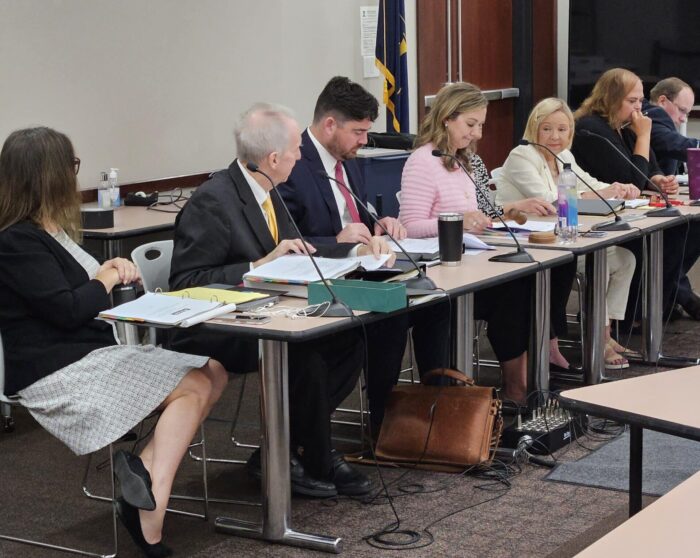
The commission is scheduled to hear challenges to eight candidates in an all-day hearing. The candidates must convince the four-member commission – comprised of two Democrats and two Republicans – that they should remain on the ballot. If the commission deadlocks in a 2-2 vote, the candidate stays in the race.
However, based on her experience with the affiliation statute, Harter expects the six candidates challenged under that law will be removed from the 2026 primary election.
“I cannot see any one of them sticking their neck out, given the Rust opinion,” Harter said of the commission members. “They’re now going to be galvanized, saying, ‘Well, (the Indiana Supreme Court) said the affiliation statute was constitutional.”
Two Republicans running for the Indiana House and one Democrat running for Congress have had their candidacies challenged solely under the affiliation statute. The candidates are:
Chris Nelson, who has filed as a Republican, is running for House District 12 in Lake County that includes the towns of Munster, Highland, Griffith and a portion of Schererville. The seat is currently held by Rep. Mike Andrade, D-Munster.
Jacob Johnson, who has filed as a Republican, is running in House District 73, which includes parts of Shelby, Decatur, Bartholomew and Jennings counties. He is in a crowded primary with another Republican candidate, Edward Comstock II, and the incumbent Rep. Jennifer Meltzer, R-Shelbyville. Meltzer voted against redistricting in December 2025.
Robert Lovely, who has filed as a Democrat, is running in Indiana Congressional District 4, which extends from Jasper and Newton counties down to Morgan County and includes Tippecanoe County. Lovely is among nine Democrats and two Republicans vying for the seat that is currently held by U.S. Rep. Jim Baird, Republican.
Two candidates are being challenged not only for their primary voting history but also for allegedly living outside of the legislative district in which they are running. The candidates are:
Jiamain “Billy” Qian, who has filed as a Republican, is running in House District 39 in Hamilton County. Qian and Democrat Lindsay Gramlich are vying for the seat currently held by Rep. Danny Lopez, R-Carmel. Lopez voted against redistricting in December 2025.
Kuren Singh Sikand, who filed as a Democrat, is running in House District 90, located in the southeastern portion of Marion County. He is the lone Democrat and only challenger to the incumbent, Rep. Andrew Ireland, R-Indianapolis. Ireland supported midcycle redistricting.
A Chicago man who is running for one of Indiana’s congressional seats being challenged for having no primary voting history and, also, because of his nickname.
Richard Mayers, who has filed as a Republican, is running for Indiana’s 1st Congressional District seat, which is currently held by U.S. Rep. Frank Mrvan, Democrat.
According to the candidate challenge filed by Randy Niemeyer, chair of the Lake County Republican Party, Mayers has listed his nickname as “Sieg Heil” on his candidacy filings. “Sieg Heil” is the Nazi salute, which translates to “Hail Victory.” Niemeyer asserted Mayers’ nickname violates Indiana Code 3-5-7-5, because it is not a “name by which the candidate is commonly known.”
Speaking to WGN in Chicago, Niemeyer described Mayers as someone who is looking for attention and not a candidate to be taken seriously.
Two candidates for the state legislature are being challenged for reasons other than their voting records.
Kimberly Townsend, a Democratic candidate for House District 36, which is in Madison County, is being challenged under the Little Hatch Act, 5 U.S.C. 1502. State or local employees whose income includes money from federal loans or grants are prohibited by this federal law from running for elective office.
Birjan Crispin of Anderson, who filed the challenge, claimed Townsend’s position as executive director of the City of Anderson Housing Authority is fully funded with federal dollars from the U.S. Department of Housing and Urban Development. Consequently, Crispin asserted, Townsend is ineligible to run for the General Assembly.
House District 36 is currently held by Republican Rep. Kyle Pierce, who voted for redistricting. Another Democrat, Novhad Melki II, is also a candidate in the race.
Alexandra Wilson, who has filed as a Republican, is running for Senate District 38, which includes all of Vigo and parts of Clay and Sullivan counties. She and one other Republican, Brenda K. Wilson, are challenging incumbent Sen. Greg Goode, R-Terre Haute. Democrat Kacey Blundell has also filed to run in the district. Goode voted against the redistricting bill in December 2025.
According to a challenge filed by Jeffrey Gallant, Alexandra Wilson is allegedly disqualified under Indiana Code 3-8-1-5 (d)(3)(C), which prohibits a person who has pleaded guilty to a felony from assuming or running for elected office. Gallant attached documents from a 2010 criminal case in Vermillion County Circuit Court in which the defendant, who is identified as Alexandra Anderson, entered a guilty plea for resisting law enforcement, a Class D felony. The one-year sentence was suspended to probation, and the judgment of conviction was entered as a Class A misdemeanor.
None of the documents submitted with the candidacy challenge identify the candidate, Alexandra Wilson, as being the same person as the defendant, Alexandra Anderson.
Two other candidates who were being challenged have since withdrawn from their respective races. Chris Walker was one of four Republicans running for House District 34, currently held by retiring Democratic Rep. Sue Errington. Brookelynne George was one of three Democrats running to unseat the Republican incumbent in House District 36.
Indiana’s affiliation statute was narrowed in 2022.
The original version of the statute, effective in 1986, enabled candidates to demonstrate their party affiliation in three ways, including allowing those who never voted in a primary to claim they were either a Republican or Democrat. In 2013, the law was amended to require the candidate to have voted only one time in the party’s primary or have approval from the local party chair.

Rep. Timothy Wesco, R-Osceola, pushed through another change to the statute in 2021. Under his bill, House Enrolled Act 1356, which passed in 2021 and took effect Jan. 1, 2022, candidates had to prove their political party affiliation by voting for that party in the two most recent primary elections in which they participated. Also, they could get certified by the party’s county chair.
Harter noted the timing of Wesco’s bill. The country was emerging from the COVID-19 pandemic and many in Indiana were angry at the lockdowns and mask mandates imposed by then-Gov. Eric Holcomb. “Regular people,” Harter said, started questioning their state lawmakers’ actions and then decided to run for the legislature themselves. Fearing they would lose their seats, the incumbents added further restrictions to the affiliation statute, she said.
Consequently, Harter has dubbed the statute the “Incumbent Protection Act.”
“The party doesn’t support people who don’t kiss the ring,” Harter said of the Democratic and Republican parties. “A question I was asking in my court case was ‘is the party the people or is it the party chair,’ because voters don’t get any decision under this statute. They don’t have any say in who’s on the ballot.”
Dwight Adams, an editor and writer based in Indianapolis, edited this article. He is a former content editor, copy editor and digital producer at The Indianapolis Star and IndyStar.com, and worked as a planner for other newspapers, including the Louisville Courier Journal.
The Indiana Citizen is a nonpartisan, nonprofit platform dedicated to increasing the number of informed and engaged Hoosier citizens. We are operated by the Indiana Citizen Education Foundation, Inc., a 501(c)(3) public charity. For questions about the story, contact Marilyn Odendahl at marilyn.odendahl@indianacitizen.org