Economic growth
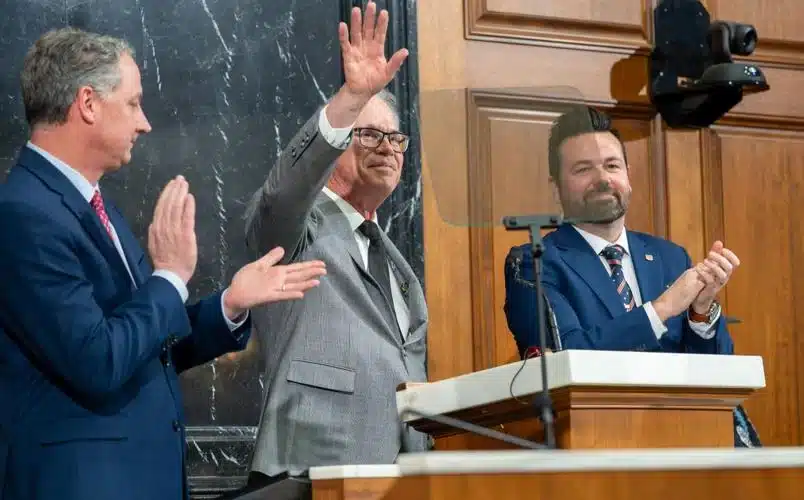
At the beginning of his speech, Braun said the state’s real gross domestic product (GDP) is outgrowing not only surrounding states but also rising faster than the national rate.
“The time is now and the place is Indiana,” Braun said. “The state of our state is strong.”
But the U.S. Bureau of Economic Analysis’ findings say otherwise, showing Indiana’s real GDP only rose 3.1% in the second quarter last year, which is lower than the 3.8% national average and every surrounding state. In fact, Illinois’ real GDP grew 4.8% according to the report.
Braun’s data could be coming from an Indiana Business Review story about the state’s outlook for 2026, which cited 2024-2025 data showing Indiana’s real GDP grew 2.6% statewide, 0.5% above the national average.
Utilities and data centers
This week, the House Utilities, Energy and Telecommunications Committee discussed House Bill 1002, which aims to lower utility bills for Hoosiers.
Braun said Wednesday night that he supports this bill because it will “hold investor-owned utility companies accountable to provide affordable energy before they can increase their profit margin.”
Last year, the congressional Joint Economic Committee Minority’s energy bill report projected that Hoosier utility bills went up over 16% in 2025, a $260 difference from 2024.
Recently, Hoosiers voiced their concerns about how new AI data centers may impact their already rising utility bills.
Last fall, Franklin Township warded off a Google data center from building on nearly 500 acres in the township, until Google rezoned for another portion of Marion County.
According to DataCenterMap.com, the state now has 72 data center facilities and plans for 19 more.
Braun said Wednesday night that he wants Indiana to lead in the country’s “AI race” without raising Hoosiers’ electricity bills, which he plans to accomplish by encouraging companies to “pay their own way.”
“Amazon, for example, they’re building a $15 billion data center in northwest Indiana,” Braun said. “They’re going to pay for every cent of their new power. They’re willing to do it and then some.”
Homeownership and property taxes
Later in the speech, Braun praised House Bill 1001, which he said will make it easier for Hoosiers to afford homes. Currently, Zillow estimates that most Indiana homes are nearly $250,000.
He blamed high housing prices on a lack of homes being built in Indiana, which could be alleviated by HB 1001, as it aims to remove barriers for builders to obtain permits.
In 2024, The Indianapolis Star reported that new-home starts in the Indy area were at their highest number since 2021, and in June last year, building permit distribution was up 3% since 2024.
One of Braun’s self-proclaimed biggest wins last year was a property tax cut bill, which he said Wednesday night will save taxpayers $1.5 billion over the next three years. The bill enacts a property tax credit of 10% of a homeowner’s bill up to $300.
Critics of the cut say it will put less money into the pockets of schools and local governments.
Education and child care
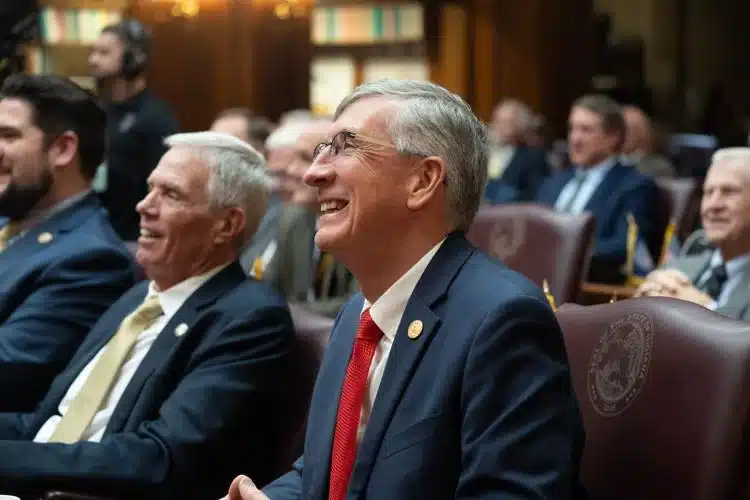
Speaking of schools, Braun highlighted efforts to raise teacher pay, fund education and give Hoosiers universal school choice.
Last session, the General Assembly passed its budget bill, which gave private school vouchers to all Hoosiers who choose to send their kids to non-public schools—also known as universal school choice.
The vouchers option was criticized by Democrats who said it would mainly help Hoosiers who are already wealthy enough to send their kids to private schools.
“Competition and choice are good things, and we’ve always funded public education as best as we can,” Braun said in his speech.
The legislature also passed a bill that raised Indiana teacher minimum wage to $45,000 per year, but the State Teachers Association says this is not enough compared to the national average salary of over $70,000.
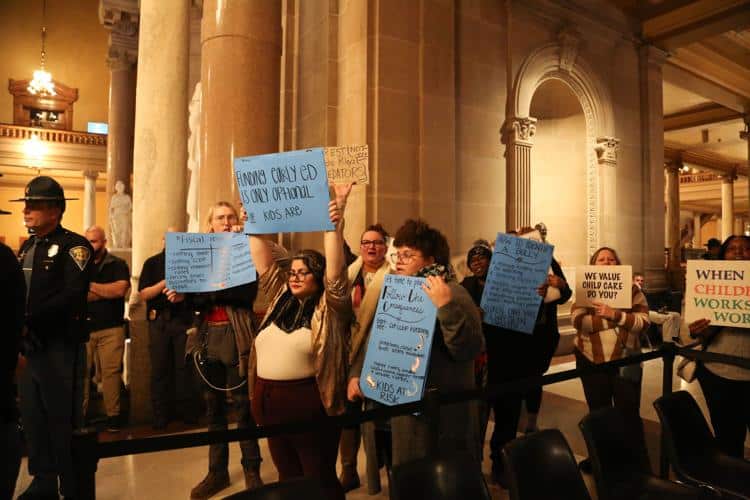
Braun briefly addressed child care, which costs Hoosiers between $9,000 and $12,000 each year on average. Instead of saying he will work to fund the Indiana Child Care Development Fund, which many Democrats want, Braun encouraged businesses to help make it more affordable.
“I would like to see a program where businesses have some skin in the game,” he said.
Health care
According to United Way of Central Indiana, as of summer 2025, people in Indiana had an estimated $2.2 billion of medical debt in collections.
To combat this issue, Braun cited authors of introduced legislation that addresses drug prices, could put statutes in place for medical debt collection, and creates a prescription drug assistance program for the elderly.
“Health care is too darn expensive. I want all of us to work on that. It’s the biggest part of the economy. It shouldn’t cost us that much, and we need to do something about it,” Braun said.
“We need creative solutions to make health care affordable and protect families from predatory collections.”
Football
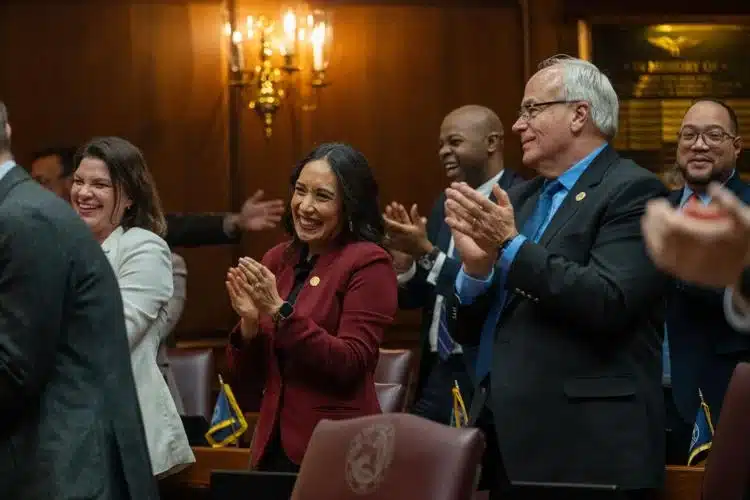
Braun mentioned the Indiana University football team on several occasions during the speech, inciting chants of “Hoo Hoo Hoo Hoosiers” from the crowd.
He shared a story about a Jack Gibson from Shoals (Braun’s “neck of the woods”) who asked for a school delay on Tuesday morning next week—the day after Indiana takes on University of Miami in the College Football National Championship.
He also said he is “working hard” to bring the NFL’s Chicago Bears to Indiana. The team is currently considering building a new stadium in the northwest portion of the state.
Reactions
Democrat Caucus leaders Sen. Shelli Yoder, D-Bloomington, and Rep. Phil GiaQuinta, D-Fort Wayne, led the Democratic rebuttal following Braun’s speech.
Yoder began her remarks the same way Braun did, discussing affordability and asking the governor, “Do you mean it?”
“Hoosiers agree on something fundamental,” Yoder said. “We believe in the rule of law. We believe in accountability. And we believe in liberty, justice and due process for all. Hoosiers are not confused, they see a pattern. Affordability is talked about, but costs keep rising. Supports are cut, and families are being told to do more with less.”
She called for greater transparency from the AI data centers coming into the state.
“We need to have better partnerships with the companies that want to come and use our resources and provide jobs, but too many of our communities are not feeling that growth in their communities as a result of the promises that are made,” Yoder said. “We need to make sure that Indiana communities and Hoosier families are protected, and transparency and accountability are step one.”
GiaQuinta referenced Braun’s commitment to lowering utility and child-care prices.
“House Democrats agree with Gov. Braun that Hoosiers are no better off than they were a year ago, and that’s thanks to him and the Braun super majority,” Giaquinta said. “If Statehouse Republicans wanted to lower costs, they would have already done that by now. They’ve been in charge for the past 20 years.
“Now that Gov. Braun is catching up to the fact that Hoosiers are struggling, he’s talking about affordable utilities and child care, but his actions of the past year speak differently.”
Speaker of the House Rep. Todd Huston R-Fishers, and President Pro Temp, Sen. Rodric Bray, R-Martinsville, led the Republican remarks after Braun’s speech.
“There is a lot of success to build on this session and in the coming years, and that’s what we look forward to doing,” Huston said.
Bray responded to an earlier comment from Sen. Shelli Yoder, D-Bloomington, that Republicans are turning to Democratic ideas to address the affordability issue.
“I don’t recall any Democrats voting for the property tax bill, nor the tax cuts that we did already,” said Bray. “Those are some conservative ideas that we are trying to decrease some of the costs for Hoosiers around the state.”
Huston said lawmakers are working together across the aisle to acknowledge affordability such as property taxes and income taxes.
“We just have a fundamental disagreement about the government’s role in working to find the right solutions for it,” said Huston.
Both spoke about attempting to reduce regulations on child care, and Huston said he prefers the word “challenge” rather than “crisis” to describe it.
“Trying to reduce some of that regulation so that people are freer to provide child care costs that are less expensive,” said Bray.
Bray agreed with Braun that AI data centers are something that need to be taken seriously.
“Artificial intelligence is here to stay, and it’s going to continue to grow,” Bray said, but he is not sure that state governments should focus on legislation just yet.
“We would probably prefer that the federal government take a look at that first,” said Bray. “It would be difficult for all 50 states to have different policies with regard to that.”