By Sydney Byerly
The Indiana Citizen
January 22, 2026
Lt. Gov. Micah Beckwith is staking out his top priorities for this year’s Indiana legislative session, including urging lawmakers to eliminate property taxes, expand cooperation with the federal government’s deportation efforts, require that the Ten Commandments be posted in schools, allow the death penalty to be carried out by firing squads and more.
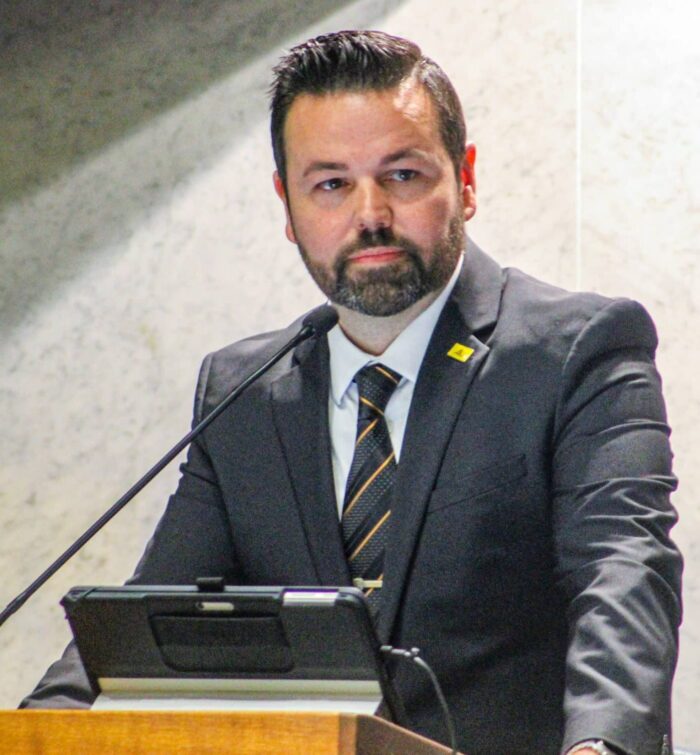
Beckwith outlined his priorities for the legislature’s 2026 session, including bills he hopes to see passed and those he aims to defeat, in a social media graphic and a nearly 20-minute long “Ask Me Anything” video posted online Tuesday.
In the posts, Beckwith said he was trying to “help keep Hoosiers informed on what their government is doing,” and promised a longer list of what he called the “good, bad and ugly” bills later in the session.
The list Beckwith highlighted reflects a partial slate of legislation the lieutenant governor has publicly endorsed or opposed throughout the session. He voiced support for seven bills, all authored by Republican lawmakers, and opposition to four bills, several of which were authored or co-authored by Democrats.
The Indiana Citizen reached out to every legislator who authored a bill Beckwith highlighted. Only a handful agreed to be interviewed, including Reps. Ed Clere, R-New Albany, Matt Pierce, D-Bloomington, and Wendy Dant Chesser, D-Jeffersonville.
HB 1288 would phase out Indiana’s property tax system, abolishing property taxes after 2027 and replacing that revenue largely by extending the state’s 7% sales tax to a wide range of services that are currently exempt, including professional services such as legal work, accounting, consulting and landscaping. The bill would also eliminate county and township assessor offices and sharply limit new bonds and tax increment financing districts.
Indiana has seen ongoing property tax debates for years, though nothing nearly as sweeping as full repeal. In 2025, lawmakers passed Senate Enrolled Act 1, which provided some property tax relief — including expanded homestead deductions, credits and business tax changes. Many homeowners saw only modest savings, and some local officials worried that services like schools, police and fire protection could see significant shortfalls without alternative revenue sources.
Beckwith has repeatedly described property taxes as “immoral,” arguing in his video that they amount to the government taxing a “God-given right.”
“When the government taxes your property, the government is taxing a God-given right,” he said. “A government has no business messing with — they should protect it, not tax it.”
He said Prescott’s bill would replace lost revenue by extending the sales tax to services and pledged continued advocacy even if repeal takes years. “I will not stop yelling about this,” Beckwith said. “I will not stop shouting this from the rooftop till the day I die.”
Prescott did not respond to a request for comment. As of publication, this bill has not been scheduled for a hearing in the House Ways and Means Committee.
HB 1039 would strengthen state and local cooperation with federal immigration enforcement by requiring compliance with immigration detainer requests and prohibiting local governments from taking actions that would facilitate the migration of undocumented immigrants into Indiana.
In his video, Beckwith argued that opposition to immigration enforcement legislation limits law enforcement officers’ discretion to act on information encountered during routine duties. He said officers should be able to rely on their judgment when they encounter potential violations, framing the issue as one of public safety rather than immigration policy.
Indiana lawmakers have returned to immigration enforcement repeatedly in recent years. In 2025, the General Assembly passed legislation requiring local law enforcement agencies to honor federal immigration detainer requests and reinforcing the state’s prohibition on so-called sanctuary policies. Opponents of similar measures have argued such laws can erode trust between immigrant communities and police and may discourage cooperation with law enforcement.
Prescott did not respond to a request for comment. As of publication, the bill has not been scheduled for a hearing in the House Ways and Means Committee.
Both bills would expand Indiana’s execution methods to include firing squads, with HB 1119 also allowing nitrogen hypoxia.
Beckwith said he supports the bills on moral and religious grounds, arguing that capital punishment is compatible with the Ten Commandments and biblical teachings on justice.
“The commandment is ‘thou shalt not murder,’ not ‘thou shalt not kill,’” he said, adding that government “does not bear the sword in vain” when it carries out capital punishment. He also said allowing condemned inmates to choose an execution method could be an act of mercy, so long as it does not impose undue costs on the state.
The state in 2024 resumed executions after a 15-year hiatus, which led to controversies over execution methods. Gov. Mike Braun last year raised concerns about the supply and cost of lethal injection drugs.
Death row inmate Roy Lee Ward’s execution on October 10, 2025 marked the state’s second execution of 2025, and just the third since resuming the death penalty.
The firing squad provisions in SB 11 and HB 1119 have drawn significant opposition from civil liberties and faith-based groups in Indiana, who argue such methods are inhumane and contravene constitutional and ethical norms. The ACLU of Indiana has opposed both bills.
Neither Young nor Lucas responded to interview requests. SB 11 has been given a hearing but not a vote. HB 1119 passed the House Courts and Criminal Code Committee with an 8-5 vote on January 21.
SB 145 would establish a downtown Indianapolis district and, if state and local officials do not reach an agreement, shift responsibility for public safety in that area to the Indiana State Police after 2026. The district would be bounded by North, East, South and West streets and include landmarks such as Lucas Oil Stadium and Victory Field.
Beckwith did not spend extended time on the bill in his video but included it among measures he supports as part of a broader public safety agenda. Since taking office, he has repeatedly criticized Indianapolis leaders over violent crime and high-profile shootings downtown, arguing the state has a responsibility to intervene when public safety in the capital city affects residents and visitors statewide.
The proposal follows a pattern of state involvement in Indianapolis governance, including recent legislative efforts to condition or strip funding from Indianapolis’ voter-approved public transit expansion through IndyGo — moves that city officials and transit advocates have opposed as infringements on local control.
Young did not respond to a request for comment. As of publication, the bill has been referred to the Senate Corrections and Criminal Law Committee, but has not yet been scheduled for a hearing.
HB 1086 would require public schools to display the Ten Commandments in classrooms and libraries.
Beckwith called the proposal “a great bill,” arguing that the Ten Commandments represent the moral foundation of American law and history.
“It harkens back to the moral law that our nation’s laws are built on,” he said, adding that the country is “rooted in Judeo-Christian principles.”
He said U.S. Supreme Court rulings support the idea that such displays are historical rather than religious, and suggested he would like to see classrooms also display the Declaration of Independence and the Constitution.
The proposal to require Ten Commandments displays in classrooms returns to a long history of church–state debates in Indiana. Similar ideas have been floated in past sessions and often face scrutiny from civil liberties advocates who question whether such measures are constitutional.
Davis did not respond to a request for comment. As of publication, this bill has been referred to but not been scheduled for a hearing in the House Education Committee.
SB 87 would require contractors on public works projects to verify employees’ work eligibility through the federal E-Verify system.
Indiana already requires certain public contractors to use the federal E-Verify system, but advocates and business groups have pointed to loopholes in existing law that allow some contractors to avoid meaningful verification, resulting in uneven enforcement.
Beckwith said he supports the bill regardless of political tensions with Goode that came to a head during the legislature’s attempt at redistricting, arguing that “if it’s good legislation, I don’t care who’s authoring it.”
Goode and Dernulc did not respond to requests for comment. The bill was unanimously approved by the Senate Pensions and Labor Committee on January 14.
HB 1022 would change how Indiana selects lieutenant governor nominees by requiring gubernatorial candidates to run with a lieutenant governor running mate as a unified ticket, rather than having party delegates choose the lieutenant governor nominee at the party’s state convention.
Beckwith has been especially vocal in opposing the bill, which he derisively referred to as “the ‘I hate Micah Beckwith’ bill.”
He argued it was written “specifically because there are legislators who do not like me in my own party” and said it would consolidate power around the governor at the expense of party delegates and grassroots activists.
Rep. Matt Pierce, D-Bloomington, a co-author, said Beckwith’s opposition is unsurprising.
“It’s pretty clear that if this bill were in place before the last gubernatorial election, he would not have been selected as lieutenant governor candidate,” Pierce said.
Pierce argued the bill would make elections more democratic by allowing primary voters statewide to still choose a ticket that runs as a team.
Lopez has not responded to The Indiana Citizen’s multiple requests for comment. As of publication, this bill has been referred to but not been scheduled for a hearing in the House Elections and Apportionment Committee.
SB 133 would prohibit law enforcement officers from requesting immigration status in limited situations involving emergency medical assistance.
Beckwith said he opposes the bill because it could deter officers from acting on their instincts, which he argued could endanger public safety.
Ford and Pol did not respond to interview requests. As of publication, this bill has been referred to but not been scheduled for a hearing in the Senate Judiciary Committee.
HB 1218 would eliminate straight-ticket voting in Indiana elections, requiring voters to select candidates race by race rather than casting a single vote for all nominees of one party.
Beckwith argued that straight-ticket voting helps voters express broad ideological preferences, especially when they lack information about every candidate.
“Sometimes, if you just don’t know what to do or where to go, you can vote straight party ticket as a last resort,” he said. “I know what this party stands for in general, and I hope the candidates that are running on that ticket will support that ideology.”
But supporters of HB 1218 say the system fuels hyper-partisanship, confuses voters and discourages engagement with individual races. Indiana is one of just six states that still allow straight-ticket voting, according to the National Conference of State Legislatures, and lawmakers partially rolled back the practice in 2016 — a move critics say created a confusing hybrid system.
Clere, who has authored or co-authored versions of the bill multiple times since 2023, said eliminating straight-ticket voting would encourage voters to evaluate candidates individually rather than defaulting to party labels.
“We should be voting for candidates rather than voting for a party,” Clere said. “Party affiliation is certainly a factor a voter could rely on, but at least the voter would have to make a selection in each race.”
Clere said the issue has grown more urgent as political divisions have intensified. “There’s simply too much division,” he said. “Partisanship is a big part of what’s driving it.”
Rep. Wendy Dant Chesser, D-Jeffersonville, a co-author, said eliminating straight-ticket voting would better reflect voters’ actual preferences and push them to learn more about the people on the ballot.
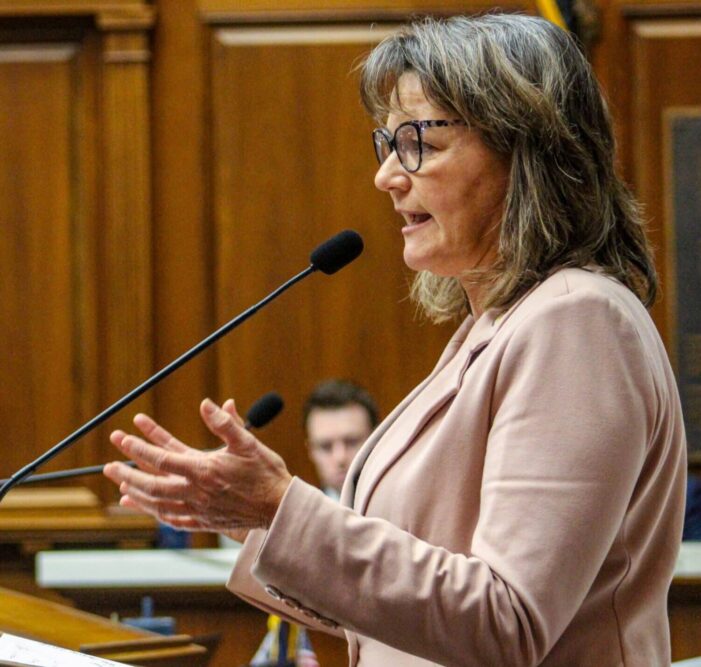
“Just because they have a letter behind their name — an R or a D — they don’t know everything about that candidate,” she said. “I just think it’s time for Indiana to respect our voters and their ability to speak for themselves.”
Dant Chesser pointed to her own 2024 campaign, recalling a neighbor who believed he could not vote for her even though he liked her, because he usually supported Republicans.
“If people think they have to choose one or the other based on party, they’re less likely to learn about the other candidate,” she said.
Clere said he does not expect HB 1218 to advance this session, citing opposition from Beckwith and resistance from committee leadership.
“The lieutenant governor engages in the sort of hyper-partisan, highly divisive politics that most people are sick of,” Clere said. “His attack on my bill is yet another example of why this legislation is more important than ever.”
House Joint Resolution 2 would amend the Indiana Constitution to allow counties to convert five currently elected offices — auditor, recorder, treasurer, coroner and surveyor — into appointed positions or consolidate their duties with other offices. The resolution would not eliminate the offices outright, but would give counties flexibility over how those functions are administered.
Those offices are currently mandated as elected positions under Article 6, Section 2 of the Indiana Constitution. Because the state constitution explicitly lists elected county offices, changes would require the approval of the legislature twice before being placed on the ballot for voters to have the final say.
Rowray, R-Yorktown, in a statement to WTHR said the measure “is aimed at helping counties operate more efficiently, increase flexibility and save taxpayers money on local government functions.”
“Some communities often have difficulty filling these elected positions, with qualified individuals hesitant to run for elected office,” she said. “This proposal would help address that concern while ensuring strong local leadership. This would not remove these positions from county government. … This is about supporting our counties, strengthening local government and ensuring taxpayer dollars are used wisely.”
Beckwith’s opposition mirrors concerns raised by county officials, including the Association of Indiana Counties. Executive Director David Bottorff told WTHR that the group believes the current system preserves checks and balances and ensures voter accountability, arguing the proposal would reduce voter choice.
HJ2 has been referred to but not been scheduled for a hearing in the House Elections and Apportionment Committee.
As the legislative session continues, Beckwith has said he plans to weigh in on additional bills. The unusual step of a lieutenant governor publicly grading legislation may raise the profile of certain proposals, but it does not necessarily determine their fate at the Statehouse.
Sydney Byerly is a political reporter who grew up in New Albany, Indiana. Before joining The Citizen, Sydney reported news for TheStatehouseFile.com and most recently managed and edited The Corydon Democrat & Clarion News in southern Indiana. She earned her bachelor’s in journalism at Franklin College’s Pulliam School of Journalism (‘Sco Griz!).
The Indiana Citizen is a nonpartisan, nonprofit platform dedicated to increasing the number of informed and engaged Hoosier citizens. We are operated by the Indiana Citizen Education Foundation, Inc., a 501(c)(3) public charity. For questions about the story, contact Marilyn Odendahl at marilyn.odendahl@indianacitizen.org.