By Sydney Byerly
The Indiana Citizen
March 12, 2026
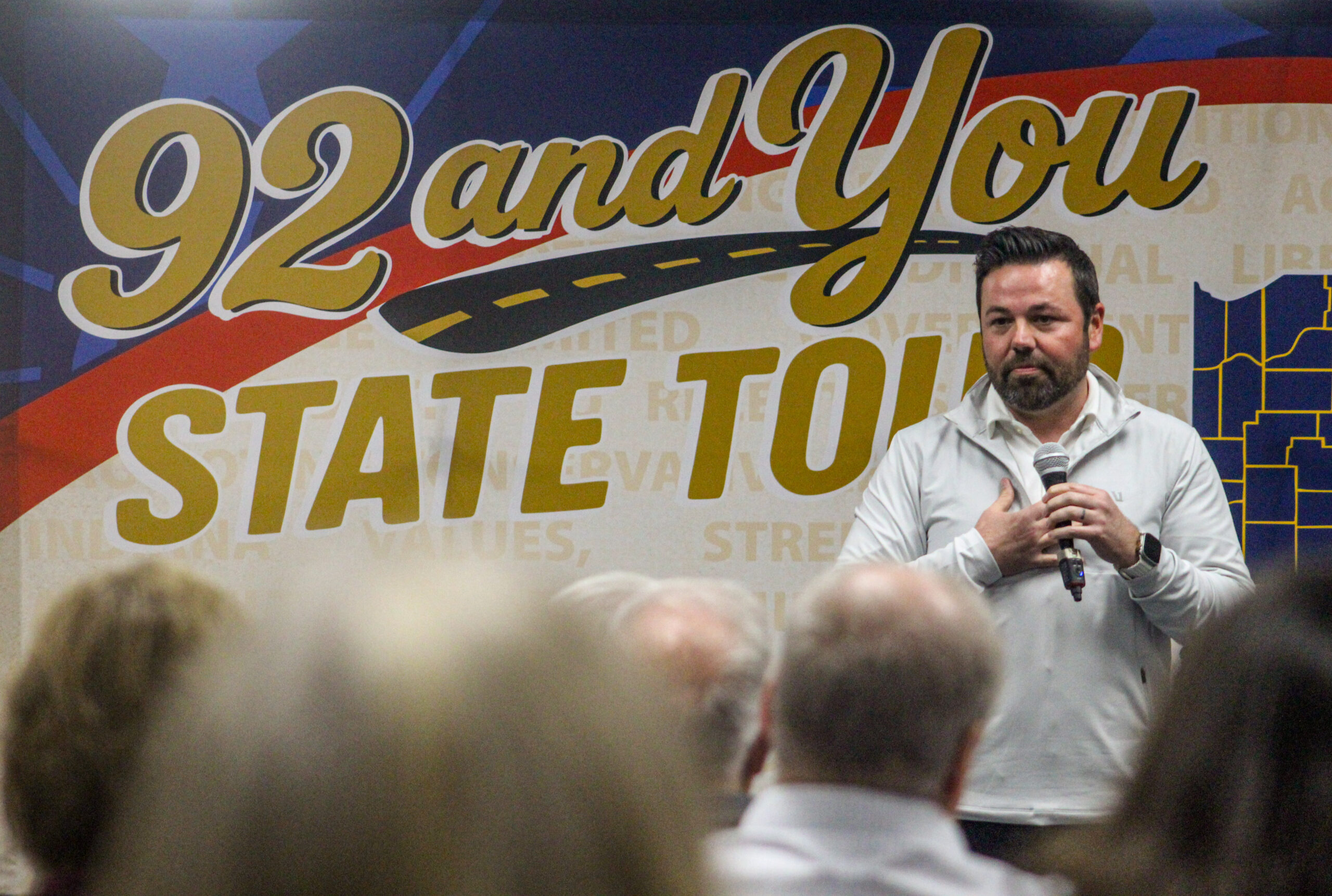
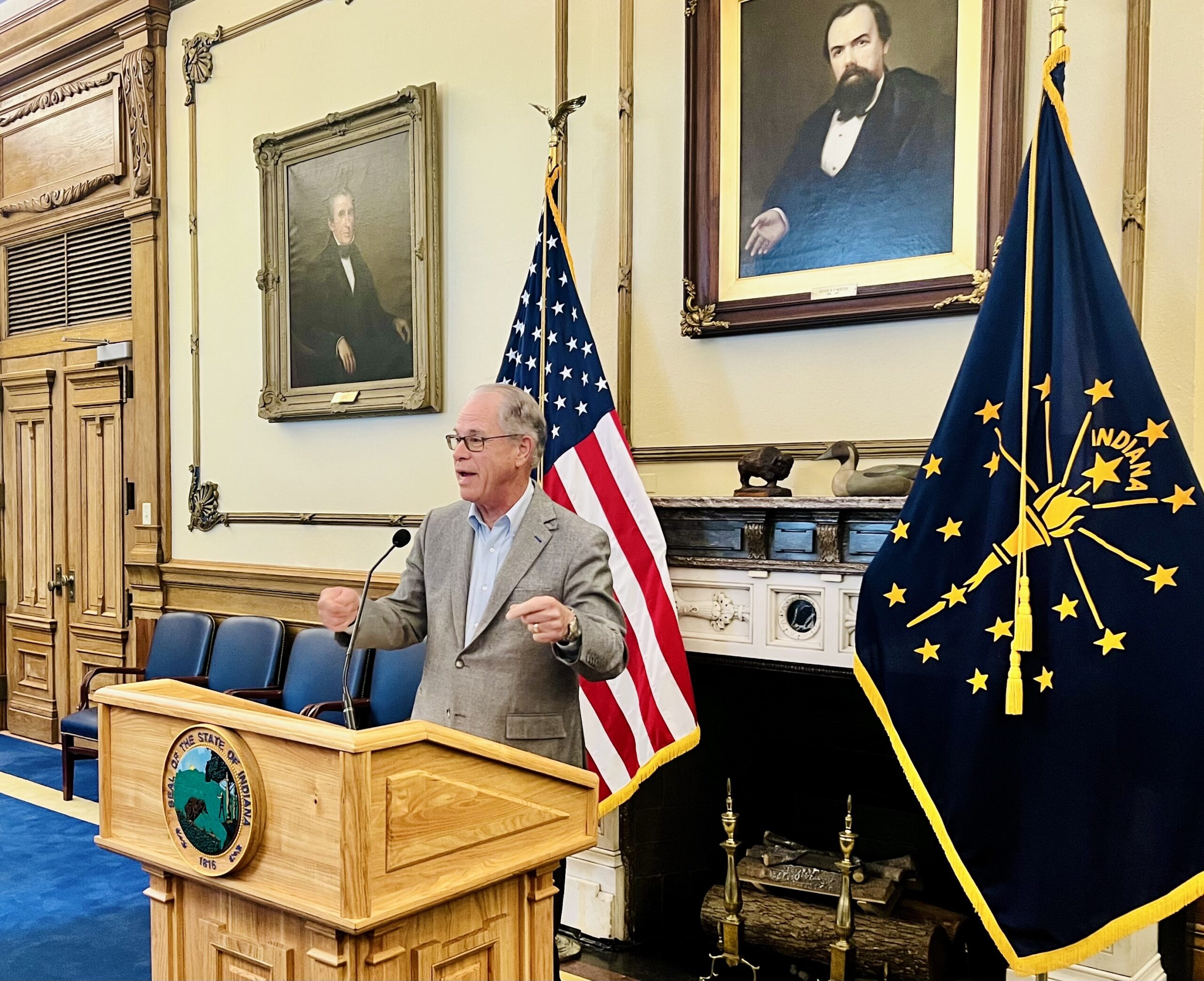
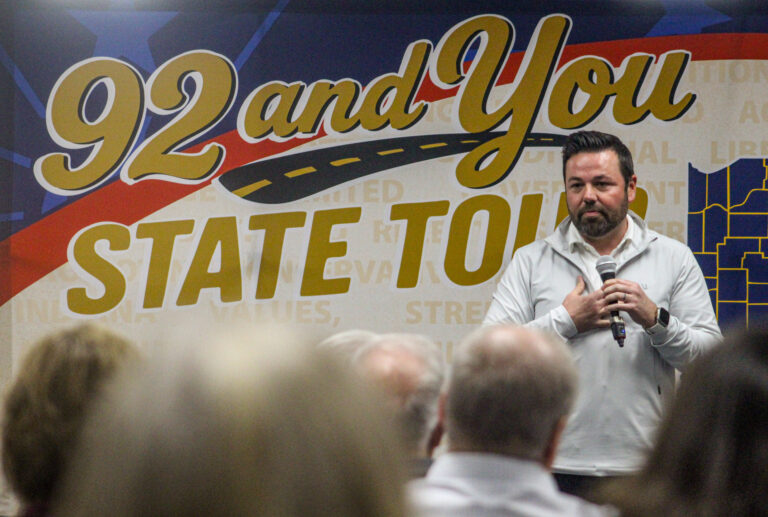
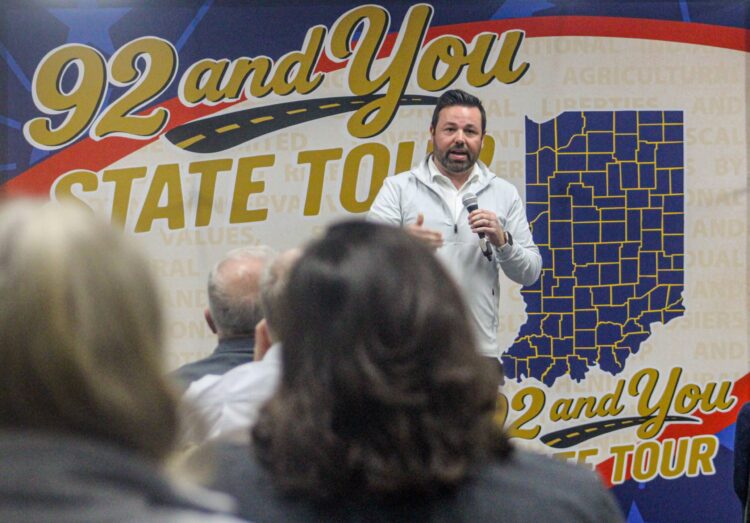
PLYMOUTH, Indiana — Lt. Gov. Micah Beckwith criticized fellow Republicans who dominate the Indiana legislature, telling attendees at a town hall Wednesday night that the party’s supermajority in the House and Senate is “a blessing and a curse” while outlining plans to apply outside political pressure on lawmakers.
Speaking to residents in Marshall County, Beckwith suggested the GOP’s overwhelming control of state government can sometimes shield lawmakers from consequences when they fail to advance conservative priorities.
“The curse is that there’s not a whole lot of threat to some of these local leaders that they might lose their seat if they don’t govern by the principles they ran on,” Beckwith said.
The town hall, held at the Marshall County Building in Plymouth, drew roughly 50 residents. Many appeared supportive of Beckwith’s remarks, occasionally applauding during his comments about property taxes and education policy, though some attendees pressed him with questions about abortion, immigration and the role of religion in politics.
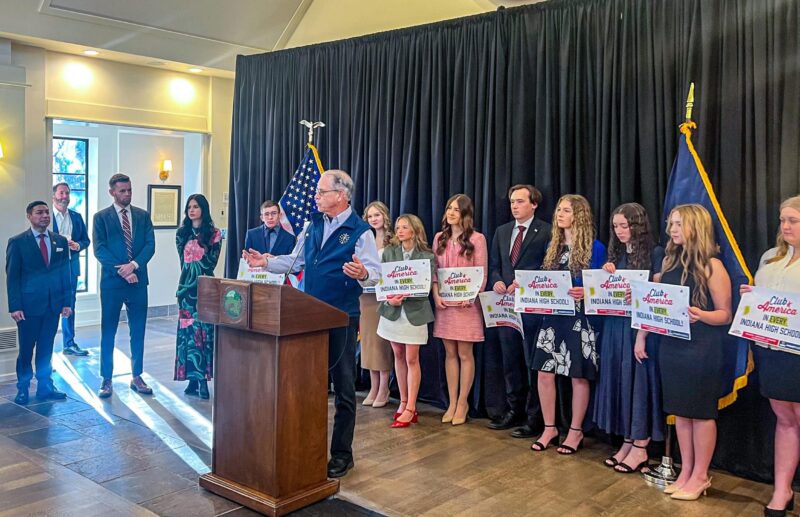
His comments came days after the Indiana General Assembly ended its 2026 legislative session and with Beckwith appearing Thursday at the governor’s residence alongside activists from Turning Point USA, who are backing primary challenges against some Republican incumbents in the state Senate — the chamber where Beckwith presides.
Those challenges follow tensions between conservative activists and Senate Republicans over the chamber’s decision not to pursue a proposal encouraged by President Donald Trump to redraw Indiana’s congressional districts in hopes of improving the GOP’s chances of flipping the state’s two Democratic-held U.S. House seats.
Beckwith framed his efforts as a way to hold Republican lawmakers accountable to the voters who sent them to the Statehouse.
“The people need to be engaged,” he said. “If we want our leaders to do what they said they were going to do when they ran, we have to keep reminding them.”
Beckwith also discussed property taxes, immigration, abortion and education during the event. Throughout the evening, he frequently framed political debates in religious terms.
“America’s problem isn’t that we are a Christian nation,” he said, quoting Charlie Kirk, founder of the conservative activist group Turning Point USA. “The problem is we are increasingly becoming an un-Christian culture.”
Beckwith, who serves as a pastor at Life Church in Noblesville, often incorporates religious language into his political message and has previously described himself as a Christian nationalist, arguing that faith should play a larger role in public life.
Beckwith argued that the decline of religious influence in society contributes to social problems ranging from violence in schools to declining civic trust.
“Morality’s gone because faith has been removed,” he said.
Beckwith held similar town halls around the state following the end of the 2025 legislative session, using the events to discuss policy priorities and field questions from voters.

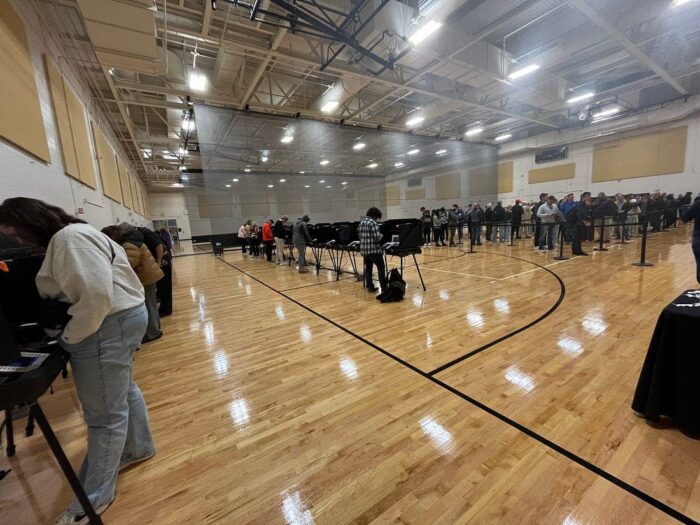
At one point, a resident from Culver asked Beckwith whether the GOP’s dominance in Indiana had led to voter apathy and low turnout.
Beckwith said grassroots activism is essential to ensuring elected officials follow through on their campaign promises.
He praised the work of Turning Point USA, a conservative activist organization founded by Charlie Kirk that focuses on mobilizing young voters and promoting right-leaning political ideas, particularly on college campuses.
At one point Beckwith described the organization as “nonpartisan,” though Turning Point USA is described in the media as a conservative youth organization that promotes conservative political ideas and works to mobilize young voters on college and high school campuses.
Instead, he said the group’s focus is encouraging people to become more engaged in civic life and understand the ideas behind their political beliefs.
“Know why you believe what you believe,” Beckwith told the crowd.
He framed that activism as part of a broader debate about Indiana’s political identity and the role voters should play in holding elected officials accountable.
Beckwith’s top focus Wednesday night was his long-running push to eliminate property taxes, an idea popular among some conservative activists frustrated with rising bills but one that has gained little traction at the Statehouse. Lawmakers have warned that eliminating property taxes could create major funding gaps for schools, police departments and other local services that rely heavily on those revenues.
He described property taxes as “immoral” and rooted his argument in what he said were the founding principles of property rights.
“When the government taxes your property, the government is taxing a God-given right,” Beckwith said. “Government has no business messing with that — they should protect it, not tax it.”
Still, Beckwith acknowledged that immediately eliminating property taxes would be difficult because local governments rely heavily on those tax dollars.
“It’s not really a viable situation to immediately eliminate them because of how dependent communities are on those funds,” he said.
As what he called a potential “government compromise,” Beckwith suggested shifting the system to base property taxes on the purchase price of a home rather than its assessed market value. Under the idea he described, property taxes would be capped at about 1% of what a homeowner paid for the property.
Some economists and policy analysts have warned that such a system could create significant disparities between longtime homeowners and new buyers while sharply reducing revenue for local governments.
Justin Ross, professor at the O’Neill School of Public and Environmental Affairs at Indiana University, previously told The Indiana Citizen that basing property taxes solely on purchase price could create major inequities in the housing market and significantly undermine local government funding.
Beckwith argued the current system unfairly taxes homeowners based on estimated values rather than what a property could actually sell for.
“Your home isn’t worth that assessed value until somebody is willing to pay that,” he said.
He framed the proposal as part of a broader effort by the administration of Gov. Mike Braun to reduce financial burdens on homeowners and simplify the tax system.
“This administration wants lawmakers to legislate in a way that relieves the financial burdens on Hoosiers,” Beckwith said.
Several attendees nodded and murmured in agreement that something needs to change as Beckwith criticized the current property tax system.
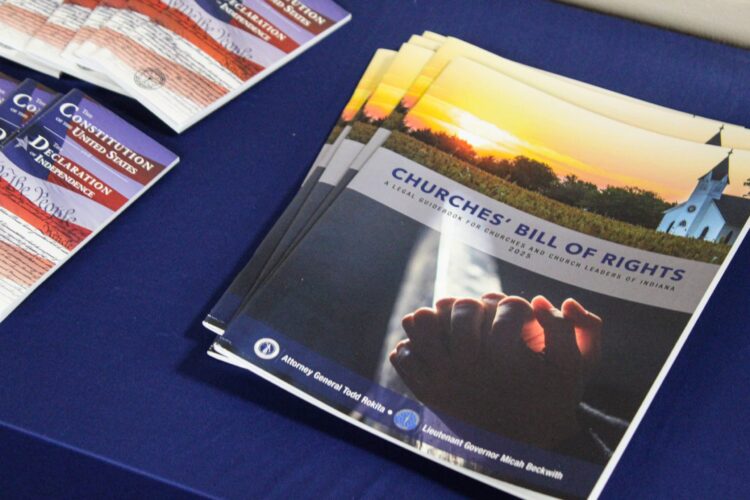
Beckwith also highlighted a new initiative created by an executive order signed earlier this month by Gov. Mike Braun.
The order directs Beckwith to lead the state’s “Fostering Faith-Based Institutions Initiative,” which calls on the lieutenant governor to work with religious leaders and recommend ways to reduce barriers to their participation in efforts such as addiction recovery, prisoner reentry, mentorship and foster care.
Beckwith said the initiative is aimed at connecting churches with government programs and encouraging religious groups to play a larger role in addressing social problems.
“We’re going to do it better than government ever could,” Beckwith said, referring to faith groups working collaboratively to address issues such as addiction and homelessness.
He said the effort is not intended to expand government funding for churches but rather to help religious organizations coordinate their work and navigate existing state programs.
“Faith communities don’t need [government funding],” Beckwith said. “They’ve got something better than government.”
Some religious leaders and church-state advocates have said they are watching closely to see if partnerships remain inclusive and do not blur the line between government services and religious activity.
Beckwith also reiterated his focus on confronting what he describes as “wokeness” in public education.
His comments came in response to a question from an audience member about political bias in classrooms.
“Teachers should help kids critically think — not tell them what to think,” he said.
The lieutenant governor argued that some schools are promoting political ideology rather than encouraging open debate.
He cited examples he said reflected ideological bias, including lessons he said portrayed communism positively and policies allowing transgender students to use bathrooms that align with their gender identity.
Beckwith did not identify specific schools or curricula during the town hall and did not provide documentation supporting those claims.
“That’s an abuse of power,” Beckwith said. “That’s a dereliction of duty.”
He said educators should be held accountable in the same way other public servants are.
“We want law enforcement to be held accountable,” Beckwith said. “Teachers should be held accountable as well.”
The Indiana Citizen previously reported that Beckwith convened an “Anti-Woke Advisory Committee” that discussed strategies for countering diversity initiatives and other policies participants viewed as ideological influence in schools.
Meeting notes described ideas such as expanding conservative student clubs — including Turning Point’s “Club America” — reviewing teacher training programs and identifying districts with policies participants labeled “woke policy creep.”
One of the evening’s most personal exchanges came when a Marshall County resident who described himself as a progressive Christian said he worries about friends who feel vulnerable in the current political climate — including women concerned about reproductive rights, LGBTQ residents and immigrants.
Beckwith responded by acknowledging the man’s concerns while emphasizing his own religious worldview.
“I can see your heart and your love for people. That’s a really Godly quality,” Beckwith said.
He added that he believes every person “is made in the image of God.”
The resident responded that scripture can be interpreted differently on issues such as abortion. He cited the biblical story of Adam, noting that God breathed life into him, and suggested that some Christians believe life begins with breath rather than conception.
He also questioned whether it was appropriate for a public official to base policy on one interpretation of scripture. The resident said it was “bold and arrogant” for Beckwith to selectively interpret biblical passages when people of faith often understand them differently.
Beckwith responded that government requires moral clarity when enforcing laws.
“Government’s job is to instill fear,” he said.
The discussion also touched on LGBTQ issues. Beckwith said he approaches those conversations in the same way he might address someone struggling with addiction, comparing difficult discussions about sexuality to interventions for people battling substance abuse.
Referencing a conversation he said he once had with state Sen. J.D. Ford, D-Indianapolis, an openly gay lawmaker, Beckwith said his approach comes from a place of concern.
“I love you enough to say something,” he said.
At one point Beckwith joked that “even Heaven has strict immigration guidelines,” adding that governments must balance compassion with justice.
“We cannot just throw out justice,” he said.
Beckwith also touched on immigration and language policies while discussing commercial driver licensing and state services.
The lieutenant governor said he believes assimilation is an important part of immigration and suggested state agencies should prioritize English as the primary language used in official interactions.
Beckwith said he has discussed the issue with Braun and officials at the Indiana Department of Transportation.
He said that “the only language at the BMV should be English.”
Beckwith also raised concerns about the use of interpreters during testing for commercial driver’s licenses, questioning whether translators might influence the outcomes of those exams.
“How do we know interpreters aren’t just giving them the answers?” Beckwith asked, though he did not cite evidence that such practices are occurring.
The town hall lasted nearly two hours, with several attendees lingering afterward to speak with the lieutenant governor individually, while others remained in small groups discussing the issues raised during the evening.
Sydney Byerly is a political reporter who grew up in New Albany, Indiana. Before joining The Citizen, Sydney reported news for TheStatehouseFile.com and most recently managed and edited The Corydon Democrat & Clarion News in southern Indiana. She earned her bachelor’s in journalism at Franklin College’s Pulliam School of Journalism (‘Sco Griz!).
The Indiana Citizen is a nonpartisan, nonprofit platform dedicated to increasing the number of informed and engaged Hoosier citizens. We are operated by the Indiana Citizen Education Foundation, Inc., a 501(c)(3) public charity. For questions about the story, contact Marilyn Odendahl at marilyn.odendahl@indianacitizen.org.