By Marilyn Odendahl
The Indiana Citizen
May 1, 2026
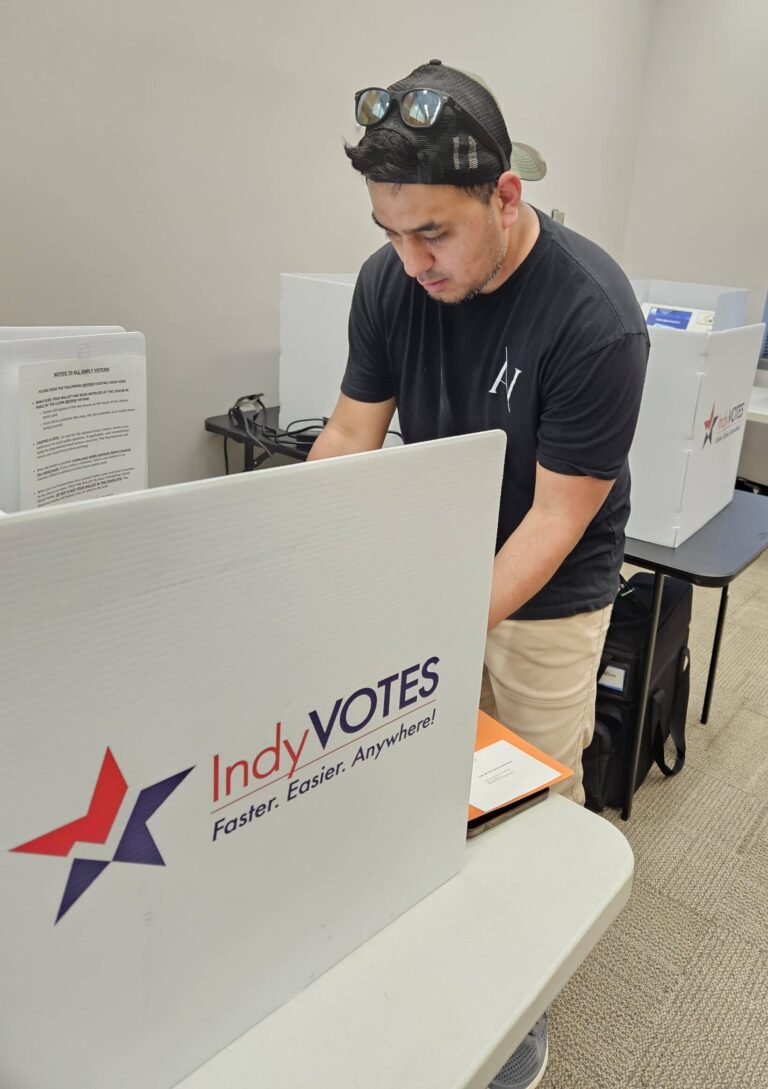
Sean Prudden of Indianapolis has regularly voted during presidential elections but for the midterms, what he calls the “in between” contests, not so much.
However, this year, the 35-year-old broke his habit of staying away from the polls in non-presidential-election years and cast an early ballot for the May primary. He was motivated by the American government class he is taking at Ivy Tech Community College and by his frustration at politicians taking positions that he sees as contrary to the wishes of the majority of people in the country, including doing too little to address the affordability crisis, imposing abortion bans and supporting the Iran War.
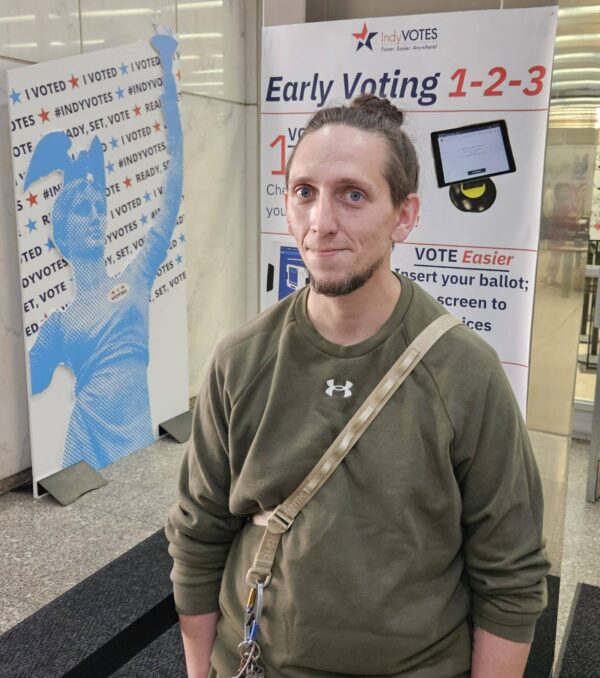
“It seems that things are going on that collectively we all disagree with, which doesn’t make sense,” Prudden said. “If we’ve elected officials to represent us and we don’t want something and it’s happening, then they’re not representing us.”
Prudden may not be alone in his discontent.
Circuit court clerks and county election officials in Indiana are reporting a brisk early-voting season with turnout topping the primaries for the 2022 midterm and the 2024 general elections. The clerks and officials contacted by The Indiana Citizen were careful to note the number of voters so far this year is not significantly higher than in previous elections and they believe most of the individuals coming to cast a ballot are not first-time voters but have voted in the past.
Also, the clerks and officials are confident their county election systems can handle any additional increase in the number of voters. They said they have voting sites spread across their counties so voters have easy access, extra voting machines that can be quickly installed at any location, if needed, to reduce long lines on primary election day, and plenty of poll workers to help the process run smoothly.
Indiana’s primary is coming after the state has enacted strict proof-of-citizenship requirements for some voters and banned students from using their college IDs as their identification at polling places. In addition, the Trump administration has sought to implement executive orders that give the federal government more control over elections and greatly curtail who may vote by mail.
Marion County Circuit Court Clerk Kate Sweeney Bell speculated the attack on voting rights might be spurring more Hoosiers to participate in the 2026 election.
“I think people realize it’s their obligation,” Sweeney Bell said. “They might be looking at it as a right that someone is trying to take away from them and they’re choosing to exercise that right, so they’ve got more voices saying, ‘Cut it out. This isn’t the America that we want.’”
Just 14% of Indiana’s registered voters turned out for the 2022 primary and a slightly improved 17% voted in the 2024 primary. A little over one-fourth of those – 27% and 29% in the 2022 and 2024 primaries, respectively – voted either early or by mail.
Tippecanoe and Bartholomew counties, which are home to state senators who voted against midcycle redistricting in December and are now facing Trump-endorsed challengers in the primary, have reported robust turnout during early voting.
Mike Smith, who has worked at the Tippecanoe County Voter Registration Office for 42 years, linked the higher turnout to the competitive races on both sides of the ballot, including the Republican contest for Indiana Senate District 23 between incumbent Sen. Spencer Deery and challenger Paula Copenhaven. Most notably, Smith said, is the interest in the secretary of state delegate races.
The delegates will go to the respective state party conventions and choose their party’s nominee for Indiana’s secretary of state. Smith has overheard conversations among voters on the sidewalk outside the early-voting place as to which delegates are supporting which SOS candidates.
“I have people coming in with printouts from their computer or little index cards and stuff like that for the delegate races,” Smith said. “I really never seen this much attention being paid to delegate races.”
Bartholomew County is home to another fierce Republican primary between incumbent Sen. Greg Walker and his challenger, Rep. Michelle Davis, which might be spurring local residents to vote. Circuit Court Clerk Shari Lentz is hoping the upward swing in voters continues through primary day on May 5. She said the early-voting site at the Gather Columbus event space recorded 95 people casting ballots on April 17 and about another 90 on April 20.
When the county’s 15 vote centers open on May 5, Lentz’s team will be prepared to handle any surge in voters. The polling locations will be stocked with poll workers and voting machines, and, if the lines get long, additional voting machines can be quickly dispatched and installed.
“(I) would be happy to bring in those extra machines to accommodate voters,” Lentz said. “That would be wonderful. There’s a lot of competition on both (Democrat and Republican) ballots, so there’s a lot of good reasons for people to turn out. I hope they will do so.”
Votes do matter
At the City-County Building in Indianapolis, poll worker Tanya Beauford helped the early voters, instructing them on how to use the voting machines and what to do after they marked their ballots. She has worked at the polls for 60 years and once early voting has ended, she will return on primary election day at 5 a.m. to work until 7 p.m.
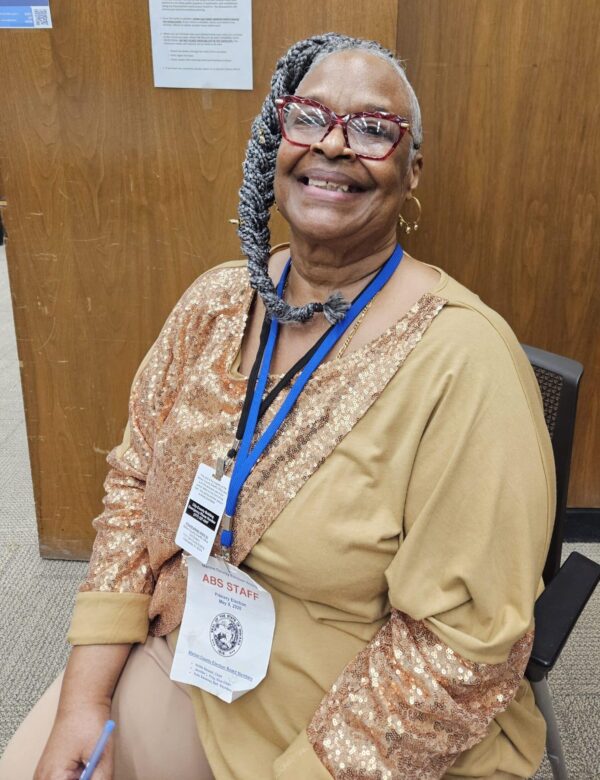
Beauford said helping run an election is serious work and poll workers are expected to do their job as they are trained. The pace of voting this primary has kept Beauford and her colleagues very busy. Through the first 16 days of early voting, 1,677 Marion County voters had cast a ballot, compared to 847 in 2024 and 809 in 2022 during the same number of days. Still, she has fun. She enjoys the voters and is especially excited when the adults bring their children along.
And to those who skip elections, thinking their vote would not matter, Beauford has a quick response.
“I tell them that’s why certain people get into office because your vote did matter, but you didn’t use it,” Beauford said. “I’m a stickler on that: vote, vote, vote.”
At 41, Carlos Cruz was exercising his right by voting in his first election. The Indianapolis resident became a naturalized citizen on March 24 and registered to vote immediately after. He stopped by the Marion County Clerk’s Office during the early-voting period, carefully performed his civic duty and then received a round of applause from the poll workers.
Cruz immigrated with his family from Mexico to the United States as a 14-year-old. He learned civics and American history in high school, learned the words to the national anthem by attending sporting events, and, while he started the naturalization process in 2012, the responsibilities that came with marriage, a full-time job and his family intervened. Becoming a naturalized citizen did not seem “necessary,” he said, but the recent crackdown on immigrants pushed him to complete his studies and take the oath of citizenship.
Casting a ballot was a special milestone.
“I just feel like I am part of the country,” Cruz said. “Now, I’m officially part of the country.”
Ten days into early voting and Allen County was almost 500 votes ahead of the 2022 primary at the same time in early voting. Also, mail-in ballots were also higher, increasing by a “couple 100 more,” according to Amy Scrogham, executive director of the Allen County Election Board.
Marion, Tippecanoe and Bartholomew counties all reported their mail-in vote tallies this year were lower than during the 2024 and 2022 elections. The clerks attributed the decline to people returning to in-person voting after they had switched to voting by mail during the COVID-19 pandemic.
Along with the normal preparations for an election, Allen County has the added task of making the transition from 278 precincts to 53 vote centers. Scrogham said the election board has been persistent in reminding voters of the change, putting notices in county tax bills, mailing postcards and creating an interactive map for its website that shows where the vote centers are located.
“We’re just trying to make it easier for voters,” Scrogham said, explaining the reason for the shift to vote centers. “Everybody can go everywhere and you don’t have to worry about (being) in the wrong location. So, that’s the biggest thing.”
Prudden in Indianapolis said the voting process for the primary was easy. He showed his ID, marked his ballot and then carried on with the rest of his day.
“I feel happy that I participated,” Prudden said. “It makes me feel closer to my city, I suppose, and everyone else. We are all collectively coming out together to try to make a change. So, that says something.”
Dwight Adams, an editor and writer based in Indianapolis, edited this article. He is a former content editor, copy editor and digital producer at The Indianapolis Star and IndyStar.com, and worked as a planner for other newspapers, including the Louisville Courier Journal.
The Indiana Citizen is a nonpartisan, nonprofit platform dedicated to increasing the number of informed and engaged Hoosier citizens. We are operated by the Indiana Citizen Education Foundation, Inc., a 501(c)(3) public charity. For questions about the story, contact Marilyn Odendahl at marilyn.odendahl@indianacitizen.org