By Marilyn Odendahl
The Indiana Citizen
February 26, 2026
The attempt to reduce early voting in Indiana seems to have died quietly during the Senate session on Monday, when the bill that included the controversial provision was not called for a second reading.
House Bill 1359, authored by Rep. Timothy Wesco, R-Osceola, would have allowed certain counties to scan ballots during the early-voting period, rather than placing them in secrecy envelopes and waiting until after the polls close on Election Day to feed them into the optical scanner. Some election officials were concerned that the change to the scanning process could potentially breach voter privacy.
HB 1359 moved through the House easily on a 71-to-20 vote with a few Democrats joining Republicans in supporting the measure.
The situation changed, however, when the bill appeared before the Senate Elections Committee, chaired by Sen. Mike Gaskill, R-Pendleton. He added language that would have slashed the state’s early-voting period from 28 days to 16 days but did not allow anyone from the public to testify about the amendment.
HB 1359 was placed on the Senate’s Feb. 19 calendar and then moved to the Feb. 23 calendar. Gaskill, who was the Senate sponsor of the bill, did not present the legislation either time.
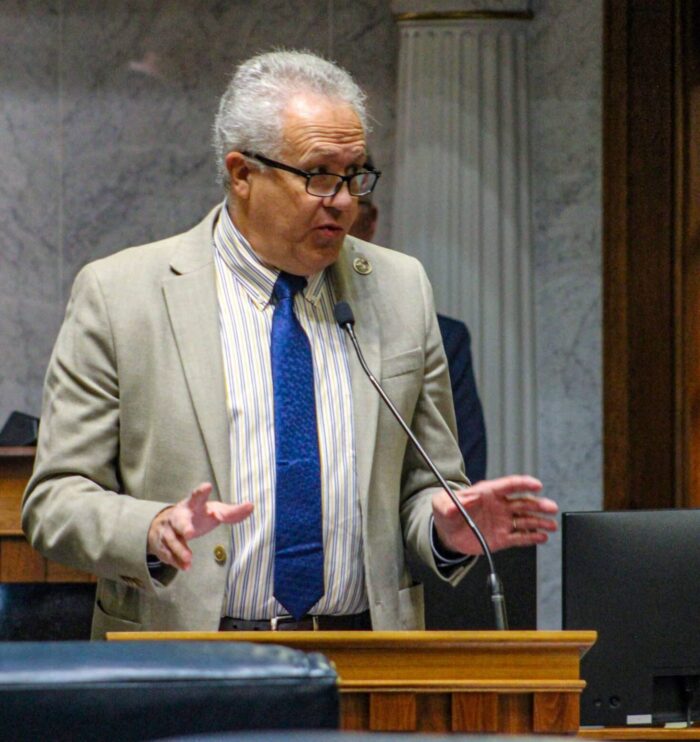
“I spoke with Rep. Wesco before adding the amendment,” Gaskill said in an email. “However, neither the early voting provision nor the underlying bill has the support to pass the Senate at this time.”
Wesco did not respond to a request from The Indiana Citizen for comment.
Opposition to the amended HB 1359 escalated quickly outside the Statehouse. Thirteen voter-rights advocacy groups sent a letter to Senate President Pro Tempore Rodric Bray, R-Martinsville, on Monday, asking him to stop HB 1359. The organizations, which are part of the nonpartisan All IN for Democracy coalition, asserted that making such a “drastic change” only a few months before the May 2026 primary without “proper vetting” or public input was “simply wrong,” especially since a shortened early-voting period would lead to longer voting lines at polling sites and increase the stress on election workers.
“We believe it is appropriate for you to intervene in this matter because the language added to HB 1359 will make a major change to early voting in Indiana and the public was given no opportunity to speak on its impact at the committee hearing,” the coalition members wrote. “It is an affront to the process for such a significant amendment to be advanced without any input from election administrators or organizations representing voters.”
The three senators who voted against Gaskill’s amendment in committee – Republican Sen. Greg Walker, of Columbus, and Democratic Sens. Fady Qaddoura and J.D. Ford, both of Indianapolis – each filed a motion to restore a 28-day early-voting period provision to HB 1359. Since the bill was never called for a second reading, the motions were not presented or put up for a vote by the full Senate.
Circuit court clerks in some counties had testified in support of the original version of HB 1359, when it received a hearing before the House Elections and Apportionment Committee in January. They told the legislators that being able to scan the ballot during early voting would save their counties time and money.
Nicole Browne, Monroe County Circuit Court Clerk and chair of the legislative committee for the Association of Circuit Court Clerks of Indiana, was among those who asked the House committee to pass HB 1359. She hopes lawmakers find a way to enact the bill’s initial intent before the legislative session ends this week.
“The original version of HB 1359 is a legislative priority bill for the Clerks Association and, for me, it was very disheartening to not see it come up for a second reading in the Senate,” Browne said in an email. “I remain hopeful that there are options for the original language to land somewhere prior to the end of session but that is not within my control.”
The concern with the original provisions in HB 1359 was that the new process could, essentially, lead to the identification of the individual voters and who they each voted for.
Under HB 1359, some counties that use the optical scan voting system would have been allowed to have their early voters feed their ballots into the optical scanning machine, rather than putting each ballot into a secrecy envelope. County clerks supporting the measure said the change in the process will enhance the safety and security of elections.
“With the passage of House Bill 1359, the ballot will be handled by election workers a minimum of only three times and, most importantly, the voter is the last person to touch their ballot before it is cast,” Amy Rolfes, clerk of the St. Joseph County Circuit Court, said during the House committee hearing. “So, this reinforces confidence in election integrity.”
However, opponents of the bill saw a potential problem arising if a ballot was challenged or had to be retracted if the early voter had died or become incarcerated. Envelopes that contain the ballots can easily be pulled. Also, for ballots that are counted on Election Day, the tabulation process separates the envelopes and ballots, so the identity of the voter cannot be traced.
Without an envelope, a “unique identifier” linked to the voter would be placed on the actual ballot. Consequently, opponents said, such a ballot could possibly be connected to the individual voter for as long as the counties are required by law to retain the ballots.
Matthew Kochevar, Democratic general counsel for the Indiana Election Division, advised the House committee to rewrite portions of HB 1359 to preserve ballot secrecy.
“The hallmark of state-run elections, since they were first formed in the 1890s, is ballot privacy. You, the voter, know who you voted for. You can tell anyone how you voted, but no one else should be able to learn how you voted on that particular ballot,” Kochevar said during the committee hearing. “We want to make sure that the IDs are as random as possible.”
The League of Women Voters of Indiana also opposed HB 1359 for the same reasons. Barbara Tully, first vice president with LWVI, said the scanning process violated the “secret ballot concept” by increasing the risk of identifying how individuals voted.
“This bill introduces exposure and uncertainty into the chain of custody for ballot handling and could be exploited by bad actors or by others acting in collusion, or by a simple mistake of election officials lacking an understanding of complex ballot procedure,” Tully told the committee members.
Keith McGinnis, of RBM Voting, which supplies the Unisyn optical-scanning voting machine to some Indiana counties, disputed the privacy concerns. He told the House committee the unique identifier is a randomly generated number that changes each election, so voters will be assigned a new identifier every time they cast a ballot.
“No one will ever have the same number,” McGinnis said.
Still, some county clerks remained doubtful. Speaking to Votebeat, Marion County Circuit Court Clerk Kate Sweeney Bell said the potential for undermining ballot secrecy comes as the public is already “fatigued from political partisanship.”
“Voters expect that when they cast a ballot, it is done privately, without the ability of clerks or staff to determine an individual’s actual vote,” Sweeney Bell told Votebeat.
Dwight Adams, an editor and writer based in Indianapolis, edited this article. He is a former content editor, copy editor and digital producer at The Indianapolis Star and IndyStar.com, and worked as a planner for other newspapers, including the Louisville Courier Journal.
The Indiana Citizen is a nonpartisan, nonprofit platform dedicated to increasing the number of informed and engaged Hoosier citizens. We are operated by the Indiana Citizen Education Foundation, Inc., a 501(c)(3) public charity. For questions about the story, contact Marilyn Odendahl at marilyn.odendahl@indianacitizen.org