By Sydney Byerly
The Indiana Citizen
February 19, 2026
The Indiana House of Representatives on Wednesday approved a revised version of a bill to extend Indiana’s syringe service programs for five years, sending the measure back to the Indiana Senate with amendments after a 70-22 vote.
The House’s proposal to Senate Bill 91 falls short of the 10-year extension previously approved by the Senate but goes beyond the two-year version advanced earlier by a House committee. Without legislative action, counties’ authority to operate syringe exchanges will expire June 30.
“It’s critical that we pass legislation to allow programs to continue to operate after June 30,” said the bill’s House sponsor, Rep. Ed Clere, who offered the amendment lengthening the extension from two to five years. “The bill accomplishes that and I think it has the potential to strengthen legislative support for syringe service programs long term, because it has brought additional members into the conversation.”
Clere stressed on the floor that syringe service programs are “about a lot more than needles,” saying they connect people struggling with addiction to testing, treatment referrals and other health services.
“These programs get people in the door with access to sterile syringes and then they provide so much more,” he said. “This has always been about local communities deciding what is right for them.”
Before final passage, the House added new guardrails aimed at addressing concerns raised by some Republicans. The amendments create a 1,000-foot buffer around schools, churches and child care facilities for exchange sites — unless those entities provide written consent — allow the state health commissioner to investigate local programs for compliance with state rules, impose geographic restrictions on participants and require one-for-one needle exchanges.
Supporters described the changes as a compromise intended to preserve the programs while tightening oversight.

Rep. Victoria Garcia Wilburn, D-Fishers, who previously worked as an addiction researcher, urged colleagues to focus on the people behind the statistics.
“Each needle actually represents a person,” Garcia Wilburn, who is a House sponsor of the SB 91, said. “These are our friends. These are loved ones. God forbid, these might be some of our children.”
Rep. Ben Smaltz, R-Auburn, called addiction a disease and said preventing the spread of HIV and hepatitis protects both families and taxpayers.
“I’m sad to have to support it. I’m sad that we need it, but I think we need it,” he said.
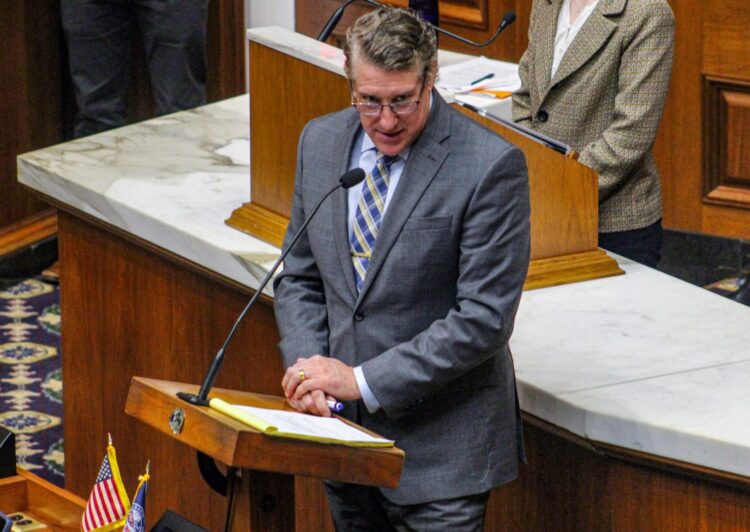
Opponents, including Rep. Matt Hostettler, R-Patoka, questioned whether the programs have expanded beyond their original intent. Citing state data last updated in 2023, Hostettler said roughly 11.8 million syringes had been distributed since the program began while about 9.9 million were returned through exchanges and other sources, leaving nearly 2 million unaccounted for over more than eight years. He argued the numbers raise concerns about whether the state is unintentionally increasing the supply of needles in communities and said the bill sends a mixed message without clearer limits, including age requirements.
Hostettler had previously voted to advance the measure from committee but ultimately opposed it on final passage.
Still, lawmakers from communities with operating programs said eliminating the programs would remove a tool they rely on to limit disease spread and connect residents to recovery.
“For the love of life and our neighbors, let’s not take away this tool in June from the communities where it’s working,” said Rep. Greg Lawson, R-Danville.
With House approval, the amended bill has returned to the Senate, which can either concur with the changes or send the measure to a conference committee. If the bill passes out of the legislature, it will head to Gov. Mike Braun’s desk.
Sydney Byerly is a political reporter who grew up in New Albany, Indiana. Before joining The Citizen, Sydney reported news for TheStatehouseFile.com and most recently managed and edited The Corydon Democrat & Clarion News in southern Indiana. She earned her bachelor’s in journalism at Franklin College’s Pulliam School of Journalism (‘Sco Griz!).
The Indiana Citizen is a nonpartisan, nonprofit platform dedicated to increasing the number of informed and engaged Hoosier citizens. We are operated by the Indiana Citizen Education Foundation, Inc., a 501(c)(3) public charity. For questions about the story, contact Marilyn Odendahl at marilyn.odendahl@indianacitizen.org.