By Bill Moreau, publisher
The Indiana Citizen
February 19, 2026
For the vast majority of the millions of people who learned of Lee Hamilton’s death on the morning of Wednesday, February 4, their understandable reaction was, “He was 94, he led a long and productive life.” For those of us who had the privilege to know him, the news was a terrible shock. He went into his office at IU on Monday and died at home late Tuesday night. Many of us were looking forward to that next visit we’ll never have, certain he’d carve out some time for us, anxious to learn what was exciting him that day. Lee Hamilton was energized by a powerful principle, said his son Doug: “He believed in doing as much good as he could for as long as he could.”
At the risk of leaving the erroneous impression I was closer to him than I really was, permit me to offer some observations from an unabashed Lee Hamilton admirer.
Lee Hamilton was cool. Admit it. If you came of age in the 60s, 70s or 80s in Indiana, you know exactly what I mean. If you don’t, you have my sympathies.
Look at the guy: tall (a “towering figure” as one clever headline-writer observed), lean, the this-is-who-I-am short hair, the easy, genuine smile, always comfortable in his own skin. I laughed when one obituary writer called him “nontelegenic.”
And that distinctive, distinctly Hoosier voice. “Call me Lee,” and he meant it.
His life story was the stuff of a Frank Capra movie. A preacher’s kid raised in Evansville, basketball star at Evansville Central and DePauw, studied in post-war Germany, attended law school at IU, became a county-seat lawyer in Columbus, Indiana, ascended to the highest heights of national and international influence over 34 years in Congress, ably led the 9/11 Commission and the Iraq Study Group, received the Presidential Medal of Freedom, authored several important books and made an indelible mark upon Indiana University.
Lee got just one technical foul during his stellar high school basketball career, meted out by none other than the legendary referee Birch Bayh, Sr., who officiated 10 state championship games, still a record. (Yes, that’s Birch’s father, Evan’s grandfather and Beau and Nick’s great-grandfather.) At 6’4″, Lee jumped center, an especially important position back in his day, when jump balls were more common. During a game reffed by Mr. Bayh, Lee lost several jump balls in a row to a shorter opponent. On the way back on defense, Lee muttered “maybe if you threw the damn ball up straight, ref…” and he was whistled for his only T.
That solitary blemish didn’t keep Lee from winning the Trester Award and being inducted into the Indiana Basketball Hall of Fame.
I came into Indiana politics through working for Birch Bayh in his last term, so by then Birch and Lee were almost 20 years into their friendship. Lee was Birch’s Bartholomew County coordinator in his successful 1962 Senate race. Lee won his first of 17 House terms in the 1964 Johnson landslide. Birch and Lee shared a deep, personal camaraderie, two super-smart, approachable Hoosier jocks who loved their lives and let it show. Their close relationship guided the way we staffers thought about Lee. He was this almost mythical figure in our world.

I had spent two years on the House side before a job opened on the Senator’s staff, so I knew how much Lee was respected by the Members. My three years on Birch’s staff really showed me why. Congressional staffs can be protective and territorial–sometimes downright nasty, in the name of “loyalty”–but among the Bayh staff, Lee Hamilton could do no wrong. It was always a joy to be in the same room with Birch and Lee because their genuine, affectionate friendship was palpable. As a staffer, if you were lucky enough to be in the outer ring of the group surrounding the two of them, you might hear their conversation, hanging on every word.
In the years following Birch’s defeat in 1980, I had many chances to be with Lee, and I must admit that I was shocked and thrilled that he even knew my name. I guess I never outgrew my 20-something, junior-staff-guy admiration for him.
In the late 90s, I helped host a fundraiser for Lee’s successor, Baron Hill, at a supporter’s home in Columbus. Lee was the star attraction. Lee thanked the hosts one-by-one and then said, “Bill, I see you standing back there. Come up here.” I was beet red with embarrassment–heck, I wasn’t from Columbus–and Lee then put his right hand on my left shoulder and said some very kind things about me. Truth be told, I wish I could remember them, but I was thunderstruck by the unexpected gesture. I was in my late 40s, but still in my 20s around him.
Lee moved to Bloomington in 2011 to lead IU’s Center on Congress (now the Center on Representative Government)– which he founded in 1999–and to teach and write. Whenever I traveled to Bloomington for whatever reason, I tried to see Lee; in retrospect, the motivation was completely selfish. Here’s the thing about him–ask anyone who admired him (who didn’t?)–Lee Hamilton made you feel better about yourself. That Lee Hamilton would give you some of his time and all of his attention provided a special surge of energy.
I spoke recently with a Purdue professor friend who invited Lee to campus last year. Lee’s version of an RSVP was to call the guy to decline, and the conversation lasted 20 minutes. Lee expressed awareness of the prof’s background and his program. He expressed genuine regret for being unable to attend. The fellow–who has interviewed Governors, Senators, Representatives and many household-name political luminaries–will tell that story like a star-struck groupie the rest of his life.
Almost a decade ago, we had a disagreement about something regarding a mutual friend. The next time I saw him, I tried to clear the air. I didn’t get one sentence out before Lee waved me off with, “Forget it, Bill. I have.” And that was the end of it.
On the drive home from Bloomington, I reflected on his forgiving gesture–sadly, politics seems to attract grudge-holders–and realized that one of the key ingredients of Lee Hamilton’s remarkable career was his ability to work with anyone, if he thought the cause was just. Imagine the thousands of charlatans, slights and indignities he endured during his 60-year public life.
Hold that in mind when you read his obituaries in the New York Times and Washington Post in which his jaw-dropping record of service is summarized. Every one of those accomplishments required him to sublimate his grievances and tolerate the knuckleheads who caused them to achieve a greater good.
And check out the recording of President Obama awarding Lee the Presidential Medal of Freedom in 2015. Lee is at the 29:20 mark. The guy in the front row with the ball cap is Willie Mays.
The two obituaries and the Medal of Freedom citation appropriately focus on Lee Hamilton’s foreign policy expertise. IU calls it their Hamilton Lugar School of Global and International Studies for good reason. But Lee knew my international relations credentials didn’t extend east of Switzerland County, so our conversations over the last decade always focused on the health of our democratic republic, especially in the Hoosier State.
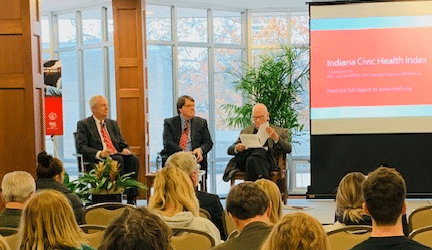
In 2019, Charles Dunlap, the president and CEO of the Indiana Bar Foundation, graciously invited me into the drafting and dissemination of their biennial Indiana Civic Health Index (INCHI). Chuck developed his own special friendship with Lee that’s beautifully captured here.
From INCHI’s launch in 2011, Lee Hamilton and Indiana Chief Justice Randall Shepard had served as co-chairs of this vital examination of Indiana’s lamentable rankings vis-a-vis the other 49 states and the District of Columbia. The statewide road show accompanying the release of the 2019 edition included a stop at IU. This is a picture of retired CJ Shepard and me–wearing my only red tie for the occasion– hanging on Lee’s every word. You can imagine how much the picture means to me.
Lee never forgot who permitted him to sustain his consequential career in the House of Representatives–rising to Foreign Relations Committee chair–the voters of the Ninth Congressional District of Indiana. Seventeen times they elected him to represent southeast Indiana, in four different iterations caused by the gerrymanderers in the Indiana Statehouse. Lee Hamilton and his dear friend and close colleague Richard Lugar are the best arguments against term limits, to my thinking.
A mythology grew around the Ninth District during Lee’s tenure that you can see in the Times and Post obits–written by Easterners who incorrectly think Southern Indiana was always ruby red–that Lee represented a “Republican district.” The truth is the Republicans essentially gave up on beating him and began packing Democratic counties like Clark and Floyd into the Ninth. Jimmy Carter in 1976 and Bill Clinton in both 1992 and 1996 narrowly carried the Ninth. Of course, Lee Hamilton ran far ahead of any other Democrat running in the Ninth, which remained a purple district–just ask Baron Hill–until the 2010 midterms, the success of Project REDMAP and the 2011 and 2021 gerrymanderings turned it into the safe Republican district it is today.
The last time we had lunch together, I had a private moment that permitted me to tell him how much I admired him, that I considered him one of my heroes. He cocked his head, smiled that big smile, looked at me incredulously like I was blowing smoke up his fanny and said, “Come on, Bill. Save that for Birch.”
I should have simply called him the highest appellation that exists, “Lee, you’re a truly Great American.”
Like thousands of people from all over the globe, from all walks of life, from Prime Ministers and Presidents to school teachers, farmers and factory workers, and lately IU students, faculty and staff, I was so lucky Lee Hamilton allowed me to know him, even a little bit. He made every one of us feel better about ourselves.
The views and opinions expressed are those of the author only and do not necessarily reflect the views of The Indiana Citizen or any other affiliated organization.
The Indiana Citizen is a nonpartisan, nonprofit platform dedicated to increasing the number of informed and engaged Hoosier citizens. We are operated by the Indiana Citizen Education Foundation, Inc., a 501(c)(3) public charity. For questions about this commentary, contact Bill Moreau at bill.moreau@indianacitizen.org