By Marilyn Odendahl
The Indiana Citizen
February 13, 2026
The launch of a new PAC in Indiana is a sign that some supporters of President Donald Trump are making good on their promise to try to unseat state Republican legislators who voted against midcycle redistricting in December.
The No Quarter Political Action Committee, which filed its statement of organization with the Indiana Election Division this week, appears to be trying to fuel an intra-party fight within the state GOP. In its filing, the PAC stated its purpose is “primarying Republicans who do not represent Republican values,” but its website and press release clearly shows the focus is on “a single political failure: redistricting.”
The PAC is spotlighting the 21 Republican state senators who joined all the Democrats in the Statehouse and voted down a new congressional district map that was promoted as making a clean sweep of the state’s delegation to Congress from seven Republicans and two Democrats to nine Republicans. The dramatic legislative showdown at the Indiana Statehouse handed Trump his first defeat in his effort to push Republican-led states to enable the GOP to retain control of the U.S. House by redistricting ahead of the midterm election in November.
In its press release, the PAC claimed the Republican senators who blocked redistricting undermined Trump’s agenda. The PAC asserted that any blue wave in the 2026 general election will hand power to the Democrats, who the PAC characterized as opening the border, weaponizing the U.S. Justice Department and tearing down the statues of “heritage American heroes.”
“Indiana voters sent Republicans to Indianapolis to win, not flinch when the President asks for backup,” Joseph Bortka, treasurer of No Quarter PAC, said in a press release. “If you campaign as a Republican and govern like a negotiator for the opposition, you should expect a primary.”
Eight of the 21 Republican senators are running for reelection this year and all have primary opponents.
However, Aaron Dusso, chair of the political science department at Indiana University Indianapolis, is doubtful that the No Quarter PAC, by itself, can make much of a difference in the May primary contests. He noted the organization will likely be limited to working on the periphery of the campaigns by sending mailers to voters and having a presence on social media.
“It could be very low cost just to be able to keep the threat alive,” Dusso said. “If … you’re going to make the threat that you’ll primary people, you need to at least show that you did something. So, this would certainly be something you could always point to as well, ‘Look there are repercussions if you don’t go along with what we want.’”
The Indiana Democratic Party declined to comment on the No Quarter PAC. The Indiana Republican Party did not respond to a request for comment.
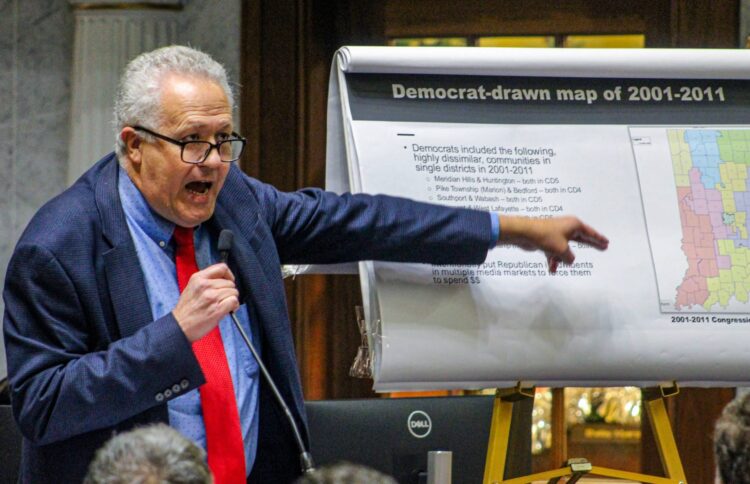
Bortka is no stranger to provoking a fight within the Indiana Republican Party.
In July 2025, he filed a lawsuit against the Indiana Republican State Committee, alleging party leadership usurped the rules and overstepped their authority by blocking the attempts by delegates and non-delegates, including Bortka, to amend the party’s platform and propose resolutions during the Republican state convention.
The Marion County Superior Court dismissed the case in December 2025, saying courts do not have jurisdiction to provide relief in matters or questions of a political nature, unless civil property rights are involved. Bortka has appealed the ruling to the Court of Appeals of Indiana, but no decision has been issued.
That same combative spirit is displayed on the No Quarter PAC website.
It asserts, without offering any evidence, that Republicans would have won all nine congressional races in Indiana if the group of GOP state senators had not “killed the 9-0 map.” Saying it wants to “hold RINOS (Republicans in Name Only) accountable,” the PAC’s website champions Trump and describes the 2024 Republican Party’s national platform as a contract between the GOP and the American people.
“Every Republican who holds office, federal, state, and local, should be held to that contract,” the No Quarter PAC website says. “Not as a guideline. As a binding commitment. If advancing it requires hardball, then play hardball. If it requires aggressive redistricting, redistrict. If it requires primaries against Republicans who obstruct, then primary them.”
Also, the website – which misstates the number of Republican senators who voted against redistricting, saying it was 20 rather than 21 – includes an interactive map of the Senate districts across the state. The districts held by each of the Republican senators who are being singled out are clearly identified and the primary challengers in those races also are listed. In races with multiple challengers, the PAC is selecting one as “Your Champion” and include the candidate’s picture and a link to that campaign’s website, but the other challengers just have their names posted.
The PAC website has mocked some of the incumbents with sarcastic nicknames. For example, Sen. Mike Bohacek, R-Michigan Shores, who pleaded guilty to a misdemeanor drunken-driving charge in 2025, is identified on the website as “Boozin’ Bohacek.” The PAC website also calls Sen. Travis Holdman, R-Markel, who was named the 2025 Legislator of the Year by the Indiana Bankers Association, “Big Bank Travis.”
Dusso said, based on his research, name calling does little to sway voters. While tagging an incumbent with an insulting moniker may make the opponent feel better, it does not have any real effect at the ballot box. In fact, he said, it can actually backfire by causing voters to lower their opinions of the attacker.
The tone of the PAC, as expressed in the nicknames and tenor of the website text, surprised Dusso.
“Obviously, people have to get along,” Dusso said. “You have to go along to get along on a lot of things. To actually start something like this and to actually go after other members of your party, that’s not as common as what we see around the state here or anywhere, really.”
No Quarter PAC is a state political action committee, so it is required to register with the state and file three reports outlining its contributions and expenses. Individual donors who contribute more than $100 must be identified. The funds collected can only be spent on political activities, such as contributing to a candidate’s campaign, fundraising and advertising through broadcast and print media, as well as yard signs, bumper stickers, T-shirts, and printed mailers.
The pre-primary report will give Hoosiers a better picture of No Quarter PAC’s supporters and finances. It will enable Hoosiers to see who is donating to the organization and how the money is being spent. However, the report will likely not be available to the public until mid-April, less than a month before the May 5 primary.
Dusso questions just how much the PAC will influence the Senate primaries. The organization will likely not be flush with money and resources to blanket a district with mailers and social-media campaigns that target Republican voters. Moreover, he said, it will probably not have the money to establish a ground game with volunteers going door-to-door, which is time-consuming and expensive but can impact the outcome of a race.
The incumbents usually have the advantage, Dusso said, because they have built a strong presence in their districts. They have attended community events, held public meetings and “brought home the bacon” from the legislature. As a result, when they knock on doors during campaign season, they are often recognized by their constituents.
Dusso said the lack of a personal connection in a Senate district will be difficult for the PAC to overcome without a lot of money.
“The possibilities here are that (No Quarter PAC), ultimately, doesn’t have much of an effect, because they don’t really have that much money behind it,” Dusso said. “If it’s just kind of a state-run thing by some members of the party who feel scorned and want to curry favor with the (Trump) administration, then it’s unlikely to have much of an effect, because they’re not going to have the resources.”
On its website, the PAC argues it does not need much money, comparatively, to turn state legislative races. The PAC keeps its focus on redistricting – even though the congressional maps are not scheduled to be redrawn until after the 2030 U.S. Census – and asserts that winning a Senate primary in Indiana costs less than $190,000. To win all eight primaries will take $1.5 million, the site says.
The PAC goes on to assume whenever the congressional maps are redrawn, that Republicans will fill all nine of the state’s seats in the U.S. House. Although its math is unclear, the PAC asserts that with a 9-0 map, donors will save $11 million each election thereafter “once those seats are redrawn safe,” because they will not be spending money trying to unseat a Democratic incumbent.
“State legislative primaries are the most cost-effective way to change the composition of Congress,” Mike Baur, president of No Quarter PAC, said in the press release. “A few thousand dollars in a low-turnout state senate primary can remove an obstacle to redistricting.”
Dusso noted continuing to talk about redistricting could fail to motivate primary voters. The battle over maps has left the news cycles and is not an issue that receives any attention these days. If it does gain traction again, it likely will not be until after the 2026 November election, when voters can see what, if any, effect the redistricting by other states has had on the makeup of Capitol Hill.
“People might be very angry if Democrats control the House of Representatives after the 2026 election by one seat, but we don’t know that,” Dusso said. “I think it’s a tougher issue to see, because it’s just not what’s on the top of people’s minds and barring serious money behind it, it’s hard to make that an issue.”
Dwight Adams, an editor and writer based in Indianapolis, edited this article. He is a former content editor, copy editor and digital producer at The Indianapolis Star and IndyStar.com, and worked as a planner for other newspapers, including the Louisville Courier Journal.
The Indiana Citizen is a nonpartisan, nonprofit platform dedicated to increasing the number of informed and engaged Hoosier citizens. We are operated by the Indiana Citizen Education Foundation, Inc., a 501(c)(3) public charity. For questions about the story, contact Marilyn Odendahl at marilyn.odendahl@indianacitizen.org