At Goodwill Horizon House in Indianapolis on Jan. 28, it was 13 degrees outside, and dozens of volunteers were bundled up in layer upon layer, preparing to head off at dusk.
Bags full of critical supplies including fentanyl test strips and CPR kits sat at the back of the room, waiting for when the teams deployed.
Those teams were helping the Coalition for Homelessness Intervention & Prevention (CHIP) and Professional Blended Street Outreach (PBSO) launch a Point-in-Time (PIT) Count, a once-a-year effort to identify the number of homeless people—in this case, in Marion County.
“In 2023, Indianapolis’ PIT Count identified 1,619 unique individuals experiencing homelessness,” Hannah Gorman, PBSO coordinator and Horizon House street outreach manager, said later in an email. “In 2024, Indianapolis’s PIT Count identified 1,701 unique individuals, which is about a 5% increase from 2023.
This year’s count will be released to the public by mid-year in order to guide community planning.
“The data we collect has to be reported to the U.S. Department of Housing and Urban Development to inform and secure resources for the community, ” said CHIP CEO Chelsea Haring-Cozzi.
In HUD’s 2024 report to Congress, it reported that “the number of people experiencing homelessness on a single night in 2024 was the highest ever recorded. A total of 771,480 people—or about 23 of every 10,000 people in the United States—experienced homelessness in an emergency shelter, safe haven, transitional housing program, or in unsheltered locations across the country.”
It said a “worsening national affordable housing crisis, rising inflation and stagnating wages” have all led to this rise in unsheltered individuals.
PBSO youth caseworker Charity Cross explained that her job on count night was to verify people outside sleeping and give them supplies.
“It’s people suffering,” she said. “But also what brings me back is our clients, seeing that empowerment, seeing that change.
“Some things that are going on may be horrible right now, but it’s temporary. There’s a permanent solution for some things that people are going through.”
In preparation for the event, CHIP created a virtual map of known locations where people were staying unsheltered across the county. Dispersed teams would distribute essential care kits including cold weather gear, naloxone and bus passes. Winter contingency shelters offered additional options to bring people inside to safety from the weather.
According to the National Alliance to End Homelessness, “Just 7% of communities have enough shelter beds for people who needed one on a single night in 2024.”
‘A growing issue that impacts public safety’
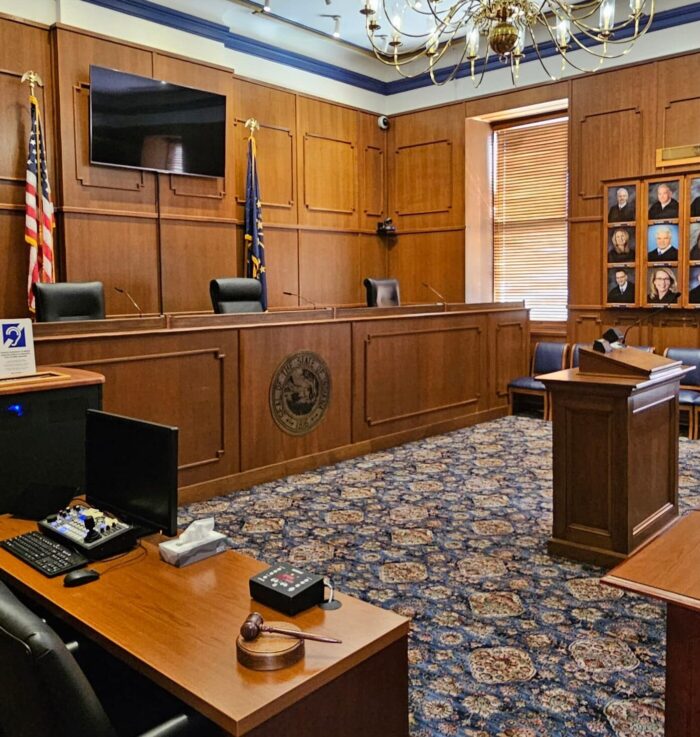
At the Indiana Statehouse, lawmakers are also looking for ways to address homelessness.
Senate Bill 285, authored by Rep. Cyndi Carrasco R-Indianapolis, would prohibit an individual from camping, sleeping or using land owned by the state or a political subdivision for long-term shelter, threatening violators with a Class C misdemeanor.
This bill passed the Indiana Senate and now waits for a hearing in the House Courts and Criminal Code Committee.
“We cannot ignore a growing issue that impacts public safety, quality of life, and the wellbeing of individuals experiencing chronic homelessness in our communities,” Carrasco said during the bill’s third reading in the Senate on Jan. 28, the same day as the PIT Count.
“Site encampments are … unsafe, unsanitary, and often become magnets for crime.”
She said the bill would reclaim public property and prevent the buildup of encampments. It also would give police regulations on how to handle encounters with homeless people.
“It provides a method for law enforcement to approach someone who is camping on a public land, give them a warning that tells them they have 48 hours to move from that location,” said Carrasco.
She said her goal in authoring the bill was to move individuals towards a healthier and more stable life through a multi-step process. But Sen. Greg Taylor, D-Indianapolis, voiced his concern that the bill may undermine local efforts like CHIP to address homelessness. He mentioned other barriers that may also make the bill ineffective.
“We do not train our law enforcement officers to enforce housing ordinance, rules and regulations. They are not required to learn about the programs that are available to people,” said Taylor. “We do not train our law enforcement officers in social work. That’s what social workers are for.”
A similar bill failed to pass in the 2025 session, following the June 2024 U.S. Supreme Court decision in Grant Pass vs. Johnson, which ruled that cities can ban people from sleeping and camping in public places.
Several other states have created anti-camping or sleeping laws after this Supreme Court decision. California enacted an encampment ordinance allowing for the swift clearing of tents. Missouri passed House Bill 1606, making it a Class C misdemeanor to sleep on state-owned land. Other states with similar laws include Tennessee, Georgia, Hawaii, Mississippi, Montana, Oregon and New Hampshire.
‘Love our neighbors’
Back at the Goodwill Horizon House, senior director Lillian Herbers-Kelly explained the importance of the PIT Count.
“We and communities across the country have been conducting these PIT Counts … to be able to be eligible for federal resources,” she said, “and to inform Congress what’s happening in cities across the country so that we can allocate and advocate for better policies, solutions and resources.”
Indianapolis Mayor Joe Hogsett highlighted the significantly disproportionate number of men who are unhoused.
“Our focus in this phase is largely on unhoused men and seeking to house 350 unhoused men in phase one,” said Hogsett.
He was referring to an initiative called Streets to Home Indy with a three-phase effort to end street and chronic homelessness, starting with helping people who are unsheltered.
“The PIT Count really served as a catalyst for the Streets to Home initiative, which is really focusing on helping people who are living outside unsheltered, and getting them directly into housing and accelerating that pathway,” said Haring-Cozzi.
She mentioned the detrimental health effects and potential fatality of people living outdoors in the frigid months. “We’re dealing with frostbite exacerbating already chronic conditions like respiratory issues,” she said.
This year had remarkably low winter temperatures, causing a sense of urgency in getting people off the streets.
“Knowing the frigid temperatures, there was a big push, not just to survey people for the count but to get people who teams found outside into shelter,” said Haring-Cozzi.
“We should never be criminalizing people who do not have access to housing and a safe place to be. … We’ve been advocating and engaged with really good discussions with policymakers around what actual solutions are.”
Herber-Kelly said CHIP uplifts Streets to Home as an example of what is possible when advocates have resources and work with urgency and intentionality to get people off the streets.
“Neighbor love is so critically important to the longterm health and wellbeing of our community here in Indianapolis, but of communities throughout the world,” said Hogsett. “Love our neighbors, all neighbors, every neighbor.”