By Marilyn Odendahl
The Indiana Citizen
February 3, 2026
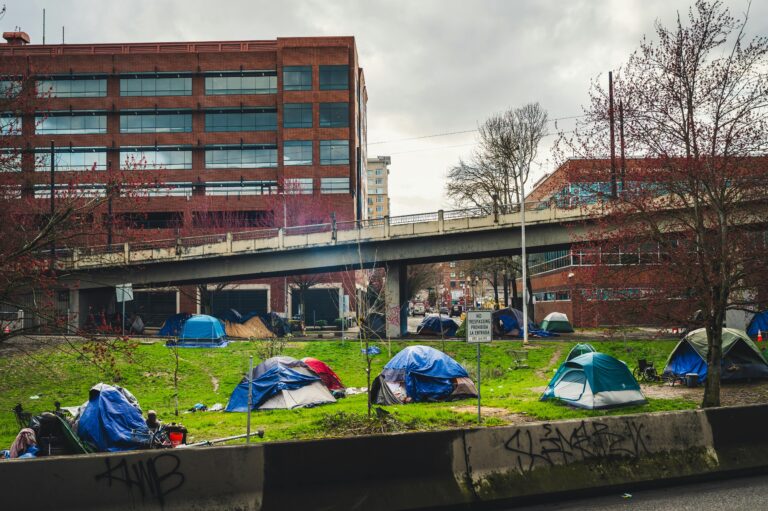
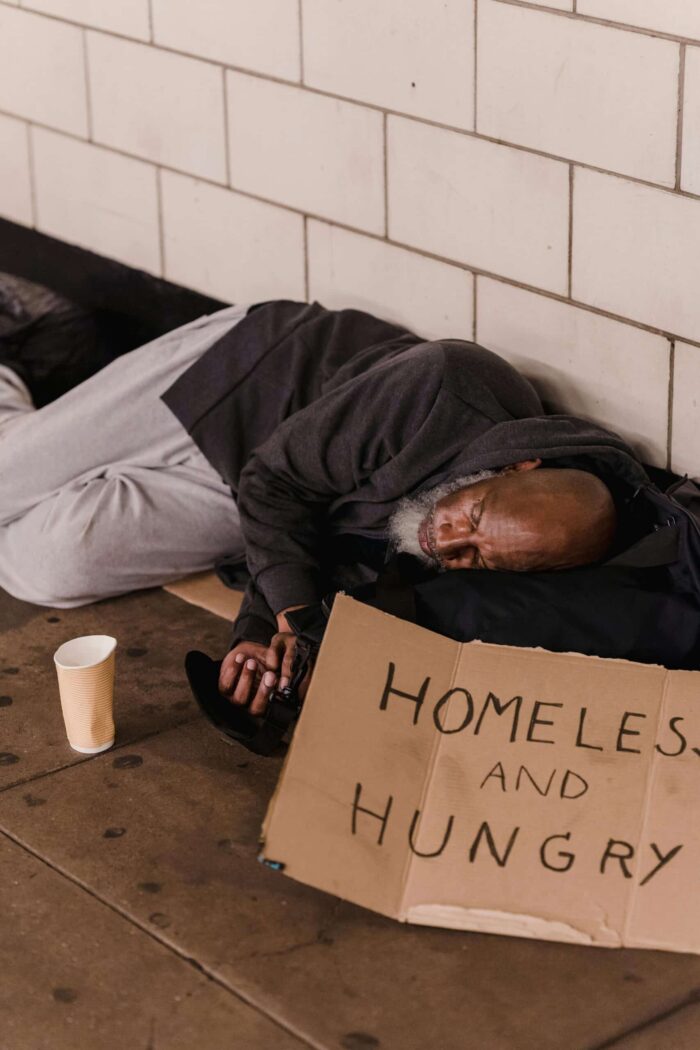
After several failed attempts in recent legislative sessions, a bill that opponents say will criminalize homelessness passed the Indiana Senate last week, increasing the stakes in another fight over whether the best way to help the unhoused in Indiana was to take a “less permissive” approach.
Senate Bill 285, among its provisions, would prohibit unhoused individuals from camping for an extended period of time on a sidewalk, alleyway, park or other public land. It would require local law enforcement to issue citations to people who do not vacate an area in 48 hours and could potentially result in homeless people getting charged with Class C misdemeanors.
Under this bill, the two-day window would begin once an officer who discovers a potential violation first gives the homeless person a warning. Also, the officer would supply information about shelters and agencies that can provide help in getting the individual off the streets.

The bill’s author, Cyndi Carrasco, R-Indianapolis, repeatedly told her colleagues the goal of this measure is not to criminalize homelessness. Instead, she contended, the bill is structured to ensure that in the initial interactions, the police are focused on intervening to help the unhoused, rather than punishing them.
“The misdemeanor provision exists to create a movement where outreach, diversion and connection to services can occur,” Carrasco said when introducing SB 285 to the Senate Judiciary Committee. “And to move individuals to a healthier and more stable life through a clear, multistep process that prioritizes services for individuals struggling with serious mental health or substance abuse issues who are unable or unwilling to seek help on their own.”
Both supporters and opponents of SB 285 agree with Carrasco that the homeless, particularly those with a substance use disorder or mental illness, need services and support to help them overcome homelessness and become self-sufficient.
Even a member of the conservative think tank, Cicero Institute, which has championed similar legislation in the Indiana Statehouse in recent years, acknowledged unhoused individuals who are struggling with addiction or psychological issues need counseling and treatment, rather than being tossed into the local jail.
Paul Webster, a senior fellow at the Cicero Institute, told The Indiana Citizen that the portion of the homeless population that needs clinical services has to be required to participate in treatment. This group of unsheltered people, he said, has to be forced to address their behavioral issues because it includes the individuals who are allegedly committing arsons, robberies and assaults.
“So, we’ve got to be less permissive with that population,” Webster told The Indiana Citizen.
However, representatives of outreach organizations and shelters that serve the homeless population pointed out that services are not uniformly available or accessible across Indiana. A study by the Bowen Center for Health Workforce Research and Policy at Indiana University School of Medicine underscored the problem. In 2023, all 92 counties in the state had been federally designated as having a shortage of mental and behavioral health professionals, which means every county had less than the minimum of one provider for every 30,000 Hoosiers.
Lauren Murfree, policy analyst at the Indiana Community Action Poverty Institute, said the pathway the bill is trying to create will lead not to services but, instead, to a cliff that results in a criminal conviction for many of the homeless who get a misdemeanor citation. Many communities, especially those in rural parts of the state, she said, do not have any programs and resources to help the unhoused, so that population will have nowhere to go.
“There’s no easy fix to homelessness,” Murfree said ahead of the Senate vote. “The easier fixes to hard issues are typically not always the best. I’m worried that this is an easier approach to take to it that is not going to address all the potential harm … that will significantly impact people’s ability to get housing.”
SB 285 passed the Senate on a 29-to-19 vote. Nine Republicans joined the Democrats in opposing the bill. It has been assigned to the House Courts and Criminal Code Committee, but, so far, no hearing has been scheduled.
The Senate debate on SB 285 lasted nearly two hours. Lawmakers praised Carrasco’s “tireless work” on the bill and said they believe she wants to help the homeless, but they raised concerns about the criminal provisions in the bill and questioned whether the measure would help address chronic homelessness.
Even as Carrasco insisted her bill was about compassion and not criminalization, legislators and service providers were skeptical.

Echoing the nonprofits and agencies serving the homeless, Democrats were critical that SB 285 was not creating or enhancing resources and programs for the unhoused. Those lawmakers said without those services, the homeless could be funneled into the local jails, many of which are already overcrowded, and then released back into the community with no job, housing or support – and a criminal record – so they would likely face arrest again.
“A real solution,” Sen. La Keisha Jackson, D-Indianapolis, said, “would involve funding low-barrier shelters, offering accessible mental health services, creating collaborative outreach programs, and funding transitional and permanent housing for homeless people to permanently transition off the streets.”
Carrasco said she did not want to push the bill off until a budget year, which likely would have happened if she had included funding provisions for services and support. She recalled her own experience working with the staff of the Indiana War Memorial and Museum in downtown Indianapolis in trying to find a solution for the people who were sleeping on the historic site’s grounds and bathing in the fountains on the Circle. Moreover, she said letting people continue to live on the streets was not a compassionate response.
“I just refuse to continue to do nothing, and the alternative of not doing this is doing nothing,” Carrasco said of SB 285. “I’ve been waiting years and years and watching and supporting efforts to address this issue, and I’ve shared the numbers. It’s not getting better.”
Data compiled and tabulated by the Indiana Housing and Community Development Authority indicates the homeless population is growing in the state. According to the Point-IN-Time count, which is conducted annually at the end of January, 4,860 Hoosiers were homeless in 2025, a 24.5% increase from the 3,904 who were unhoused in 2019. The sheltered population has grown 8.7%, swelling from 3,367 in 2019 to 3,659 in 2025, while the unsheltered population has exploded 123.6% in the past six years, ballooning from 537 to 1,201.
Lawmakers and homeless advocates also pointed to the practical matter of the misdemeanor provision. They pointed out that when the police issue citations, homeless individuals will have to appear in court. Since this population struggles to get transportation, many will likely miss their appearance, so a bench warrant will be issued for their arrest and their next encounter with law enforcement could result in an arrest, a fine, and possibly jail time.
The opponents of SB 285 said having a criminal conviction would become another barrier to the homeless getting a permanent place to live and a job, since many landlords do not want to rent to people and many employers are reluctant to hire people who have records.
Carrasco pointed to the other provisions in the bill as a safeguard against criminalizing homelessness.
Specifically, SB 285 requires local law enforcement to keep track of the number of arrests made for violations of the street camping ban and report the totals to the Indiana State Police. The data will then be provided to the Indiana Housing and Community Development Authority.
“It’s so important to me that this bill does not result in the criminalization of homelessness,” Carrasco said. “If we do end up having a situation where these people are going to jail, despite the fact that other data doesn’t show that, then we need to make an adjustment, because the point of this bill is to get people to help.”
Even so, the Indiana Sheriffs’ Association was not supportive of SB 285. Testifying before the Senate Judiciary Committee, Steve Luce, executive director of the ISA, said the bill is better than similar measures offered during other sessions, but it still would cause “quite a few problems.”
Luce said the county sheriffs were concerned this bill would add to the overcrowding issues many jails are currently experiencing. Also, at a time when many jails are understaffed, the personnel would have to expend more energy and attention trying to determine the history and medical needs of the homeless who violate the camping ban and are then taken into custody.
“There’s a lot of things to consider with these individuals,” Luce told the committee. “I just, personally, don’t want to see the jail as being the final resting place for these people, because they need help.”
During the judiciary committee’s hearing vote, three Republican senators – Jim Buck of Kokomo, Liz Brown of Fort Wayne and Sue Glick of LaGrange – were hesitant in their support of the bill. They questioned whether it would be a step to solving homelessness and expressed concern that the unhoused would end up in jail.
“The cure for all this is money,” Buck said. “Where’s the money going to come from?”
Carrasco rejected the notion that under SB 285, people sleeping on the streets would be rounded up and slapped with a $500 fine, which is included in the penalties for a Class C misdemeanor. She said she believed the homeless who appear in court on the misdemeanor charge would be offered the opportunity to enter a diversion program, in lieu of the fine, so they could get the help they need.
However, Sen. Ron Alting, R-Lafayette, was not convinced. He pointed out the bill did not give law enforcement any discretion but, rather, required officers to issue citations to people camping in public places.
“I appreciate this bill, but this bill is just a Band-Aid,” Alting said. “I think everyone agrees to that.”
The prohibition on street camping and the misdemeanor language in SB 285 duplicates legislation introduced by Rep. Michelle Davis, R-Whiteland, in previous sessions. House Bill 1413 stalled in committee in the 2024 legislative session and House Bill 1662 failed to muster enough support to get a floor vote during the 2025 session. The language was revived briefly last session in an amendment to Senate Bill 197, but then removed in conference committee.
This session, the ban on street camping and the criminal provision appeared in House Bill 1431, authored by Rep. Doug Miller, R-Elkhart. That measure did not get a committee hearing, but Miller is the House sponsor of Carrasco’s SB 285.
Davis’ bills were modeled on legislation crafted by the Cicero Institute. Although Carrasco said SB 285 was “not a Cicero template bill” and added that she had worked a number of hours researching and writing it herself, the legislation’s misdemeanor provision reflects the conservative organization’s effort to curtail or end Housing First initiatives.
Housing First programs provide homeless families and individuals with help getting permanent housing before helping them tackle their other needs, such as finding a job, paying off debt or getting treatment for an addiction or mental health issue, according to the National Alliance to End Homelessness. Participation in services or counseling is not mandatory to obtain or retain housing.
Studies show the approach is successful. The National Alliance said research has shown that 75% to 91% of the homeless helped by Housing First remain housed after one year. Similarly, a study done with the National Institutes of Health and published in 2020 compared Housing First to Treatment First, which requires homeless people address their psychiatric or substance abuse issues before getting a permanent place to live. The study found Housing First programs were vastly more effective, decreasing homelessness by 88% and improving housing stability by 41%.
However, the Texas-based Cicero Institute cites to data from the U.S. Department of Housing and Urban Development and maintains Housing First is a failed policy that wastes taxpayer dollars. The institute says the homeless should be required to participate in services and programs, before being assisted in finding permanent housing.
Webster, at the Cicero Institute, testified in favor of SB 285. Speaking to The Indiana Citizen, he dove into HUD’s Continuum of Care data and calculated that from 2005 to 2024, Indiana had received $420 million from the federal government to address homelessness of which more than 80% of those dollars went to permanent housing. Pointing to more HUD data, he said homelessness had decreased during that time period by only 36% to roughly 1,500 across the entire state.
Taking a swipe at Housing First, Webster said he was not opposed to the approach, but rather said the camping ban was another tool to help communities solve homelessness.
“The big advocacy organizations … believe that the only way to solve homelessness is to get people a government-subsidized lease on an apartment,” Webster said. “So when you say this camping ban won’t solve homelessness, the way that I interpret that is that this camping ban doesn’t provide a government-subsidized lease. … I think that there’s more room out there to think of these things creatively than whether or not everything we do for homeless people results in a government-subsidized lease.”
Opponents of SB 285 countered that the camping ban will actually shift resources away from helping the homeless. Agencies serving the unhoused population, they said, will have to take money supporting homeless services and instead use those dollars for helping families and individuals pay off their court fines and fees because they got cited for staying in one place longer than 48 hours.

“The bill, in its current form, diverts resources, both public and philanthropic, away from real, sustainable solutions to short-term cleanups that do nothing to solve the problem,” Brian Lohsl, impact and public policy strategist at Indiana United Ways, told the Senate Judiciary Committee. “SB 285 will cause local United Ways to shift these resources away from things such as substance use disorder programs, mental health services and rental assistance, amongst others, to emergency shelters to keep individuals out of jail and to help counter fines.”
Webster further calculated from the HUD data that of the estimated 1,500 homeless in Indiana, about 1,000 were either suffering from a mental illness or had a substance use disorder. This group of 1,000, he said, cannot necessarily be enticed to get off the street and accept treatment. They have to be required to go for help, he said, and if they are put in jail, they might opt to go in a diversion program rather than stay locked up.
“I get it,” Webster said. Advocates say “people can’t focus on their mental illness or their substance use disorder issues if they’re out on the street. This is true, but that’s not to say a government subsidized apartment is going to allow them to do that, because … you cannot require anyone to get treatment.”
Murfree, from the Indiana Community Poverty Action Institute, said Webster’s calculation was a “misleading, inaccurate interpretation” of HUD data regarding the number of homeless. In particular, she noted individuals could be struggling with both mental illness and substance use, so the total population Webster is focusing on is likely less than 1,000.
Moreover, Murfree countered the stereotype that most of the homeless are mentally ill or suffering from substance use and do not know how to help themselves. She noted she has engaged with the unsheltered for many years and a majority do want help.
“People want housing,” Murfree said. “They want services. It’s just fear. A lot of them are fearful of what people see in them. It’s a lot of shame of being unhoused and homeless.”
The problem, Murfree reiterated, is too few services. Court diversion programs and community-based mental health and addiction services are not available in every community, she said. The programs that are operating often have waiting lists.
Under SB 285, Murfree said, homeless families and individuals would be punished for the lack of resources and programs. Lawmakers should instead be collaborating with the local nonprofits who serve the homeless population, she said, and working to provide the monetary support needed to help this population.
“I respect the intention,” Murfree said of SB 285. “We all want to address homelessness, but the facts of this and the context that we are in, we don’t have these services … in place. “That’s my concern.”
Dwight Adams, an editor and writer based in Indianapolis, edited this article. He is a former content editor, copy editor and digital producer at The Indianapolis Star and IndyStar.com, and worked as a planner for other newspapers, including the Louisville Courier Journal.
The Indiana Citizen is a nonpartisan, nonprofit platform dedicated to increasing the number of informed and engaged Hoosier citizens. We are operated by the Indiana Citizen Education Foundation, Inc., a 501(c)(3) public charity. For questions about the story, contact Marilyn Odendahl at marilyn.odendahl@indianacitizen.org.