This column was originally published on The Throckmorton Initiative, a blog written by Warren Throckmorton.
By Warren Throckmorton
January 19th, 2026
(This is an updated post from earlier versions in 2022 and 2025)
To remember Dr. King today, I want to highlight his visit to the annual convention of the American Psychological Association in 1967. He was invited to speak to a division of APA – Society for the Psychological Study of Social Issues – by Kenneth Clark, the first Black president of the APA.
Thomas Pettigrew, president of SPSSI at the time, told me in 2022 that the majority of the APA board in 1967 did not want King to speak, saying his invitation was “too political” and warning that psychologists would not be interested in what he had to say. As it turned out, over 5,000 people showed up which forced the organizers to secure the largest meeting room in the venue.
The title of his speech was, “The Role of the Behavioral Scientist in the Civil Rights Movement.” Below are some excerpts:
For social scientists, the opportunity to serve in a life‐giving purpose is a humanist challenge of rare distinction. Negroes too are eager for a rendezvous with truth and discovery. We are aware that social scientists, unlike some of their colleagues in the physical sciences, have been spared the grim feelings of guilt that attended the invention of nuclear weapons of destruction. Social scientists, in the main, are fortunate to be able to extirpate evil, not to invent it.
If the Negro needs social science for direction and for self‐understanding, the White society is in even more urgent need. White America needs to understand that it is poisoned to its soul by racism and the understanding needs to be carefully documented and consequently more difficult to reject. The present crisis arises because, although it is historically imperative that our society take the next step to equality, we find ourselves psychologically and socially imprisoned. All too many White Americans are horrified not with conditions of Negro life but with the product of these conditions—the Negro himself.
White America is seeking to keep the walls of segregation substantially intact while the evolution of society and the Negro’s desperation is causing them to crumble. The White majority, unprepared and unwilling to accept radical structural change, is resisting and producing chaos while complaining that if there were no chaos orderly change would come.
King’s words seem as timely now as when he said them. White supremacy is on the rise, and supremacists have seats at the table of the Republican party. Elites in the MAGA movement openly lament the civil rights movement as bad for whites.
Negroes want the social scientist to address the White community and “tell it like it is.” White America has an appalling lack of knowledge concerning the reality of Negro life. One reason some advances were made in the South during the past decade was the discovery by northern Whites of the brutal facts of southern segregated life. It was the Negro who educated the nation by dramatizing the evils through nonviolent protest. The social scientist played little or no role in disclosing truth. The Negro action movement with raw courage did it virtually alone. When the majority of the country could not live with the extremes of brutality they witnessed, political remedies were enacted and customs were altered.
Last year at this time, I was guardedly hopeful. Today, the backlash against diversity, equity, and inclusion has poisoned progress on peace and equality. Nonetheless, I still believe the psychological, educational, historical, and other scholarly communities need to present their findings about the impact of prejudice, racism, and discrimination.
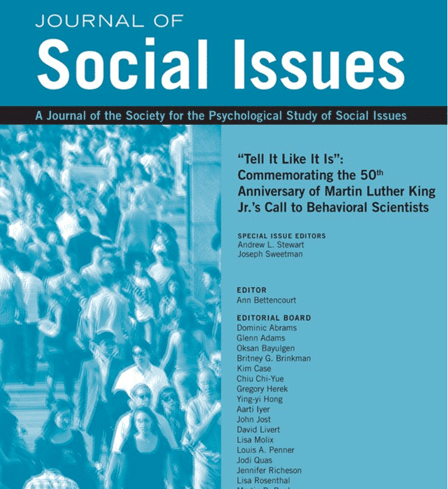
In 2018, the Journal of Social Issues revisited the speech with a special issue titled, “Tell It Like It Is”: Commemorating the 50th Anniversary of Martin Luther King, Jr.’s Call to Behavioral Scientists.” Former SPSSI president, Thomas Pettigrew contributed a piece summarizing his assessment of how social psychologists have answered Dr. King’s call to “tell it like it is.” He wrote, “Summing up all the papers, we can only give a mixed answer to the key question as to whether we have answered Dr. King’s 1967 call.”
Pettigrew continued:
In general, SPSSI and social psychology have done reasonably well in researching much of what Dr. King called for a half century ago. But the hard truth is that we have failed to communicate our findings sufficiently to the public; thus, the full meaning of this large body of work has been effectively resisted by many white Americans…
National surveys provide a glimpse of the extent of our failure to communicate our findings to the American public. Recent Pew Research Center surveys show only 36% of White Americans think racial discrimination is involved in Blacks having “…a harder time getting ahead than Whites,” only 22% believe that Blacks “are treated less fairly in the workplace,” while 38% believe that the United States “…has made the changes needed to give [B]lacks equal rights with [W]hites.”
These findings contrast with more recent surveys of Black Americans. Gallup found in 2024 that “Over eight-in-ten Black adults with a bachelor’s degree (84%) say Black people have to work more than everyone else to achieve success.” Over 71% of Black adults under 30 said they experience racial discrimination; that percentage climbed to 80% for Blacks over 65.
Generally, the development of critical race theory and diversity programs are dated after the assassination of King. However, one can see in his 1967 remarks the seeds of some of CRT’s and DEI’s points. King very specifically referred to “radical structural change” (systemic change) that was needed for Black Americans to achieve equity. King said white Americans were “poisoned” by racism and called on social scientists to document this. Now, social scientists are condemned by critics of CRT and DEI when they document and call out the poison and say exactly what King said in 1967.
The bitter and discouraging irony is that many of these critics invoke decontextualized King quotes they like in order to criticize CRT and DEI and tell us King would also reject CRT. Dr. King’s APA address calls that project into question.
Scholars today have additional hurdles due to the Trump administration’s pressure on universities to back away from recognizing and teaching facts and reality about racism. King’s words remain an encouragement to this day to persist.
Warren Throckmorton retired from Grove City College. He now writes about Christian nationalism, religion, history, and politics at The Throckmorton Initiative. To learn more about subscribing to The Throckmorton Initiative, click here.
The views and opinions expressed do not necessarily reflect the views of The Indiana Citizen or any other affiliated organization.